
English source · 11 min
Connected platform follow-ups: public acceptance
Observed on 29 October 2026 against the public Veyndo services in Chrome. All records below are synthetic and remain in the private Abnahme 29 Oktober sandbox of the existing acceptance shop. Payments are explicitly simulated.
Source and rollout
The initial public import and browser purchase below ran after Core
48f97c39e934fc1a2d56d80f270a5b7ab1b345f0, image forlorn-planes-560, had
completed its snapshot-backed migration and health-checked release. The next
release, fc4489c900038d76f0509baec44f75024c03d557, image rare-north-926,
started Core at 14:21:47 CET, 29 October. Its fresh snapshot
26-10-29-132028-backup, successful 12-second migration job and 1/1 passing Core
instance with zero restarts were observed. The customer simulation and public
designer/reference journeys below ran on that latter release.
The complete required Linux checks passed for
PR #229,
PR #230 and
PR #231.
The first-app correction merged as db0ab30891ac3be1e828bf3209f7765e39615837.
Image decorous-sail-719 started Core at 14:49:26 CET. The release completed
at 14:50:33 CET, after snapshot 26-10-29-134807-backup, an 11-second
successful migration job and one healthy Core instance with zero restarts.
The original description-led app request then succeeded publicly, as recorded
below. Subsequent source fixes retain separate rollout evidence.
Native working view and catalogue intake
The public Google entry returned to the existing shop through the ordinary
single-use Studio handoff. The tester created one private sandbox through Studio.
The configured public gpt-6.1-sol model then received this merchant request:
Zeige mir hier eine native Arbeitsansicht mit unserer Produktliste, den Produktdetails und dem Katalogimport. Ich möchte Produkte öffnen und per CSV hinzufügen können. Ändere keine Shopdaten.
The task finished after three model steps and offered Arbeitsansicht öffnen. Opening it displayed the native product grid, details and catalogue intake. Diese Ansicht anheften saved the view in Mein Arbeitsplatz. Following a complete reload, the Produkte pin reopened the same native view and its CSV entry. The authenticated session and selected sandbox survived the rollout. An old lazy-loaded bundle displayed the explicit reload recovery during that rollout; using it recovered the view without an unsaved commerce change.
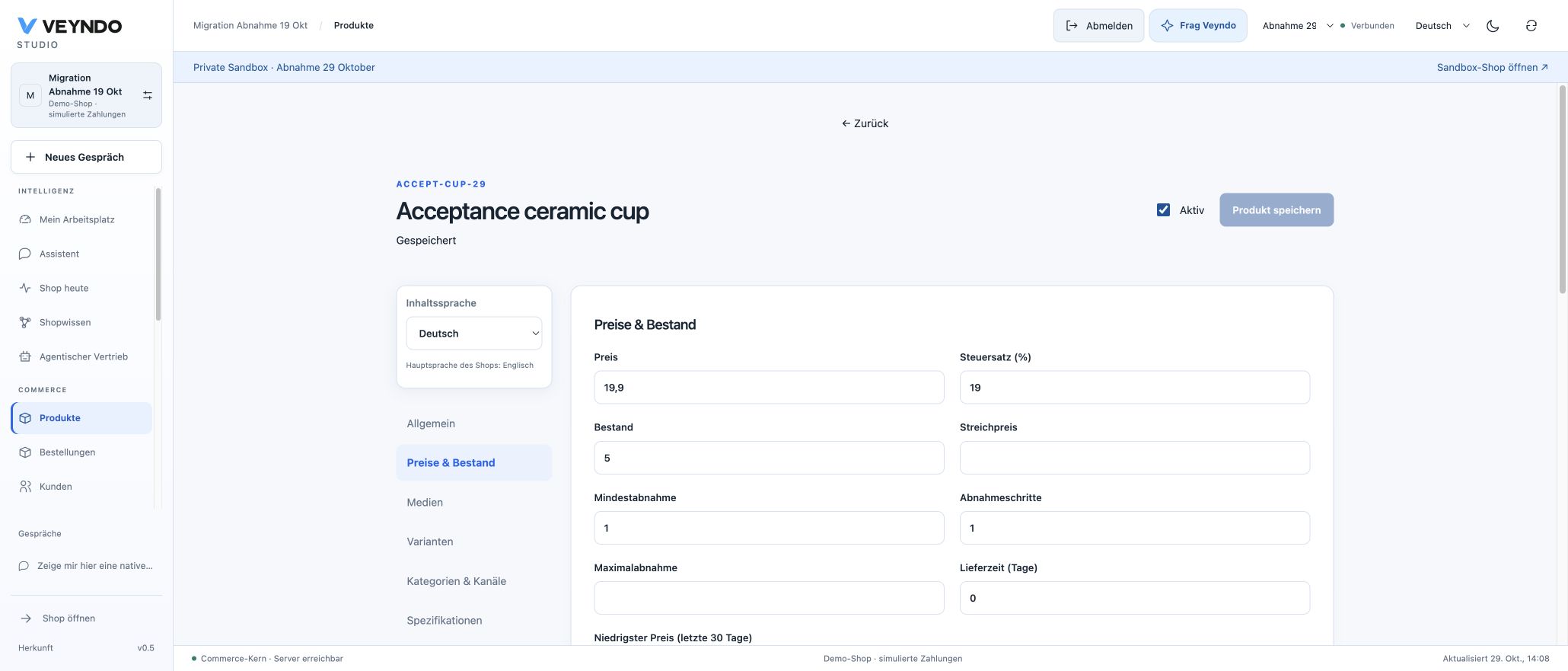
The CSV contained one synthetic Acceptance ceramic cup, product number
ACCEPT-CUP-29, EUR 19.90 and its plain description. The preview required an
explicit tax rate. The tester selected 19%, saved the selected product privately
and opened the actual native product editor. It retained the product number,
price, description and zero initial stock. Setting stock to five saved through
the ordinary revisioned product editor. No catalogue release was performed.
Native purchase, return and empty basket
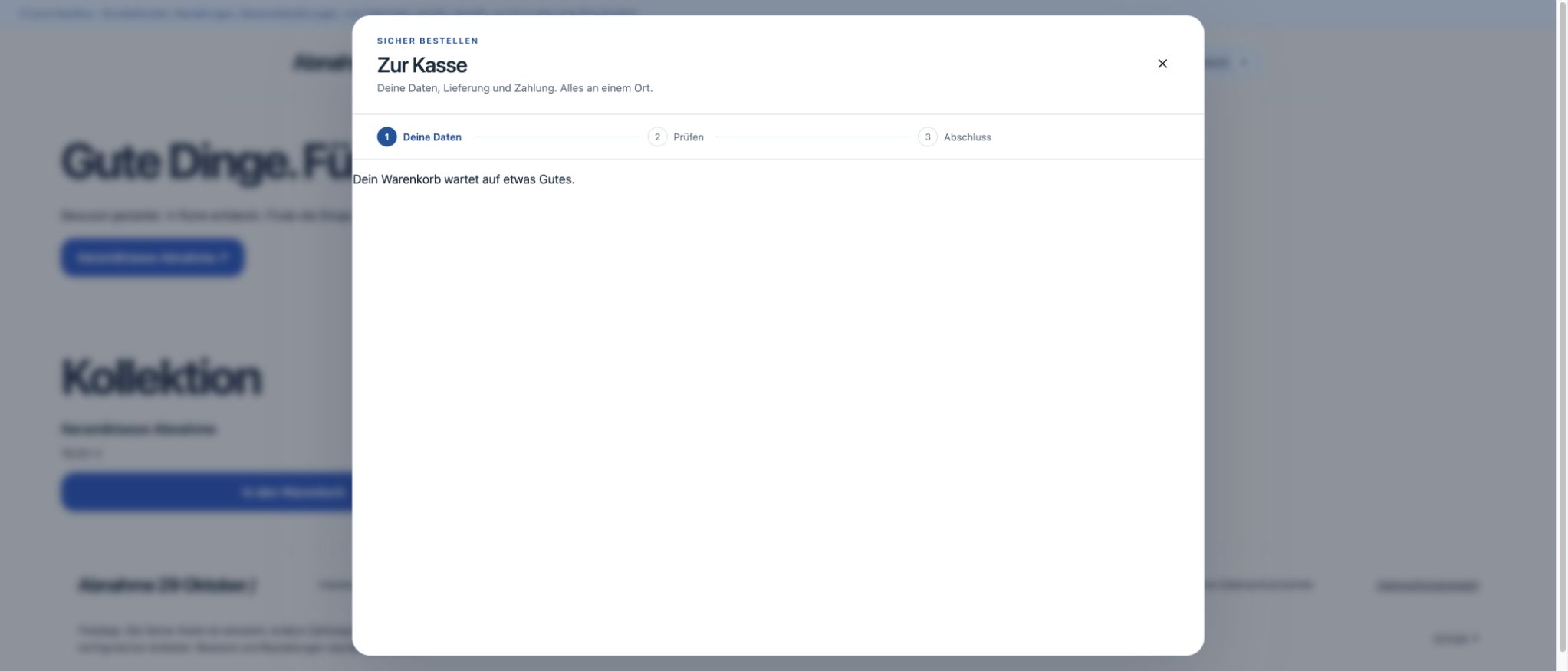
The sandbox storefront displayed the imported product at EUR 19.90 with five in stock. A guest purchase used synthetic contact/address data, pickup, 19% VAT and Demo-Zahlung · Testzahlung · kein echtes Geld. The review confirmed the final amount before submission.
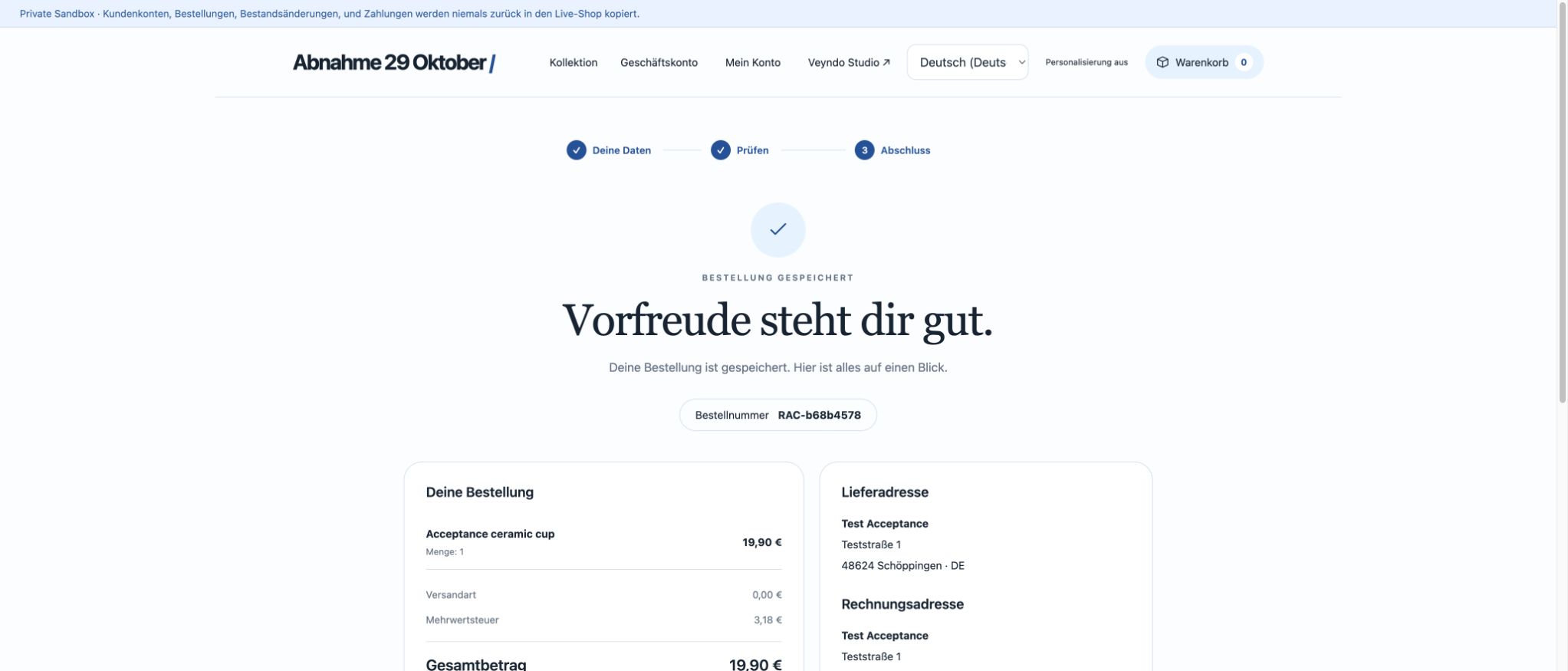
Order RAC-b68b4578 completed for EUR 19.90, including EUR 3.18 VAT.
The confirmation retained the product, quantity one and simulated authorization.
Zurück zum Shop, a full reload and opening the basket again showed zero items
and the empty-basket message. The optional tracking rejection also survived. Studio then showed exactly one
private order with the same product, amount and authorization, plus the existing
order.placed Flow entry in its persisted history.
Public saved customer scenarios
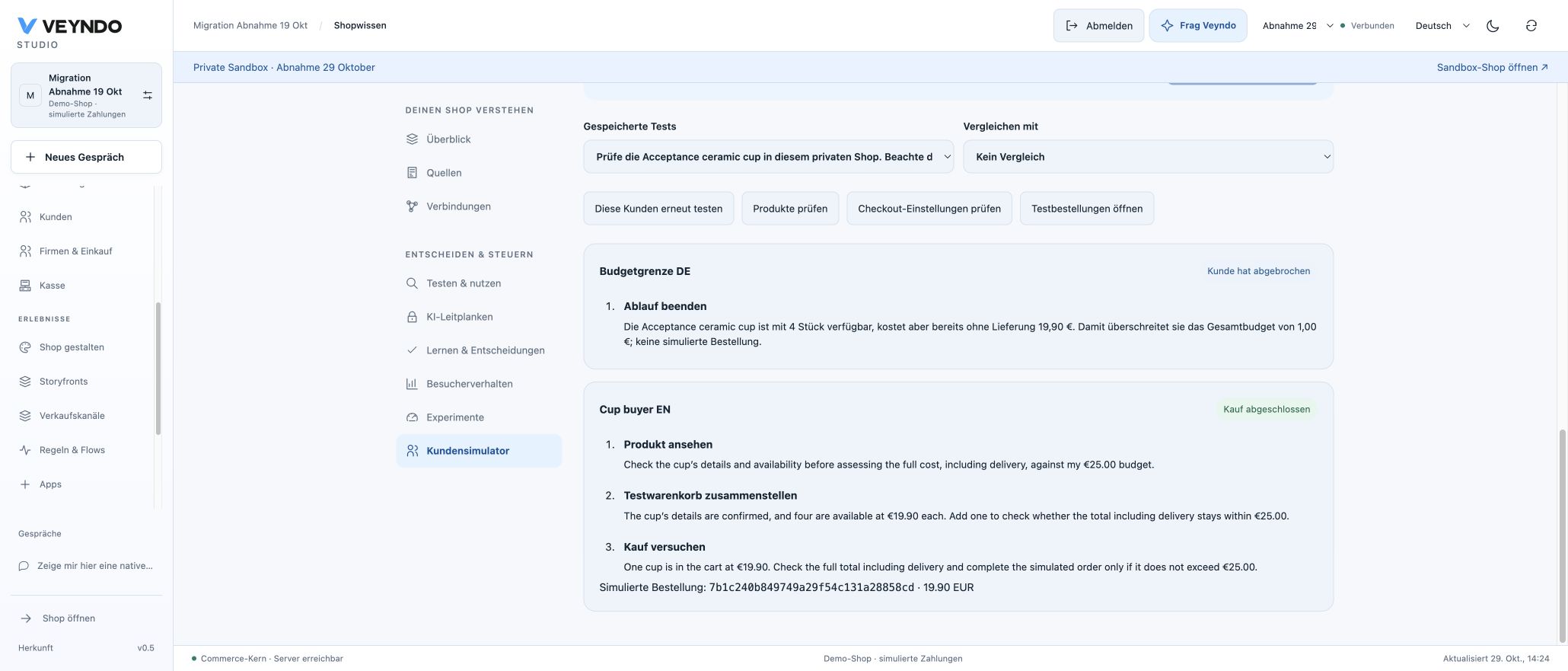
From Shop gestalten → Mit Kunden testen, the tester prepared two fictional profiles for the same private cup: Budgetgrenze DE, German, EUR 1.00; and Cup buyer EN, English, EUR 25.00. Both used Germany and the same bounded goal including delivery in the budget. The actual configured public model ran the existing native-commerce simulation.
The first profile stopped because the product alone cost EUR 19.90. The second
read product details, created a test basket and completed exactly one simulated
order, 7b1c240b849749a29f54c131a28858cd, for EUR 19.90. The results retain their
steps and actual order reference. A full reload and selecting the saved test
reopened both profiles’ recorded outcomes and the same order reference. This is the existing native API simulation;
the separate manual browser purchase above verifies the rendered checkout.
Public designer gestures and selected agent scope
In the same private sandbox, the tester reviewed and installed the first-party
Shop gestalten 1.0.0 package with only its own data.read/data.write grants.
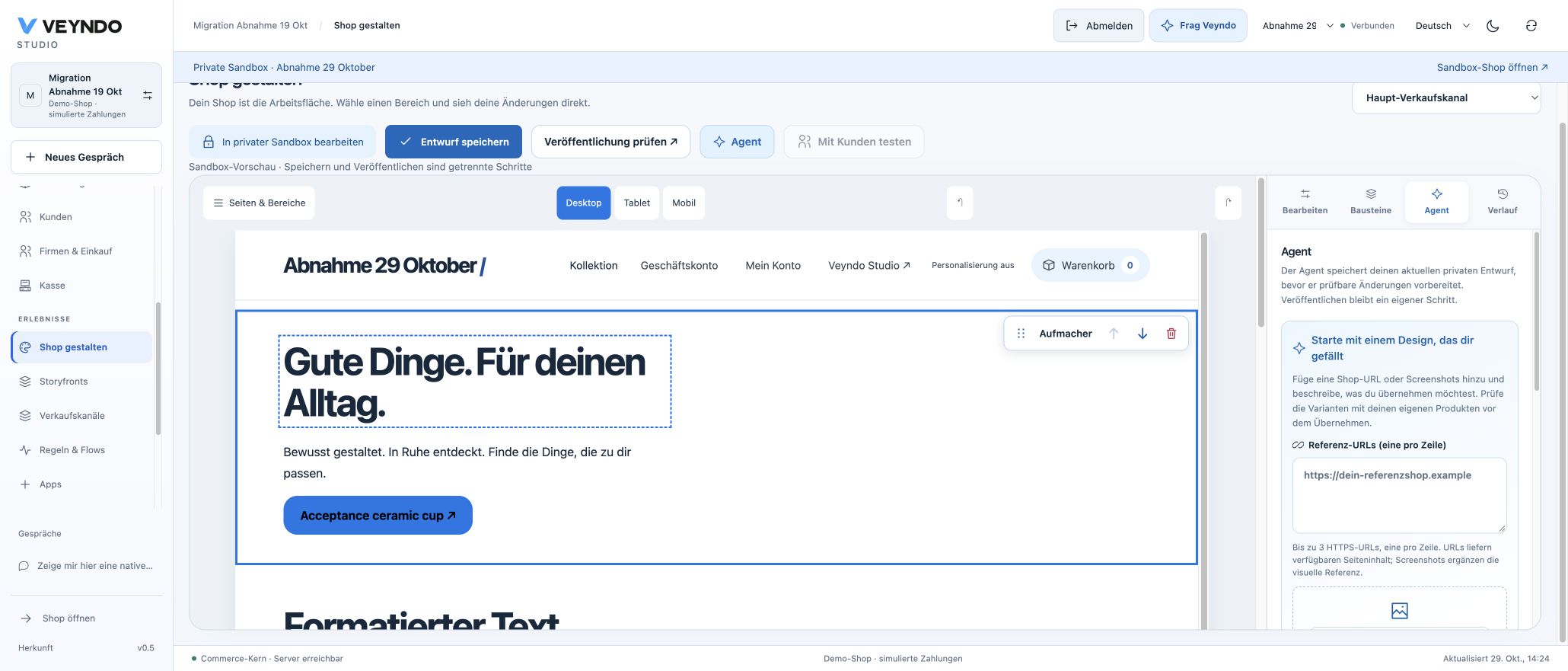
Preparing the private draft retained the actual cup in the native shop preview.
The graphic palette displayed compact illustrated component choices.
A real pointer drag inserted Formatierter Text between the existing hero and product list, increasing the sections from two to three. Dragging its grip moved it above the hero; its upward arrow became disabled at the first position. The downward arrow moved it back, deletion removed it, and Undo restored it. The agent rail defaulted to Ausgewählter Bereich, enabled content/structure and disabled page-wide style with explicit guidance. Three further Undo actions returned to the original two-section saved draft with no unsaved changes. No design release was performed.
Public reference proposal and private revision
The tester supplied https://www.veyndo.ai/, requested three blue style variants
and selected style only. The actual public model returned three proposals and
explicitly explained that the fetched reference was limited HTML, so it could not
visually verify the source typography or blue styling. Each candidate reported
five changed theme properties and zero inserted, removed or moved elements.
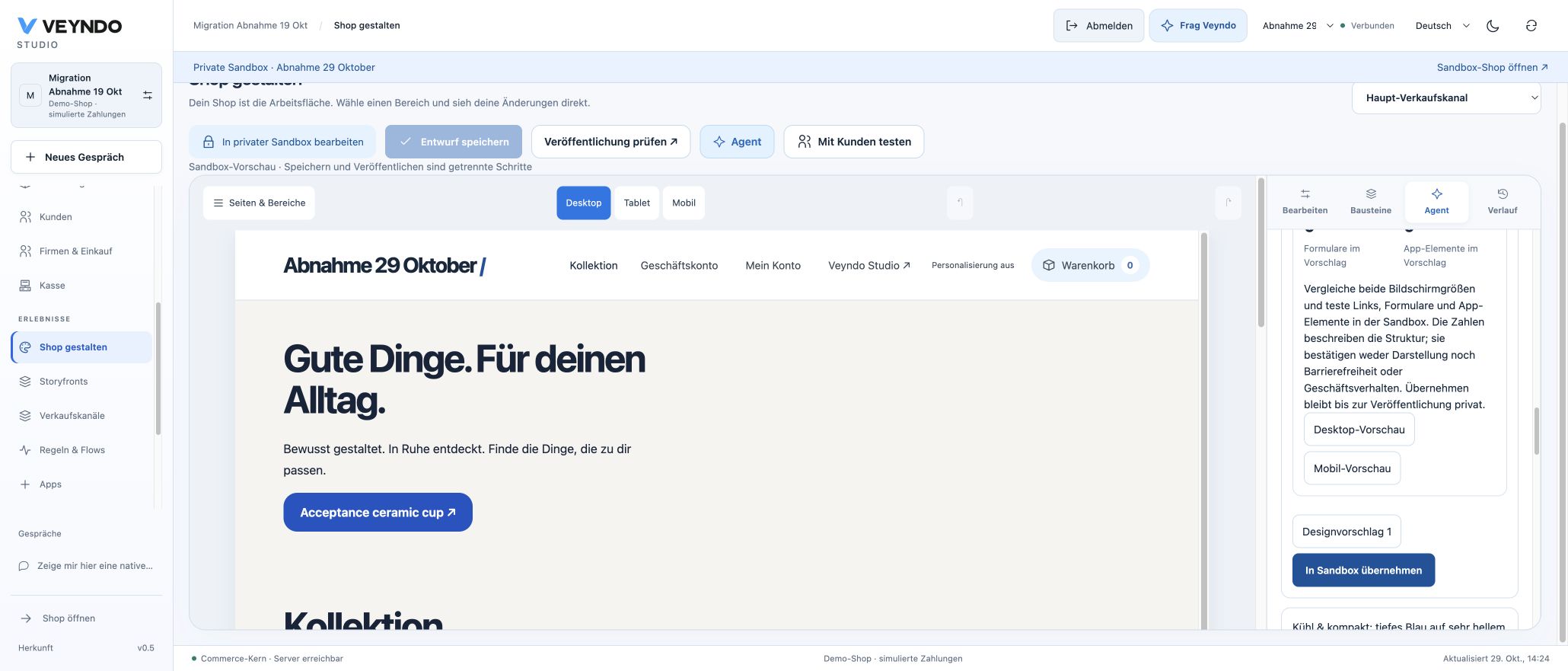
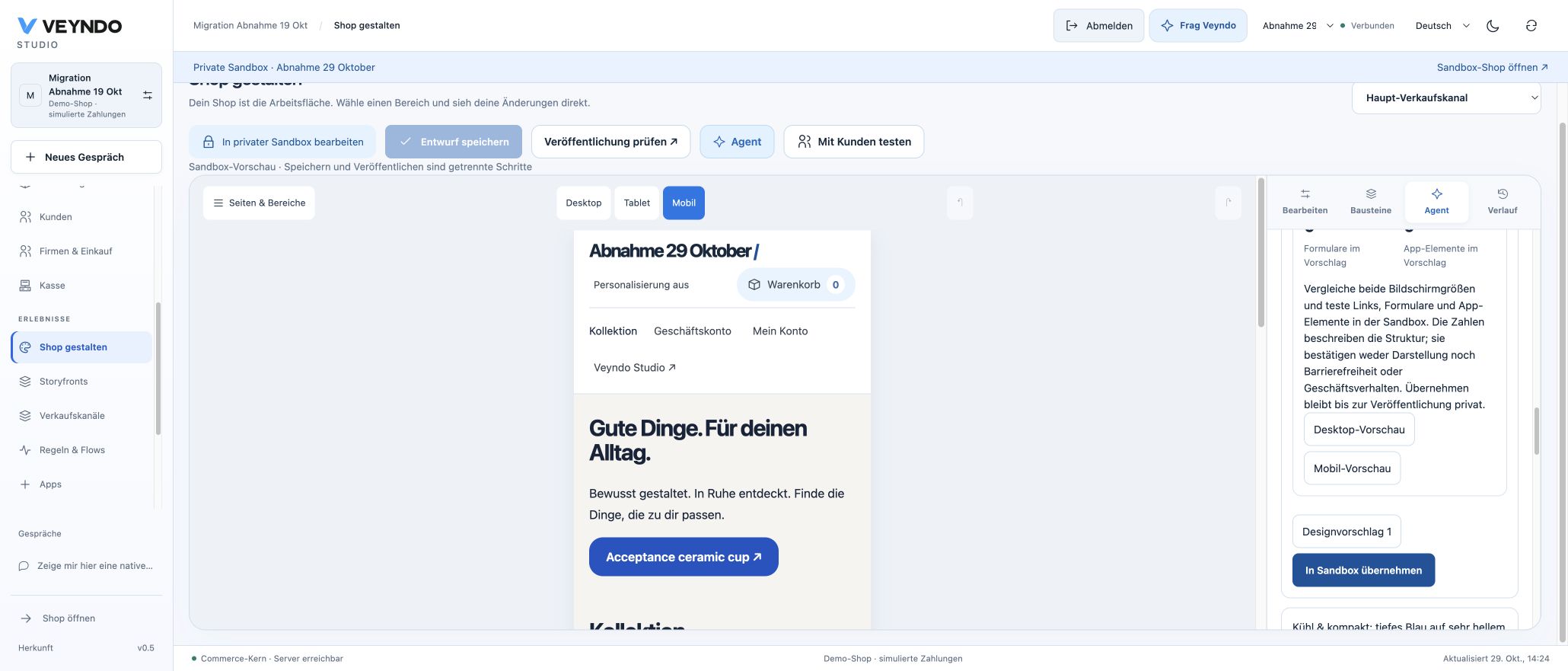
Desktop and mobile previews retained the actual cup, native content and page
structure. Applying the first reviewed proposal saved private page revision two;
the history shows revision one at 13:26:30 UTC and revision two at
13:32:15 UTC. This was not published to the parent live shop. The URL-based
public acceptance is separate from the local screenshot-based journey linked
below.
Purchase after adopting the generated design
The actual sandbox storefront loaded the saved style revision. The tester added an explicit German product-name translation through the native product editor; reload resolved both the hero product link and live product list to Keramiktasse Abnahme. No stock instruction was sent with that text edit. The actual product grid showed three remaining units after the first browser purchase and the one successful AI purchase.
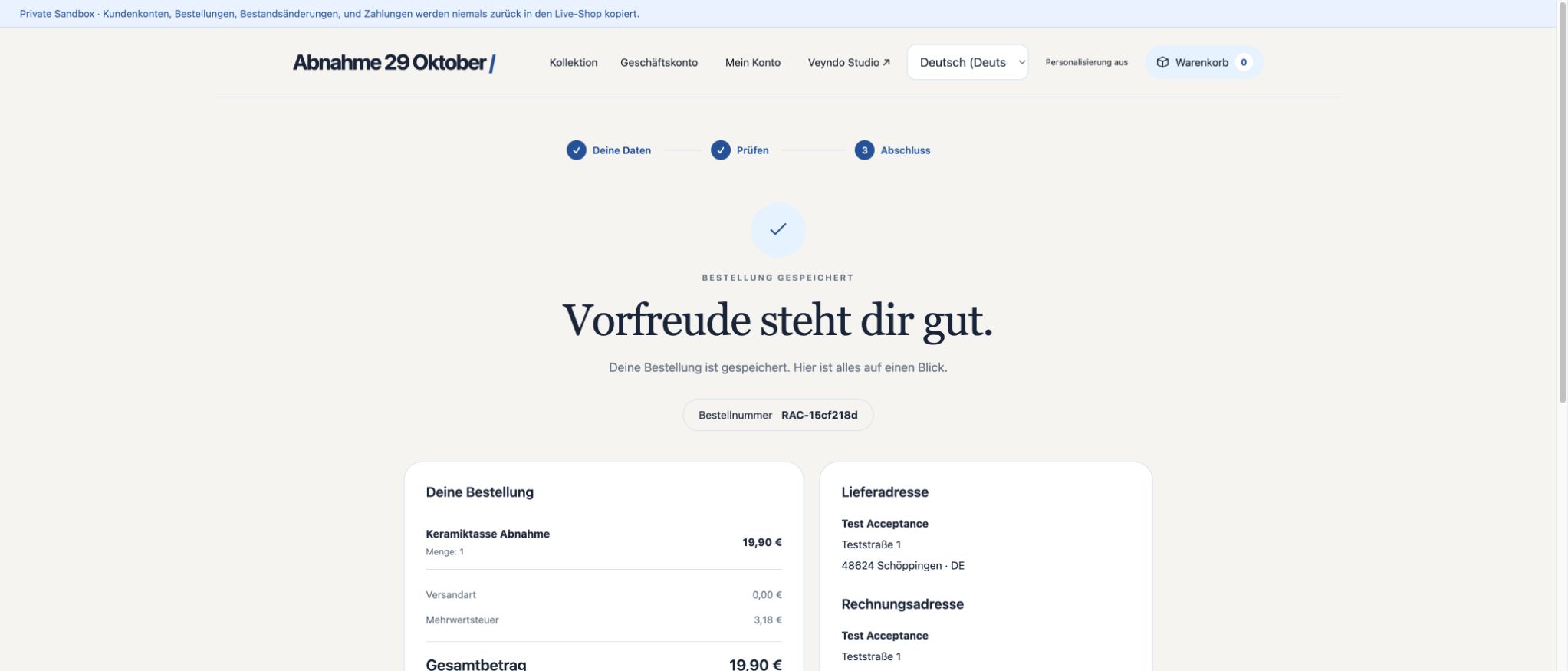
Buying from the adapted page completed simulated order RAC-15cf218d, quantity one, EUR 19.90 including EUR 3.18 VAT, with that German product name in the stored confirmation. Returning to the designed shop, fully reloading and opening the basket showed zero items. The prior optional tracking rejection remained. Studio showed exactly three private orders: the two observed browser purchases and the single successful AI purchase. Reopening the first order still showed its original English name, rather than rewriting historical order content after the new German translation.
Public description-led app generation
The first public description-led consultation attempt reached the actual
configured gpt-6.1-sol provider but the native validator rejected its field
constraints with Malformed action schema constraint; a diagnostic clarification
then exposed an invalid field relationship. No generated app version was accepted.
The repair keeps native admission unchanged and constrains first-app generation to
five valid field families and typed field-validation keys under immutable
app-brief@2. The same original merchant brief subsequently produced a valid
saved app with the actual local Qwen model. Independent review and local native
checks and complete required Linux CI passed. The correction is merged through
PR #231.
After that public rollout, the tester repeated the original merchant brief,
without technical corrections or a replacement prompt. The actual configured
public gpt-6.1-sol provider produced Beratungsbereich, version 0.1.0.
The native build was saved and adopted in Studio. Its private
consultation_request model contains five fields: a required existing-product
reference, translated title and description, an optional private design file and
the statuses new, reviewed and completed. The package includes a product tab,
a private administration view, native list/save/upload actions and the required
text setting team_name. Its generated labels cover the four enabled shop
languages. It does not grant MCP access implicitly.
The next ordinary Vor Installation prüfen action exposed a distinct problem:
the selected owned sandbox returned Environment unavailable under the separate
restricted tenant/system database connections. The original strict binary
reproduced that failure locally. PR #232
moves the existing exact ownership check inside the existing bounded system
transaction before inspecting stage data. It adds no database grants or serving
bypass. Its regression checks distinguish private stage data from live data and
reject missing, foreign and actor-private environments and insufficient rights.
Local registered native suites, 340 Rust tests, strict Clippy, formal checks and
184 broken-policy mutation controls passed. Independent review found no issue.
Its completed hosted installation and record acceptance is recorded below.
The first complete CI attempt also caught test-fixture interference: retained durable work from earlier suites reached the app-generation model before its own first request. That provider fixture now owns a separate disposable database, retains all real workers and wire assertions and cleans up its owned database. The mixed native sequence of customer scenarios, durable agents, authority checks, app assistance and generation passes. The incremental independent review found no issue. The complete final CI result is recorded with the final rollout below.
The corrected source passed complete required Linux CI,
including all three native partitions, the official combined coverage collectors,
source provenance and unchanged final admission. PR #232 merged normally as
d65bc050913610f8065a20df2f549b158622be8d at 15:16:45 UTC. The ordinary
Northflank workflow then started at 16:16:48 CET for that exact commit.
The merged Git tree is identical to the completely tested e97f419a tree.
Image best-day-1904 started Core at 16:27:11 CET. The ordinary release
completed at 16:28:21 CET, after snapshot 26-10-29-152549-backup, a
successful 12-second migration and the release health checks. The resulting
Core instance was observed 1/1 passing with zero restarts. The subsequent
complete main verification
also passed all native partitions, combined coverage and final admission.
Installation, private upload and retained record
On that actual public release, the same saved package passed Vor Installation
prüfen with Bereit zur Installation, then installed version 0.1.0 in the
selected ordinary sandbox. Its native Beratungsübersicht navigation entry
appeared. The product editor opened Beratungsanfragen for the actual private
cup created earlier. This ordinary installed view correctly sees that sandbox's
cup; the separate F5 preview clones the parent live catalogue instead.
The tester created Public cup consultation, described a custom blue glaze,
uploaded synthetic public-consultation-design.txt through the ordinary file
chooser and saved the record. The native upload retained its Privat marker.
Changing the status from Neu to Geprüft and saving updated the same
record. A full browser reload and reopening the product tab retained exactly one
request, its title, description, private file and reviewed status. The editor
reopened the same saved request. No private record or file was published to the
parent live shop.
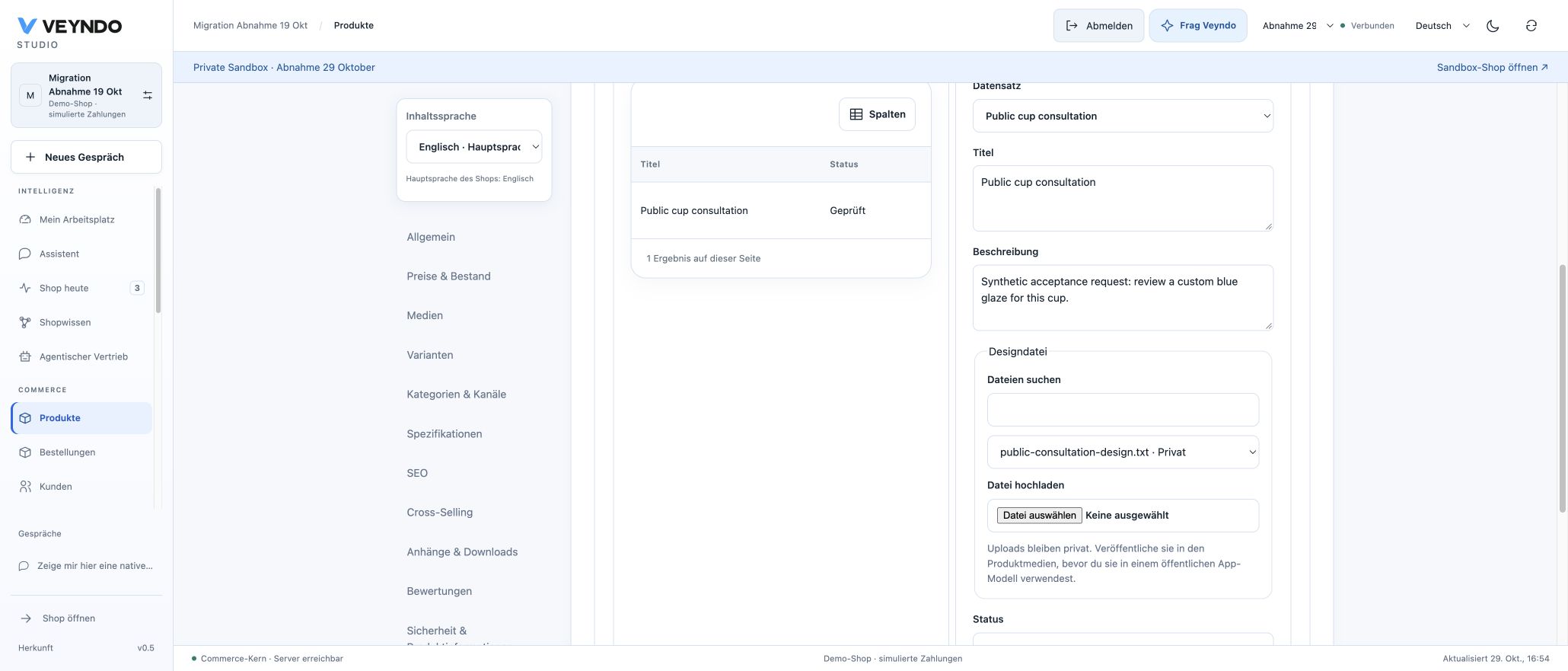
This public check covers generated package admission, installation and actual record use. Required installation settings, selected package publication and restoration are covered by the separately linked complete local app journey; this public sandbox check does not claim that live settings were configured.
Shared embedded-table controls
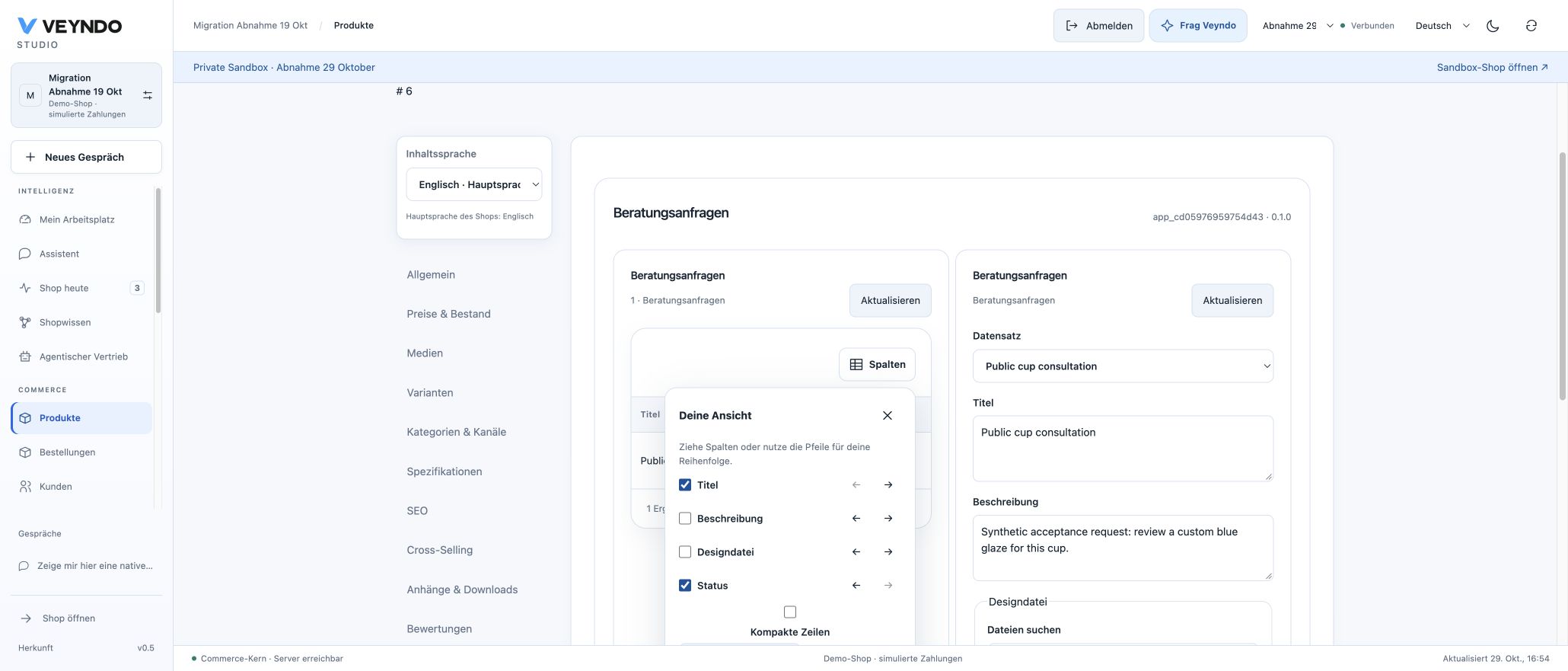
This actual app acceptance exposed a layout defect in narrow native app tables:
without a search control, the column menu began at the left edge and its
right-aligned panel was clipped. PR #234
aligns the shared tools at the inline end of their existing flex toolbar. It
changes one shared CSS property, with no API, permission or storage changes.
The complete frontend build and required scoped CI
passed; incremental independent review found no issue. The normal merge is
69fd45683af1e04a0c608aaedbe4924477e3cad6.
The ordinary release ran for that exact source with image united-toys-4065:
snapshot 26-10-29-155202-backup, successful 11-second migration, Core start
16:53:22 CET and successful release 16:54:31 CET. The new instance was
observed 1/1 passing with zero restarts. Reloading the public Studio retained the
same product, installed app, request, private file and reviewed status. The
column panel's labels are now visible inside the narrow card. Hiding description
and file columns through that actual panel left the request title and reviewed
status in the compact native grid; this changes the view, not the stored record.
Apple callback configuration
After explicit action-time approval, the existing ai.vendune.web Service ID
retained its old domains/callbacks and added start.veyndo.ai and
experience.veyndo.ai with their exact
/api/onboarding/oauth/apple/callback addresses. Saving and reopening the Apple
configuration confirmed all four domains and all four return addresses.
Both public entry routes now redirect to Apple's authorization page without
invalid_request or the previous invalid-web-redirect error. The browser shows
the ordinary Apple account sign-in form. An authenticated Apple account return
was not part of this observation.
Actual public homepage owner
The public handbook and static Core homepage were published from the documentation
release 20f12567. The live apex homepage is owned separately by the existing
Experience application. Editing only site/pages/index.html does not update that
React application. The owning four-language marketing copy now describes native
working views, contextual design, generated consultation apps, private uploads and
stored-data upgrade review; it reuses the current public app/customer captures and
links to this handbook's current status and exact journeys.
The existing Experience service deployed source
5c1afc2c2ffeab82bc4b81c13ebacd144edb6e2e, image wild-party-5333, at
17:08:29 CET, 29 October. One instance was observed 1/1 passing with zero
restarts. A request during the automatic rollover returned no healthy upstream;
after the health check, reload rendered the new homepage normally. Actual public
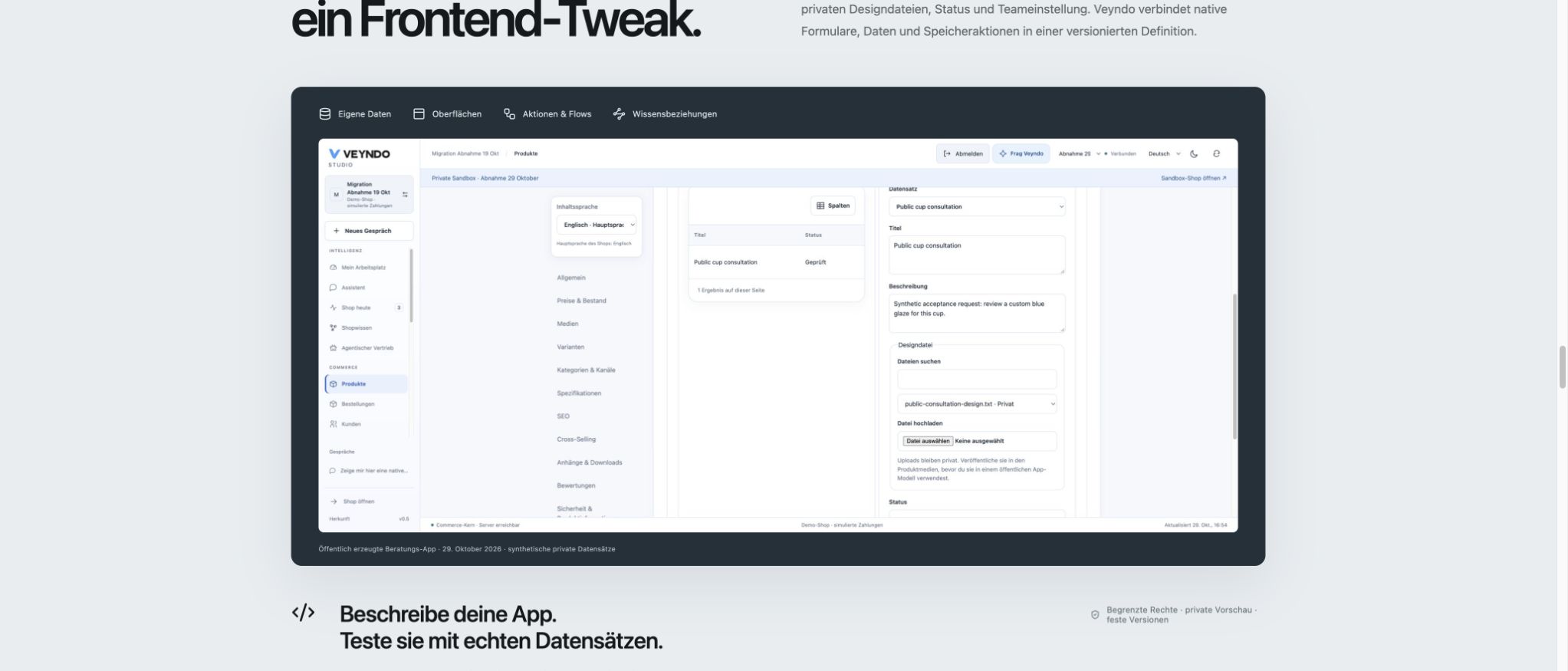
English/German switching, current copy, proof links and the loaded 2060 × 881 app
image were observed. The original Storyfront pin, provider, session, creation and
checkout code were not changed by this website update.
The separate website source passed its complete local project check: typecheck, module boundaries, four-language parity, 252 application tests and production packaging. Its hosted CI job did not start and is not recorded as passing. The public Core's complete required CI and documentation publication results above remain separate.
Related complete local journeys
- Description-led consultation app, upload, settings, publication and restoration.
- Upgrade admission against saved data, current consumers and migrations.
- Saved customer profiles and actual browser before/after purchase.
- Shop/app drag and drop, undo and screenshot-derived design proposal.
- Actual WooCommerce source, interrupted resume and purchase.
- 150-table restore, restricted logins, local SMTP, invoice and simulated refund.
These dated local journeys and the public observations above retain their own scope. They do not turn the local database restore into a hosted snapshot restore or a simulated payment into real settlement.