
English source · 5 min
Agentic Studio grids
See the connected AI workspace for the 20 October context, reviewed private execution, complete app composition, real preview, editable list handoff and remembered merchant-guidance workflow. Current status.
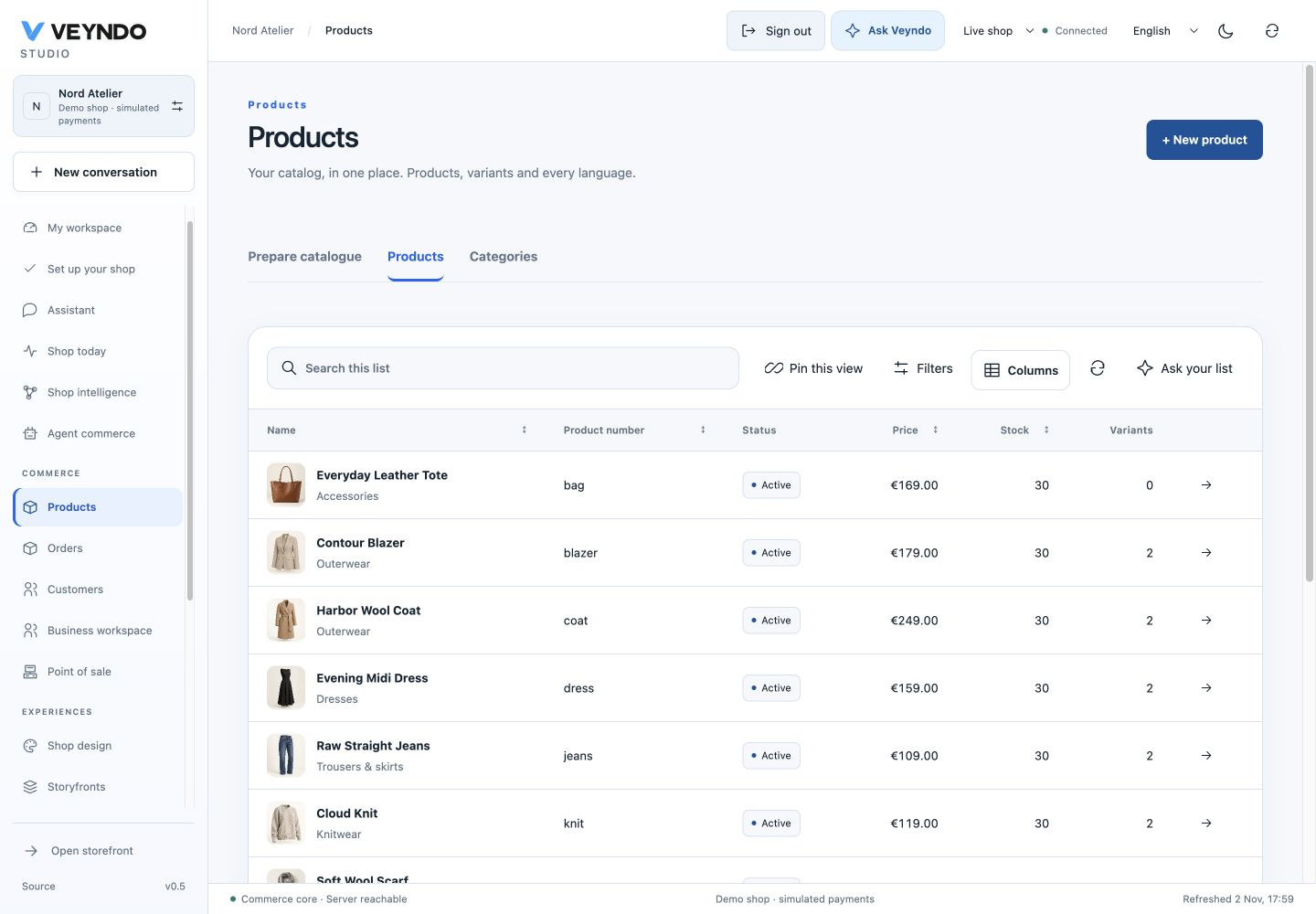
The merchant agent can also compose these same directories into a pinnable working view with native details and private product intake. These are additional entry points to the same grids, not model-generated record tables.
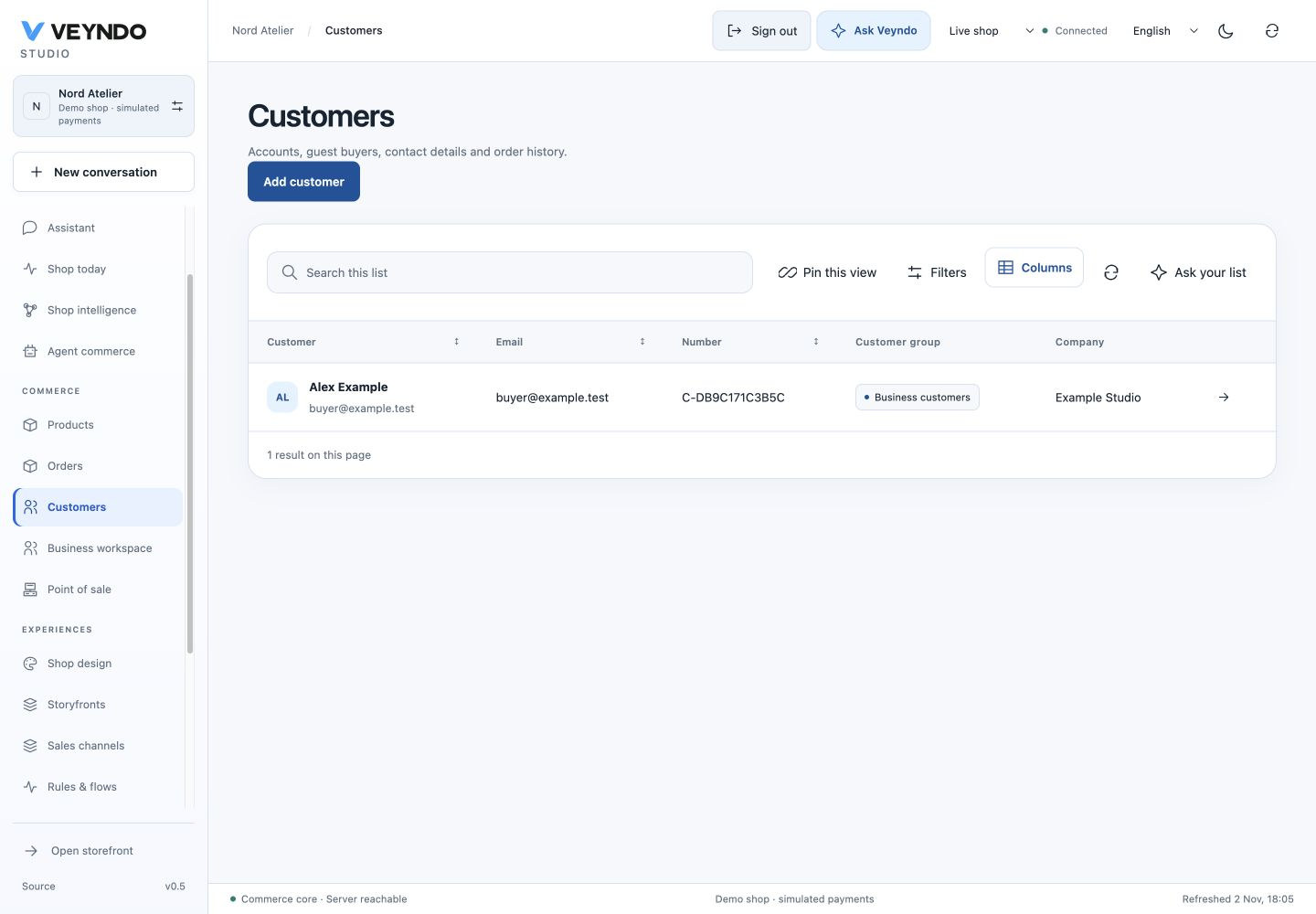
Orders, products and customers now share one grid instead of separate fixed lists. People and agents use the same native filter/sort contract. The grid never owns prices, customer identity, order states or a second database.
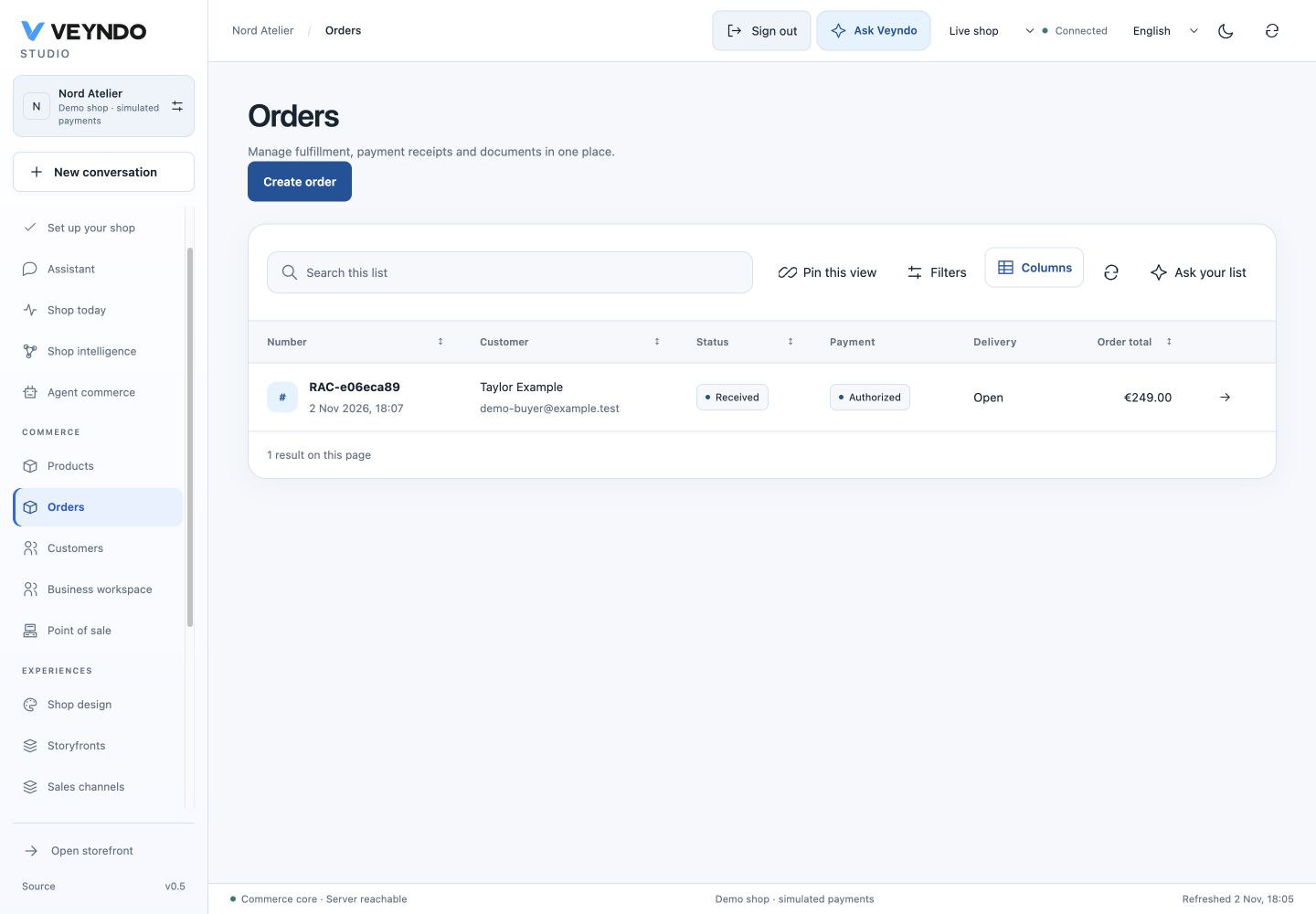
Use the list
- Open Orders, Products or Customers in Studio. Search runs on the server, across the entire permitted directory, with a short input debounce.
- Open Filters. Orders support customer-name/email text, order/payment/delivery states, channel ID and an inclusive UTC date range. Products support active status, category and low stock. Customers support registered/guest contacts, active status and configured groups. Applied filters appear as removable chips.
- Click a sortable column to switch ascending/descending order. Pages are sorted before the cursor is applied; the browser never sorts only the visible page.
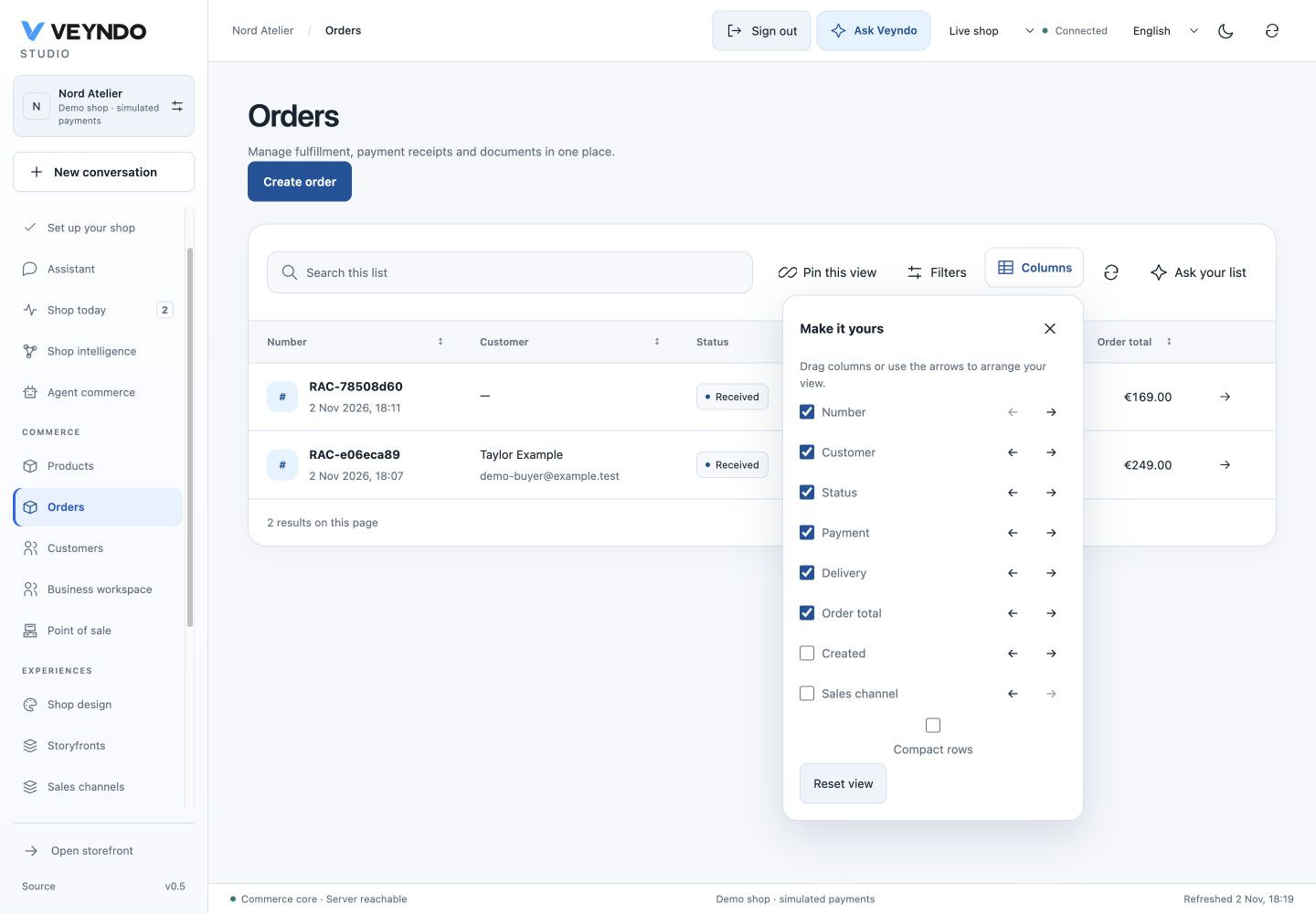
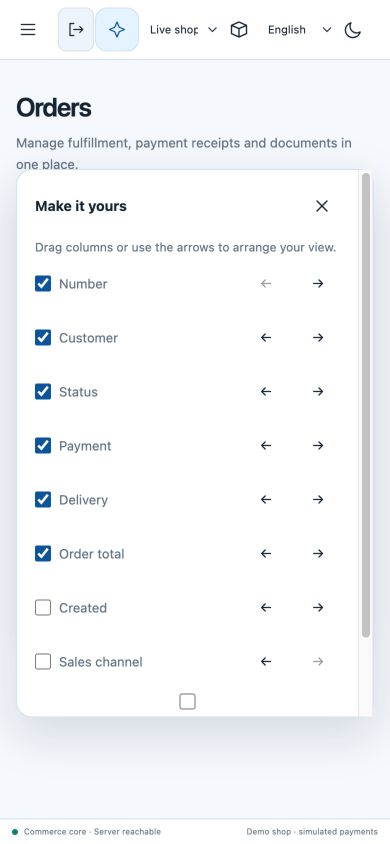
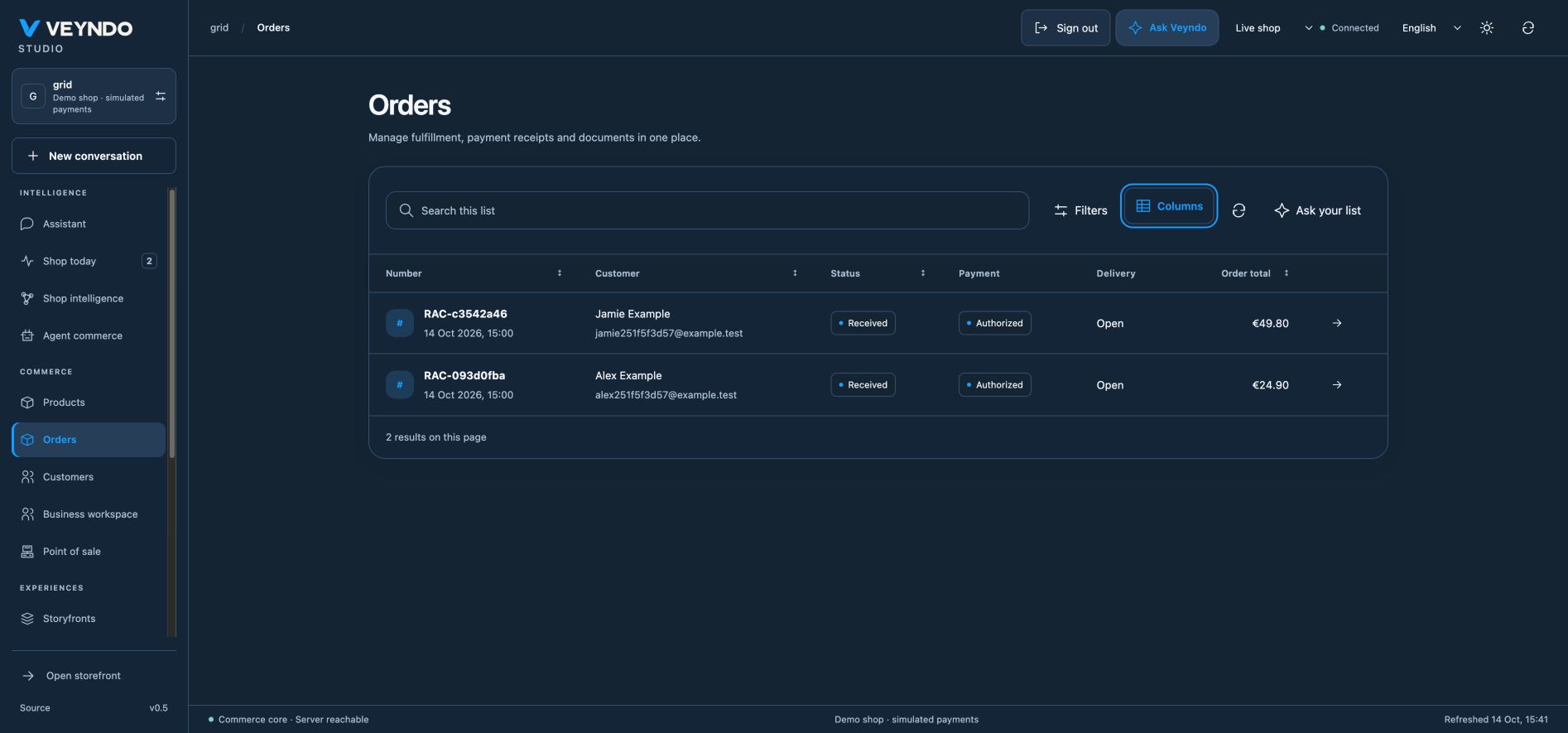
- Open Columns to hide/show columns, move them with arrows and change density. Drag a table heading to reposition it. Keyboard and touch users can use the arrows. The details action stays available even when the original name/number column is hidden.
- Open a record and return to its list. The workspace retains the current criteria and page cursor in memory. Reloading resets search; no customer names or search text enter browser preference storage.
Column layout/density is a device preference scoped by origin/shop/sandbox and list ID. It contains column IDs only, not records, credentials, business configuration or release units. This is deliberately distinct from entity history and staging.
Ask your list
With assistant.use and the list's current domain rights, open Ask your list:
- “Show all orders from customer Alex Example.”
- “Show active products with low stock.”
- “Find guest customers.”
The central configured model receives the explicit question, entity, current date and allowlisted criteria schema. It receives no fetched customer/order dataset. The request can itself contain names or other data you type; it goes to your configured model provider. No separate provider credential or browser-side model client exists.
The model returns typed filter suggestions. Studio shows them for review and Apply filters issues an ordinary native list read. Unsupported constraints must be reported instead of silently dropped. Invalid fields/types/dates/sort keys are rejected. Provider failure leaves manual search/filtering available.
OpenAI's strict wire format represents unused optional fields as null. The
native grid validator normalizes only known optional fields before validation;
unknown identity fields remain rejected even when null. Explicit false values
(such as inactive customers) remain real filters. The central provider adapter
and ordinary HTTP/MCP owner are shared across this path.
Blank planned text filters are rejected instead of being treated as a useful
search proposal. Manual list APIs retain their existing empty-search behavior.
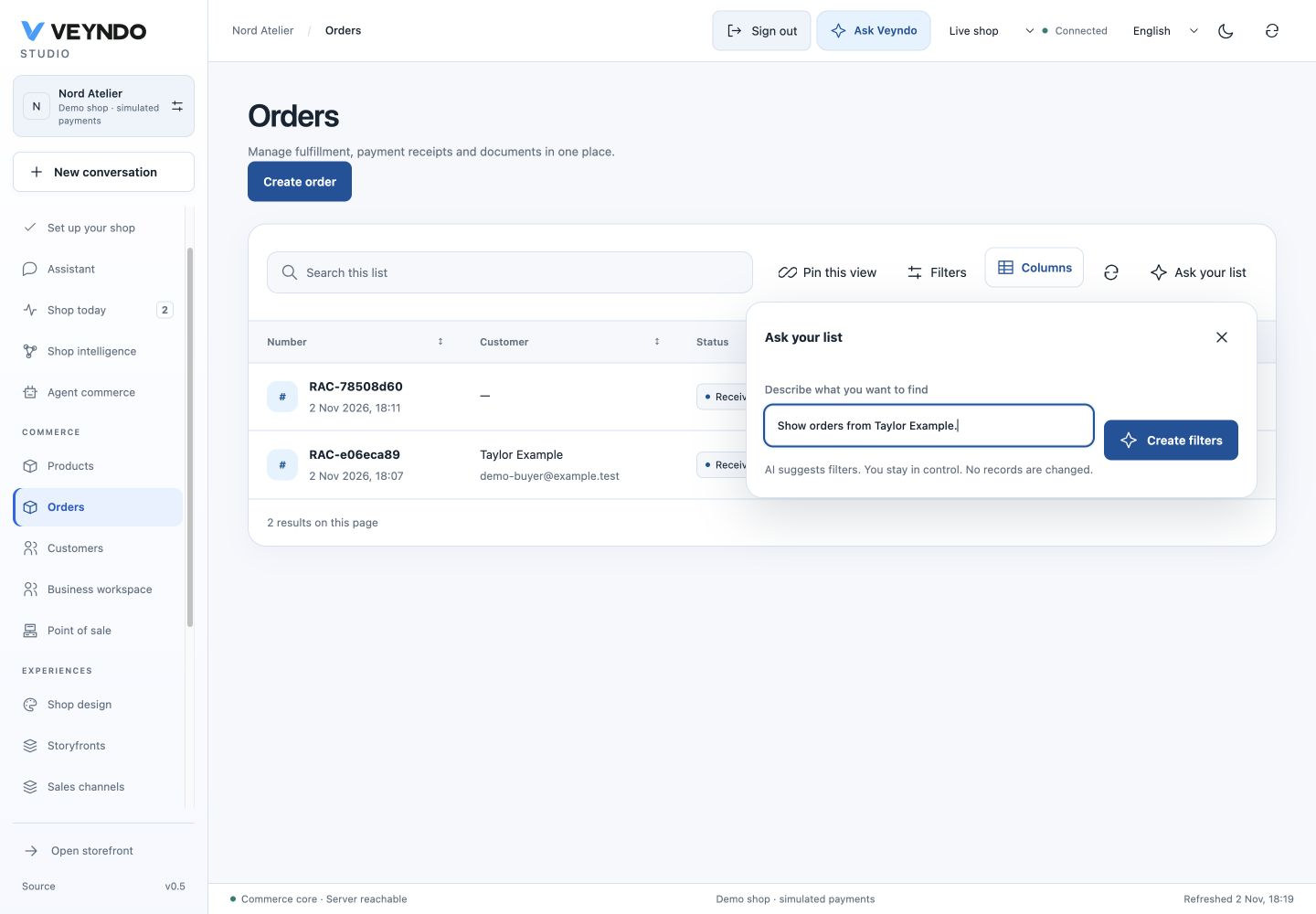
The inline images show the current grid, column controls and natural-language input in a synthetic shop, captured 2 November 2026. No model request was made for these images. The earlier loopback-model example retains its original review-path evidence.
The customer filter matches text in the immutable order customer snapshot (name/email) and legacy contact fields; it does not claim to disambiguate people with identical names. Exact email text can narrow the result. Category/channel/parent references must be explicit IDs; the model must not fabricate IDs from display names. Product-name sorting uses the same native language inheritance as the displayed name. Each page reads current committed data; edits during browsing can move a row, so refresh the list when you need a new view. Dates use UTC. Amount sorting compares displayed numeric order amounts, not economic value across currencies, and performs no conversion or aggregation.
One native contract
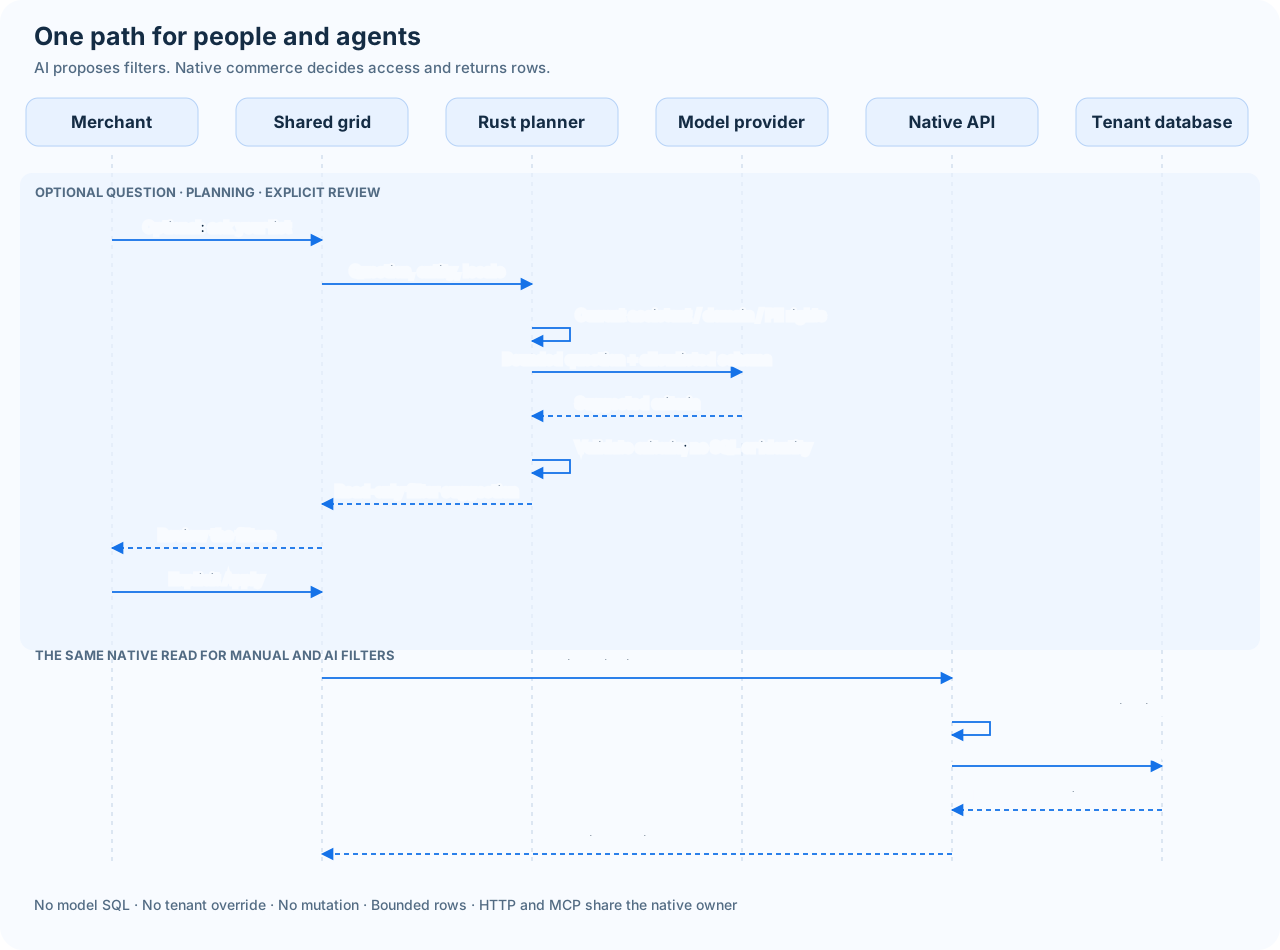
Manual searches go directly from the grid to the native list owner. AI planning adds the optional question/review steps; database results return through that same authorized API. Editable Mermaid source · Structured diagram.
POST /api/merchant/grid/plan and MCP merchant.grid.plan share the same owner.
Manual execution continues through /api/merchant/orders, /customers, /products
and merchant.orders, merchant.customers, merchant.products. The MCP schemas
use the same grid field registry. No model-produced SQL, tenant/principal field,
write action, approval bypass or automatic purchase is accepted.
Planning requires assistant.use plus orders.read or customers.read with
customers.pii; product planning requires catalog.read. Ordinary list reads
retain their existing domain/PII requirements. MCP discovery and direct invocation
apply current rights. Model calls reuse central inheritance, process admission and
fleet-wide tenant leases. Sandbox reads use the existing environment context;
operational orders/customers are not copied into a stage.
Reuse and boundaries
frontend/src/shared/grid/ owns presentation, layout, debounced paging and review.
Domain directories supply columns, allowed filters, existing request functions and
native navigation. New entity directories must reuse it rather than copying a list.
Bundled controls are translated into EN/DE/FR/ES. Merchant content and app labels keep
their existing main-language inheritance.
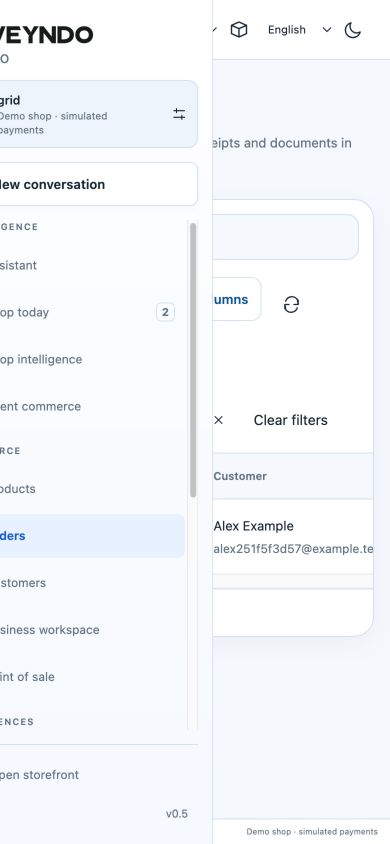
The table scrolls inside its container on narrow screens; it does not expand the whole page. Column ordering has keyboard and touch controls, and popovers support an explicit close action, Escape and outside clicks. Compare the actual mobile order list, mobile column controls and dark appearance.
Declarative app table blocks also reuse the column/density/expanded-row shell and retain their native inline forms and current app actions. Their existing indexed filter/action contracts are preserved: this change does not silently add arbitrary full-text search, sorting or model planning to every installed app. Metrics tables, variant draft editors and document/line-item summaries are not global entity directories.
The SQL owners retain bounded pages and tenant predicates. The default customer email path keeps its existing per-branch limits. Non-default sorts can still require PostgreSQL to sort eligible rows; this release does not claim a million-row latency benchmark or replace the existing database/resource limits.
Verification
The grid_directory suite creates an isolated database, real customers and simulated
orders via Store API, and calls actual Rust HTTP/MCP plus a loopback model provider.
It verifies global filter/sort paging, schema/output rejection, provider failure,
current domain/PII rights, foreign tenants/cursors and empty operational staging.
It sends no paid model, live payment or real customer data. Provider fixtures verify
wire/admission behavior, not the semantic quality of a particular live model.
The same suite also switches central platform configuration to a loopback OpenAI Responses fixture, restarts the native owner and checks strict nullable fields, HTTP/MCP agreement, explicit false values, unknown null identities, empty supported plans, unsupported requests and provider failures.
Frontend regressions cover sorting, filters, keyboard ordering, drag headers, layout persistence, explicit AI review, unknown-field rejection, permission presentation, stale response fences and native app forms. Browser acceptance uses the same synthetic native orders and local model provider. Measured tests.