
English source · 15 min
Shopware Payments: integration and test acceptance
Updated 4 November 2026. The private Rust connector implements the provider path; the public Core owns the order and payment ledger. The public catalogue now ships the versioned 1.6.0 contract for all 17 methods. Install or upgrade it through the existing app lifecycle, connect the configured account and enable its methods. Installing the contract does not provision the private service or activate methods. Use the provider contract for deployment.
Actual PayPal Sandbox purchases and refunds, 4 November 2026
The hosted private Rust service 1.6.4, with contract 1.6.0, completed actual PayPal Sandbox purchases through the native shop and original Storyfront. Both use the authorized fake seller and buyer. These requests reached PayPal's Sandbox; no Live payment was enabled. Earlier dated sections retain their historical simulation scope.
| Journey | Order | Captured | Completed refunds | Return and basket |
|---|---|---|---|---|
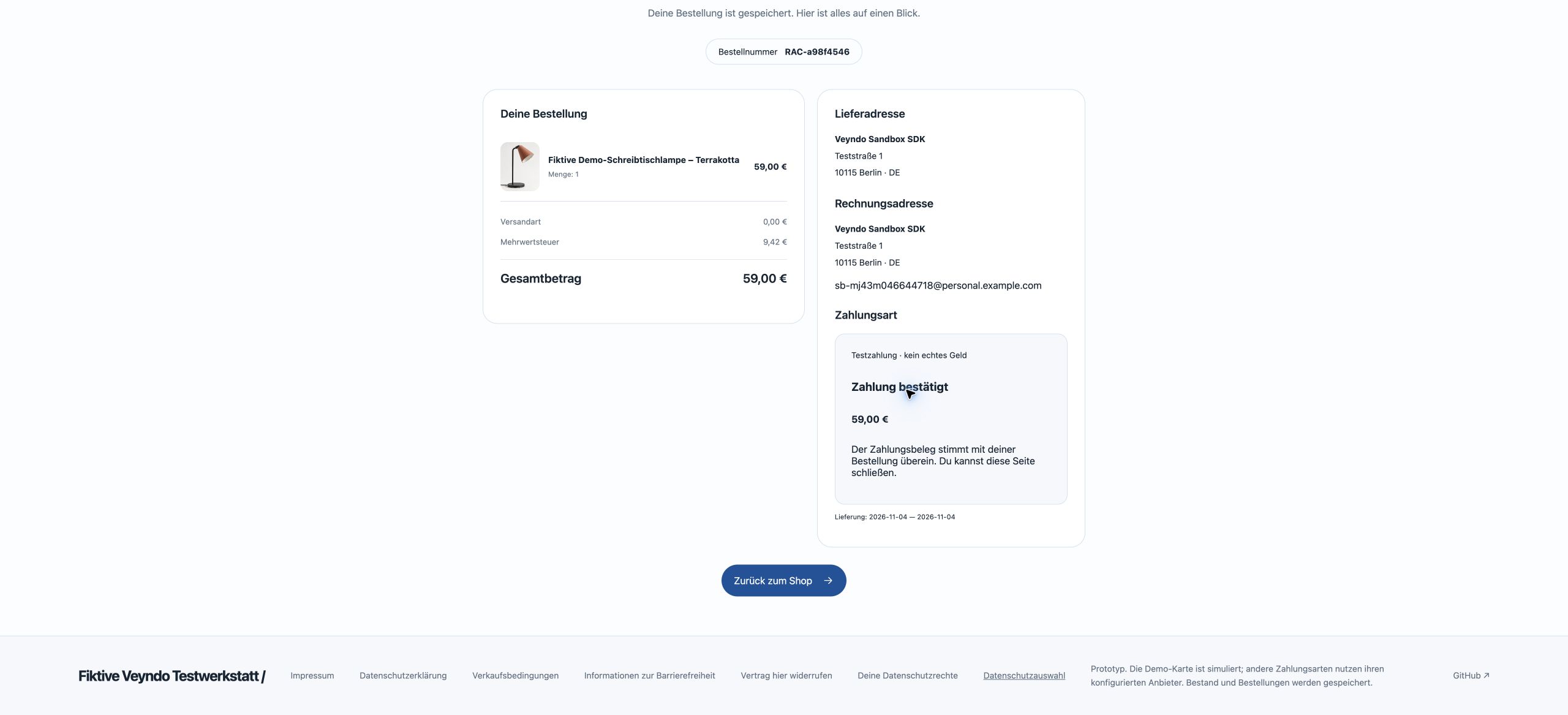
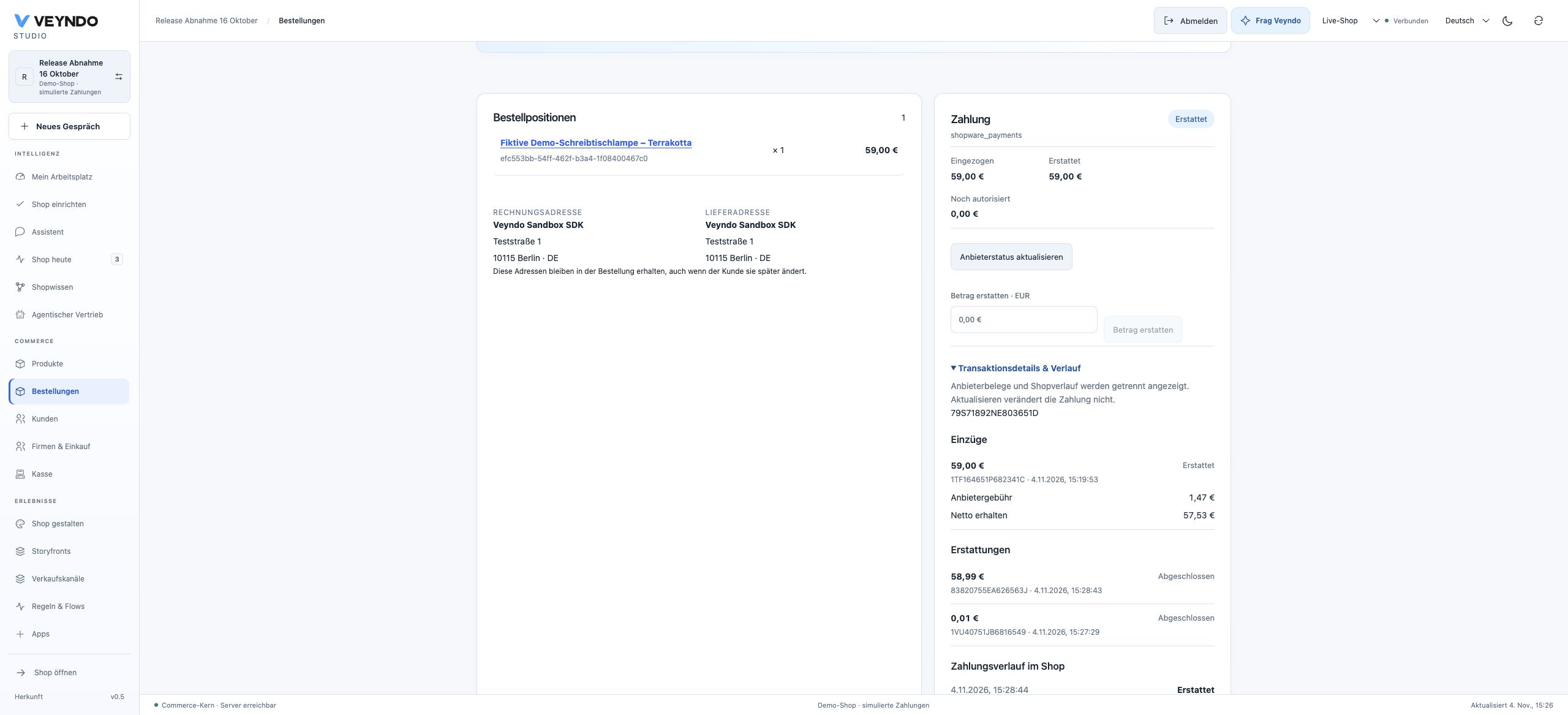
| Native direct SDK | RAC-a98f4546 | EUR 59.00 | EUR 0.01 + EUR 58.99 | SDK popup closed, native confirmation, original basket empty after full reload |
| Native provider fallback | RAC-2d95fe9e | EUR 59.00 | EUR 0.01 + EUR 58.99 | Payment confirmed, return to shop, original basket empty |
| Original Storyfront | RAC-8e248b79 | EUR 59.90 | EUR 0.01 + EUR 59.89 | SDK popup closed, embedded confirmation, return to Experience, original bag empty after full reload |
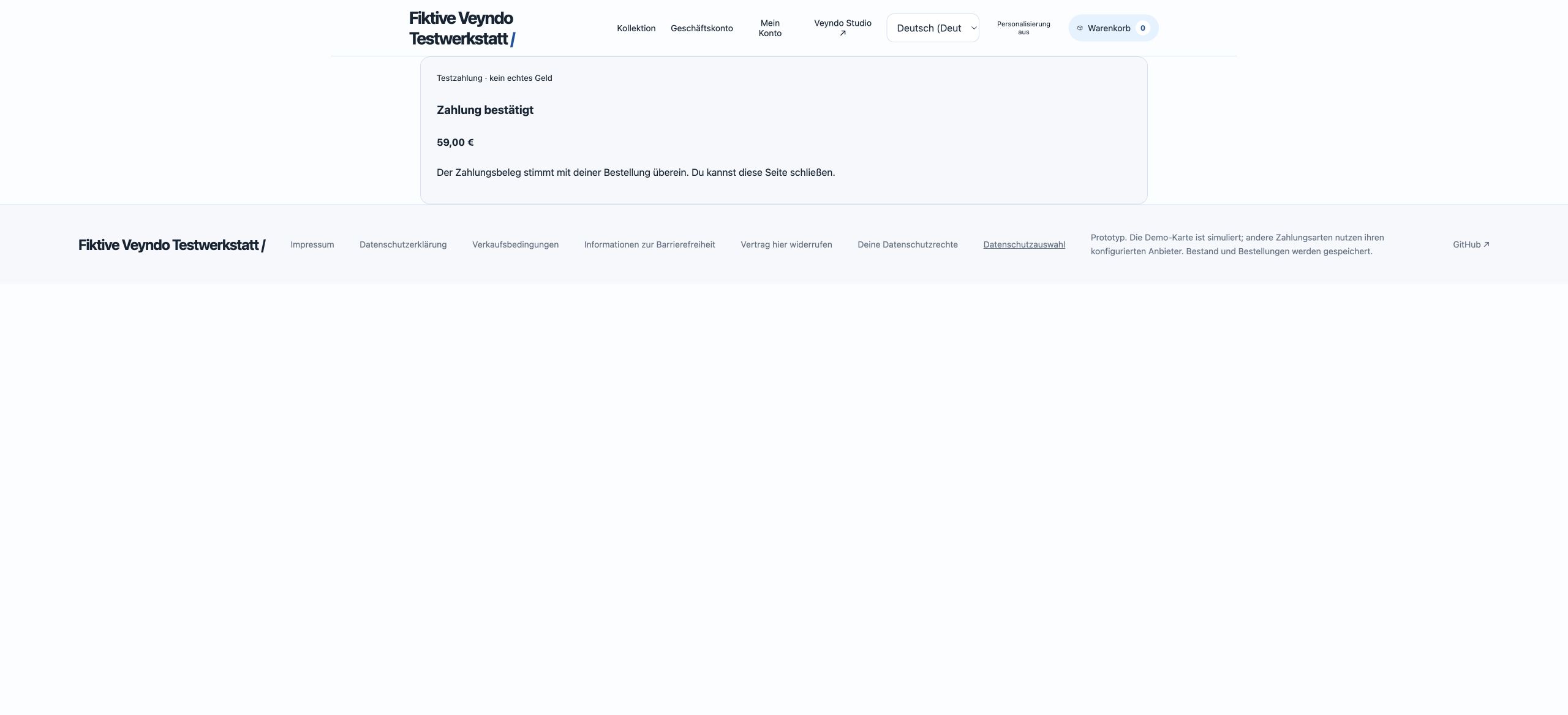
The Storyfront journey used the original Experience, native checkout iframe and nested private payment iframe. Its Sicher bezahlen button opened PayPal SDK v6 in German. Provider approval returned to Zahlung bestätigt inside that same checkout. The native shop used the approved provider fallback page. Its original provider return URL was reloaded after the Core fix and showed the correct confirmation and basket count of zero. A separate native SDK purchase then completed as RAC-a98f4546: the popup returned automatically to payment confirmation, the basket stayed empty after return and full reload, and both exact refunds completed.
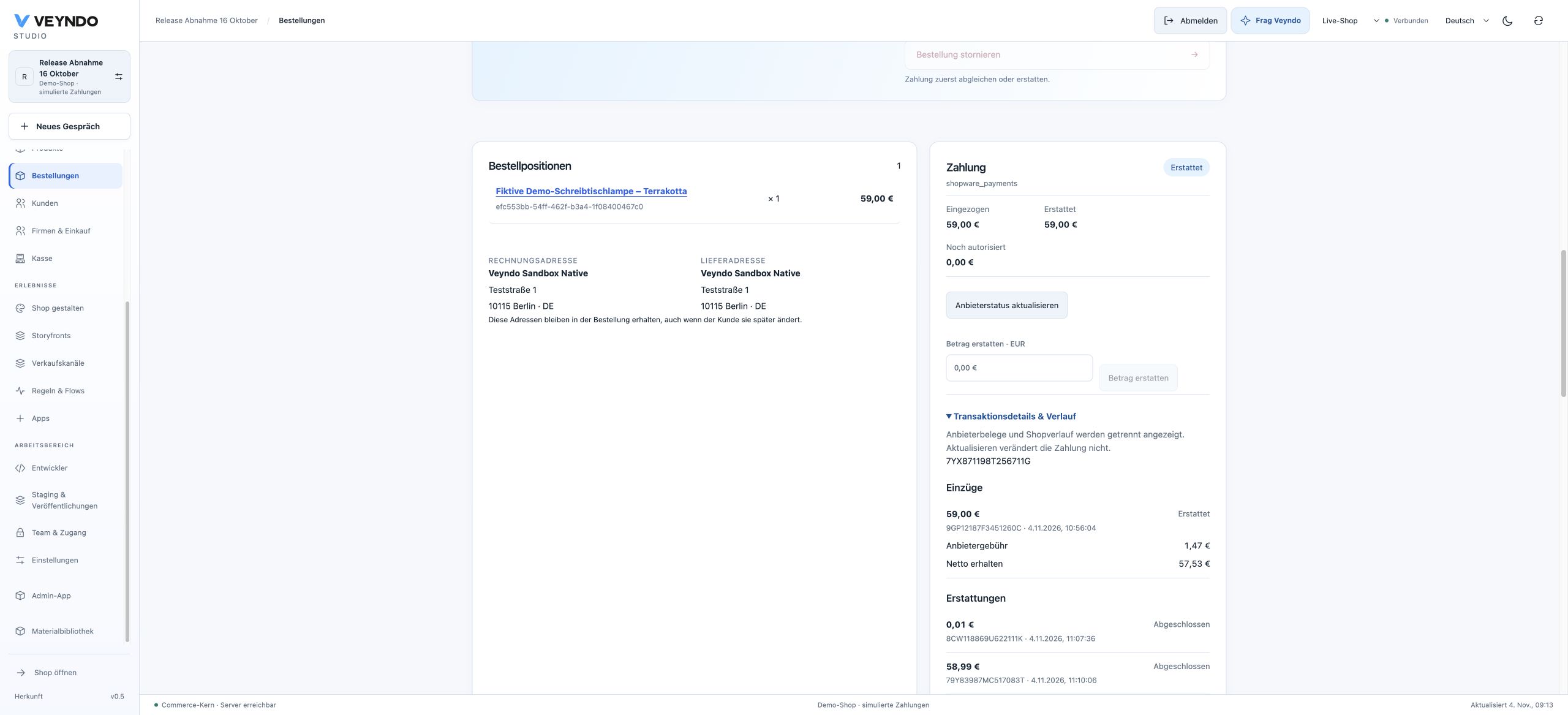
Studio shows the actual provider order and capture IDs, completed refunds and
fees. At capture the provider reported EUR 1.47 fees / EUR 57.53 net for the
native order and EUR 1.49 / EUR 58.41 for Storyfront. These are capture records,
not post-refund profit figures. The native Flow history records the Storyfront
order.placed and payment.captured events.
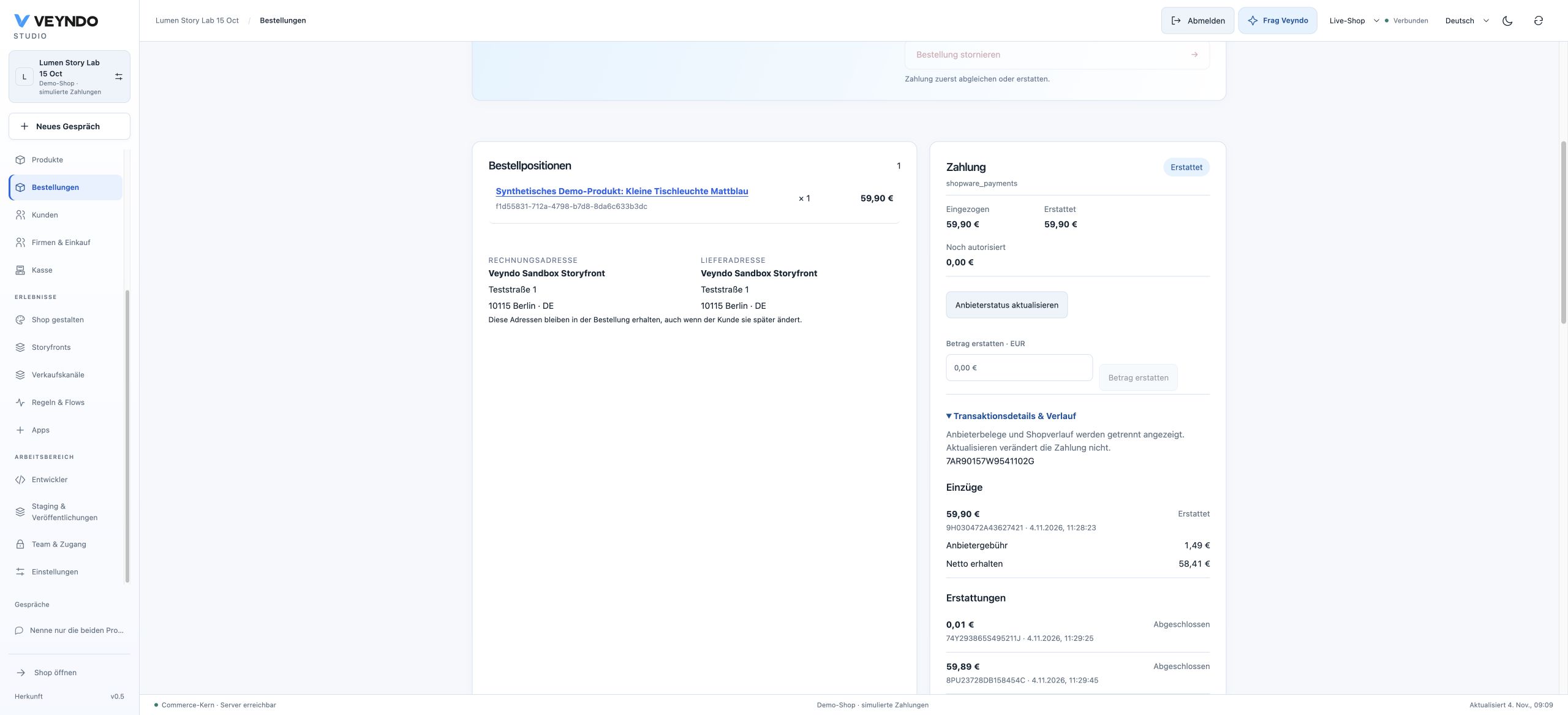
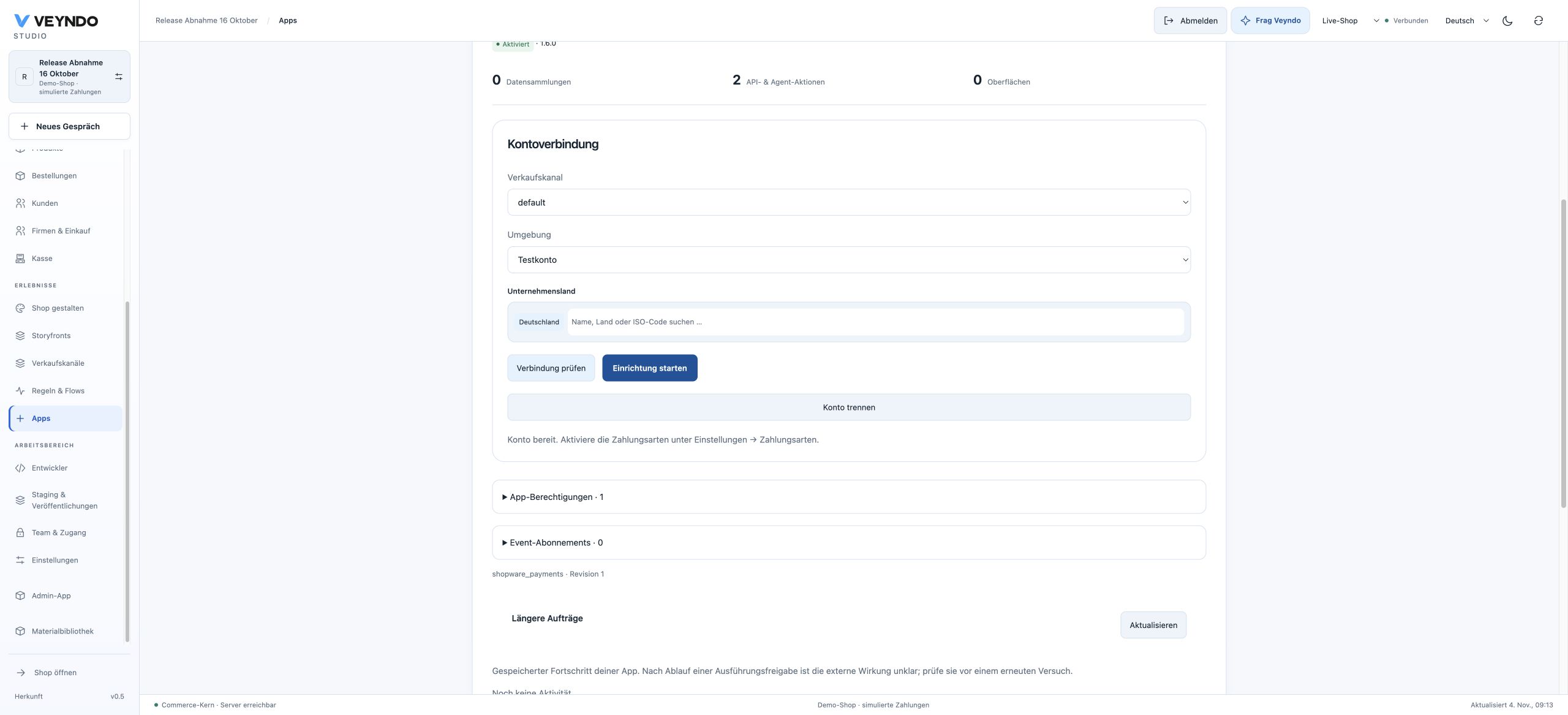
Native direct SDK confirmation · Native SDK empty basket after reload · Native SDK provider capture and refunds · Connected Sandbox seller in Apps · Native Studio capture and refunds · Native provider return after the fix · Original Storyfront bag after return and reload · Structured observations.
The public Core runs db0e00c9 from build abundant-crib-4273, with one ready
replica. The additional invoice and wallet corrections were delivered as private
service 1.6.5, commit f174e0c9, build ambitious-crow-9499; its public health
endpoint reports sandbox ok. The accepted wallet purchases above ran on 1.6.4. Private migrations 003/004, restricted runtime grants and the vault
key are configured; temporary database admin access was removed.
Two defects found on the real browser path were fixed: the SDK now receives the
full shop locale (de-DE rather than unsupported de), and provider-added
fragment parameters no longer corrupt the native payment attempt reference.
A historical Storyfront attempt expired during debugging with zero captured;
it is excluded from the successful purchase above.
This accepts actual Sandbox PayPal wallet capture/refunds and the observed return/basket paths. Saved-method reuse, deferred invoice approval, authorization and void, every other payment method and Live payments retain their separate provider acceptance requirements. Complete Shopware parity is not claimed.
Saved methods and invoice follow-up, 4 November 2026
The targeted actual local Rust/Core/PostgreSQL checks pass native invoice PDFs, automatic and Flow emails, instructions during pending review, exact refunds, restart and lost-response recovery. The private invoice form now binds provider risk correlation to its checkout session and loads official legal disclosures before submission. Known documented provider rejections become no-funds cancellations, while unknown outcomes preserve the original input fence.
The actual hosted save attempt reached PayPal Sandbox and returned
NOT_ENABLED_TO_VAULT_PAYMENT_SOURCE. A registered fictional Veyndo customer is
ready for the next check. Enabling the provider feature and completing actual
saved-method reuse/revocation are still required. Provider invoice approval also
needs its own account capability and acceptance. The local passing paths do not
substitute for these provider results. No Live payment was enabled.
Clear activation diagnostics
Missing provider activation is now projected as a safe operational code. The shared transaction history explains the cause and the next step in all four interface languages, including the order view and payment app. Unknown provider text stays hidden. The actual local Rust/Core/PostgreSQL regression confirms zero captured money, current merchant rights and foreign-shop denial. The component was also rendered at 390px in light and dark themes without horizontal overflow. This display does not complete provider approval or change payment state.
Saved customer methods, 3 November 2026, local implementation
Contract 1.6.0 adds explicit save consent, encrypted private tokens, account-bound second purchases and revocation. It preserves the separately recorded capture, transaction detail and invoice contracts. Local native-service acceptance covers HTTP/MCP, guest/foreign denial and delayed confirmation across restart without a second capture. Hosted schema, key and service rollout completed on 4 November; actual PSP saved-method tests remain pending. Automatic recurring debits remain open. Customer guide.
Transaction details, 3 November 2026
Contract 1.4.0 adds owned provider capture/authorization/refund observations, exact fees/net amounts and native durable payment history through HTTP, MCP and shared Studio controls. Reads do not reconcile or create financial jobs. Native services passed local current-rights, isolation and unchanged-ledger checks. Usage and evidence boundary.
Capture management, 3 November 2026
Contract 1.3.0 adds native partial/multiple capture, exact per-capture refunds, confirmed remainder void and pending/lost-response recovery. The order and payment views share the balance/allocation controls; shop/channel settings choose immediate capture or authorization. Workflow and acceptance boundary. These additions have local native-service acceptance. They are not yet a new public provider acceptance. The owner deferred external account tests until later.
What can be tested now
The existing private tests/local_stack.py starts the actual private Rust service,
public Rust Core and disposable PostgreSQL against a synthetic PayPal-shaped HTTP
server. This exercises financial state changes through the real services. The PSP
responses and merchant are synthetic; no external payment network is contacted.
| Journey | Current acceptance |
|---|---|
| Merchant onboarding, channel account and disconnect | Real services with simulated referral/account callbacks; disconnect survives a delayed callback |
| Purchase and immediate capture | Real Core/private-service order and signed callback, exact receipt and once-only capture |
| Authorization and void | Private provider lifecycle, including pending outcome rejection and repeated confirmed void |
| Partial, pending and full refund | Real native ledger; pending refund is polled by its original ID rather than submitted again |
| Currency | EUR, USD and zero-decimal JPY purchases and refunds; malformed precision and unsupported currencies denied before PSP traffic |
| Recovery | Private service restart and saved request replay; original EUR adapter 1.0.0 remains usable |
| Tenant, receipt and browser-session isolation | Foreign tenant/account/payee/amount/parent rejected; scoped token and nonce retained |
| SEPA form confirmation | Private endpoint validates the IBAN and explicit mandate consent before the original nested provider request |
| Native browser purchase | Actual Chrome desktop and 390px viewport: private SEPA form, confirmed payment, return and empty cart; simulated PSP only |
| Hosted simulation contract | All 17 methods with 12 concurrent callers, native cancellation, exact partial/full refunds and durable replay across restart; zero PSP traffic |
| Restricted service runtime | Separate migration bootstrap and non-owner runtime; owner runtime and runtime migration rejected |
| Shipped simulated form | Actual scoped session and confirmation endpoint, German shop language over English browser default, readiness nonce and no bank inputs; native Chrome SEPA purchase, return and empty cart also pass |
| Original Storyfront server integration | Real original checkout/completion handlers with native transfer, private simulated capture, exact proof rejection and complete refund; browser framing is separate |
| Public original Storyfront card checkout | Order RAC-ef438264: actual nested native/provider frames, EUR 59.90 captured, return, original empty bag after reload, EUR 0.01 + EUR 59.89 refunds and provider reconciliation |
The connector's 1.1.0 package widens PayPal/card currency declarations to its supported currency list. It preserves the exact currency scale in new invoices and replay fingerprints. PayPal's HUF and TWD whole-unit rule is checked without rounding an invoice. Unsupported three-decimal currencies stay unavailable. Method declarations still require account capabilities and method-specific country/amount admission.
Embedded form loading
The native checkout waits visibly for the provider form. Providers can return
readySignal: true in their scoped session and send veyndo.payment.ready with the
bound nonce after rendering controls. Exact frame window, origin and nonce are
required. A readiness message never records payment or queues capture.
A form that does not respond within 20 seconds shows a translated recovery action.
Reloading requests a new presentation session for the same attempt; it does not
place another order or create another payment. Older providers retain their frame
load behavior. Session request failures also offer recovery. Explicit loopback HTTP
UI origins are permitted only for contract-fixture and must still appear in the
operator's approved origins; Sandbox and Live continue to require HTTPS.
Observed native browser journey
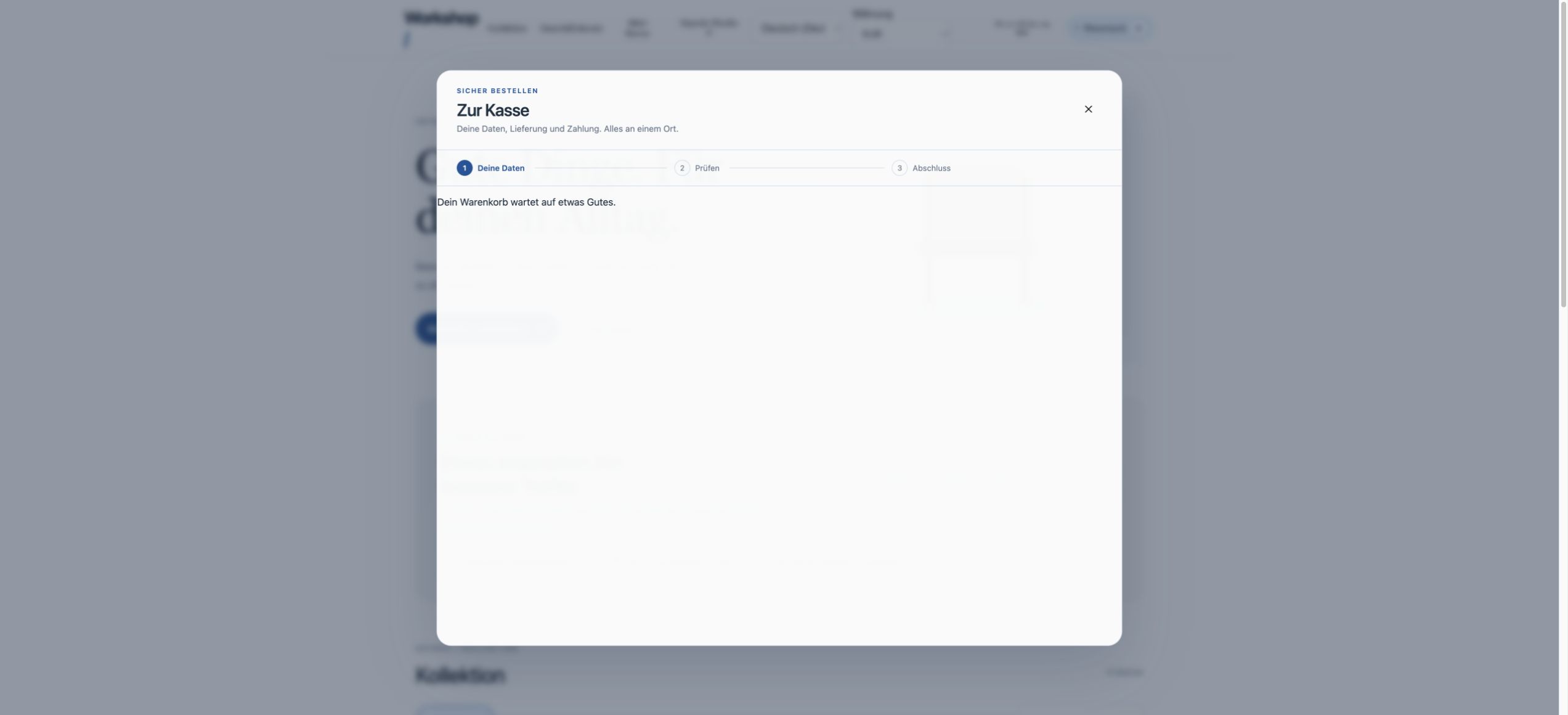
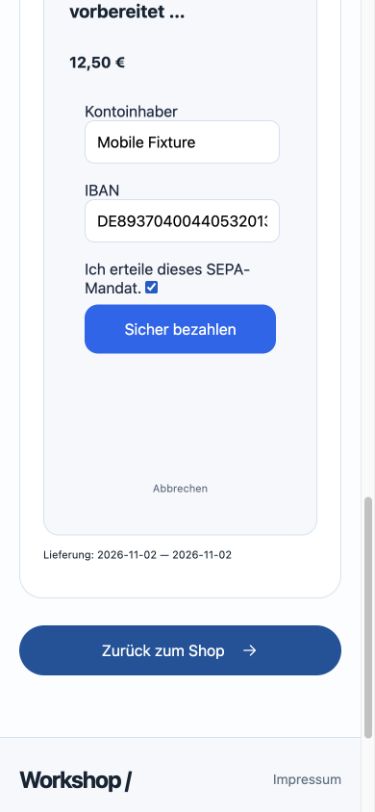
Two local Chrome purchases used the actual private SEPA form: desktop order
RAC-7e79c7d1 and order RAC-15319777 at a 390 × 844 viewport. The browser
entered the synthetic account holder/IBAN, confirmed the test mandate and displayed
Zahlung bestätigt for EUR 12.50. Both returned to the collection and opened an
empty bag. The same two orders then passed a one-cent native merchant refund,
replay of that refund key and the exact EUR 12.49 remaining refund.
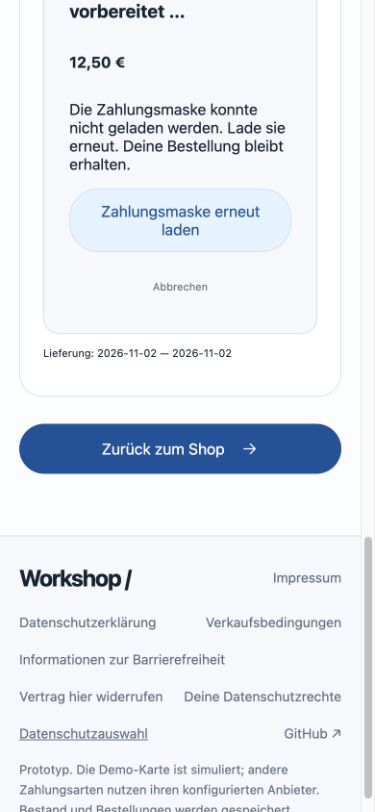
The initial iframe document was held by the browser controller after HTTP 200. The visible timeout and Zahlungsmaske erneut laden recovered the form on both viewports, without another order. These captures show local simulated provider acceptance, not an external bank transaction or Storyfront acceptance.
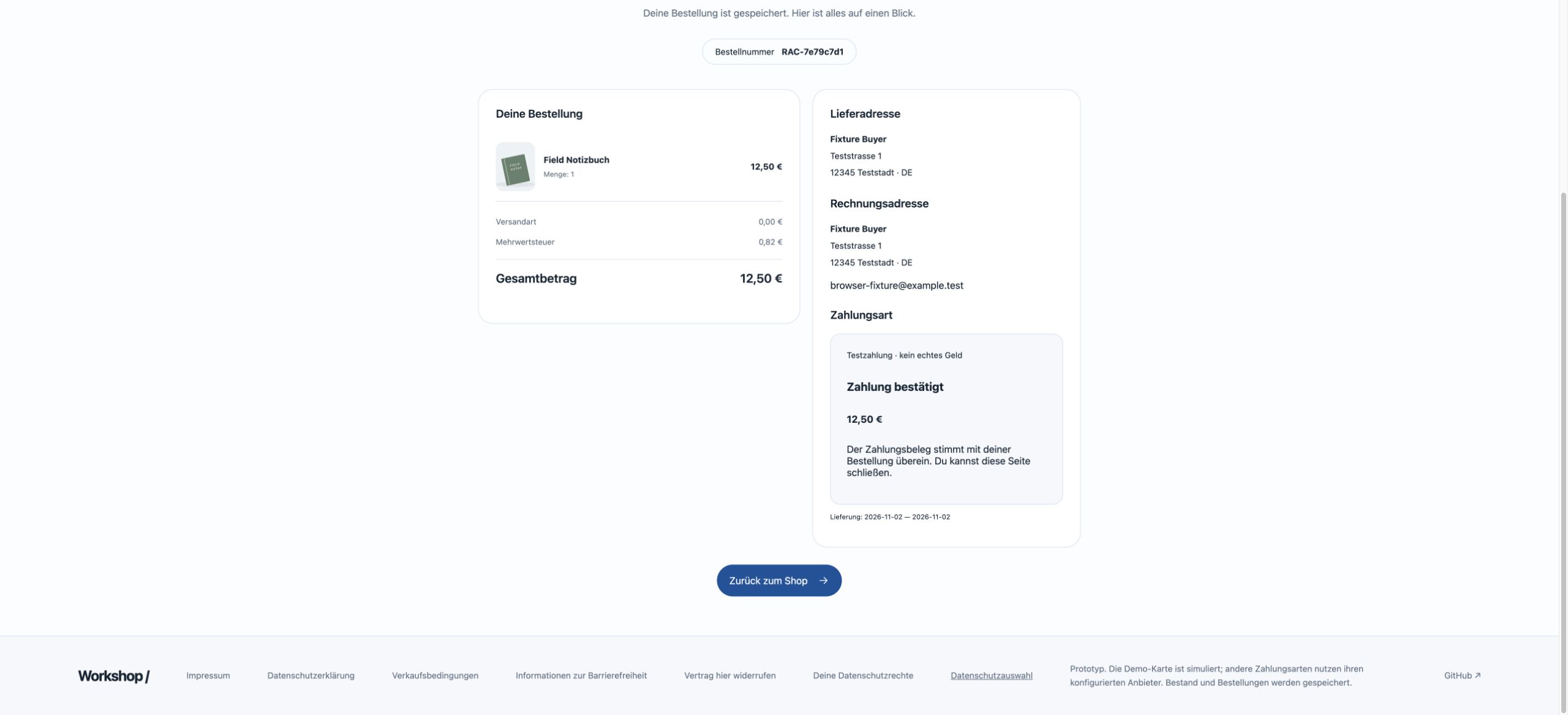
Mobile private SEPA form · Mobile form recovery.
Hosted simulation browser acceptance, version 1.2.0
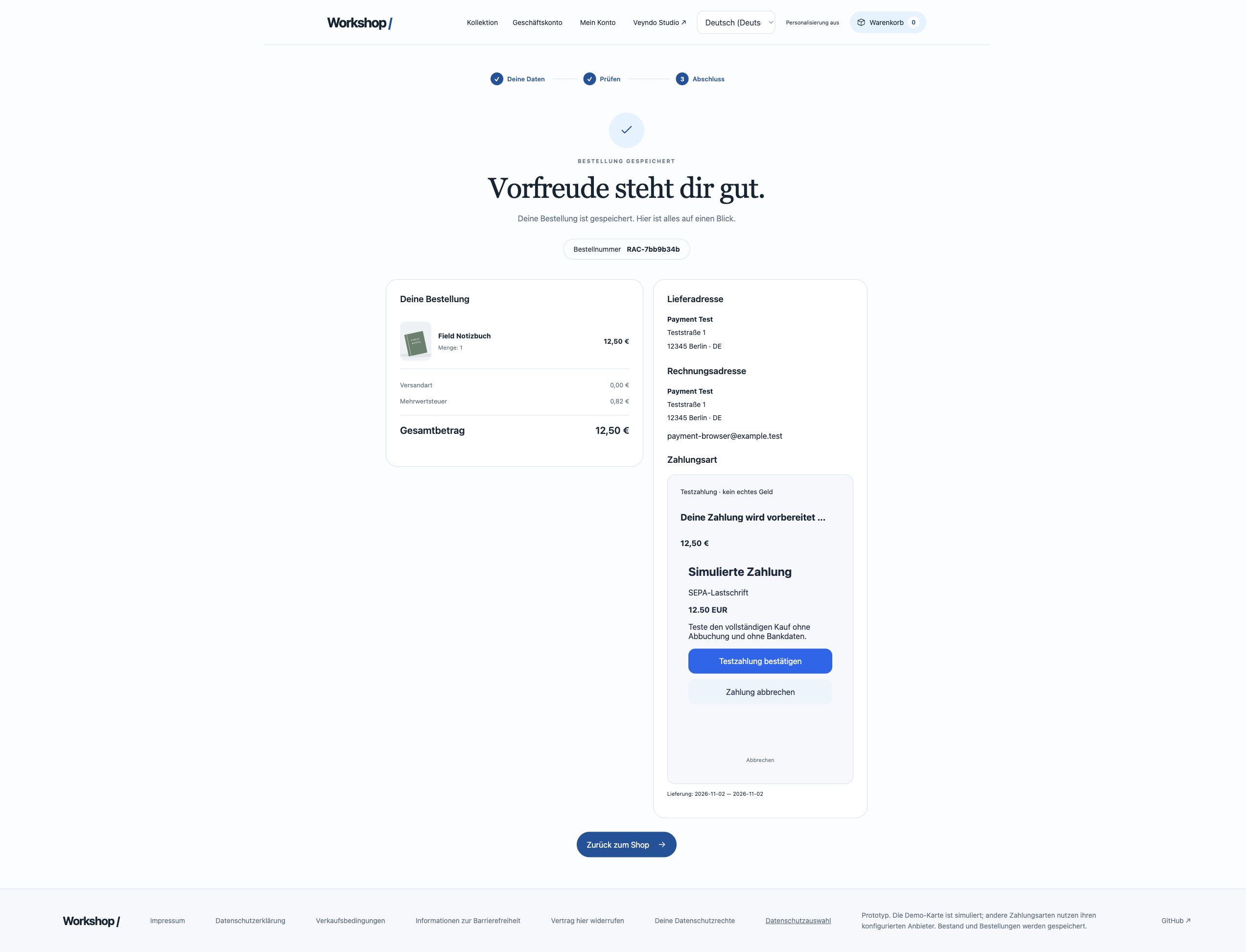
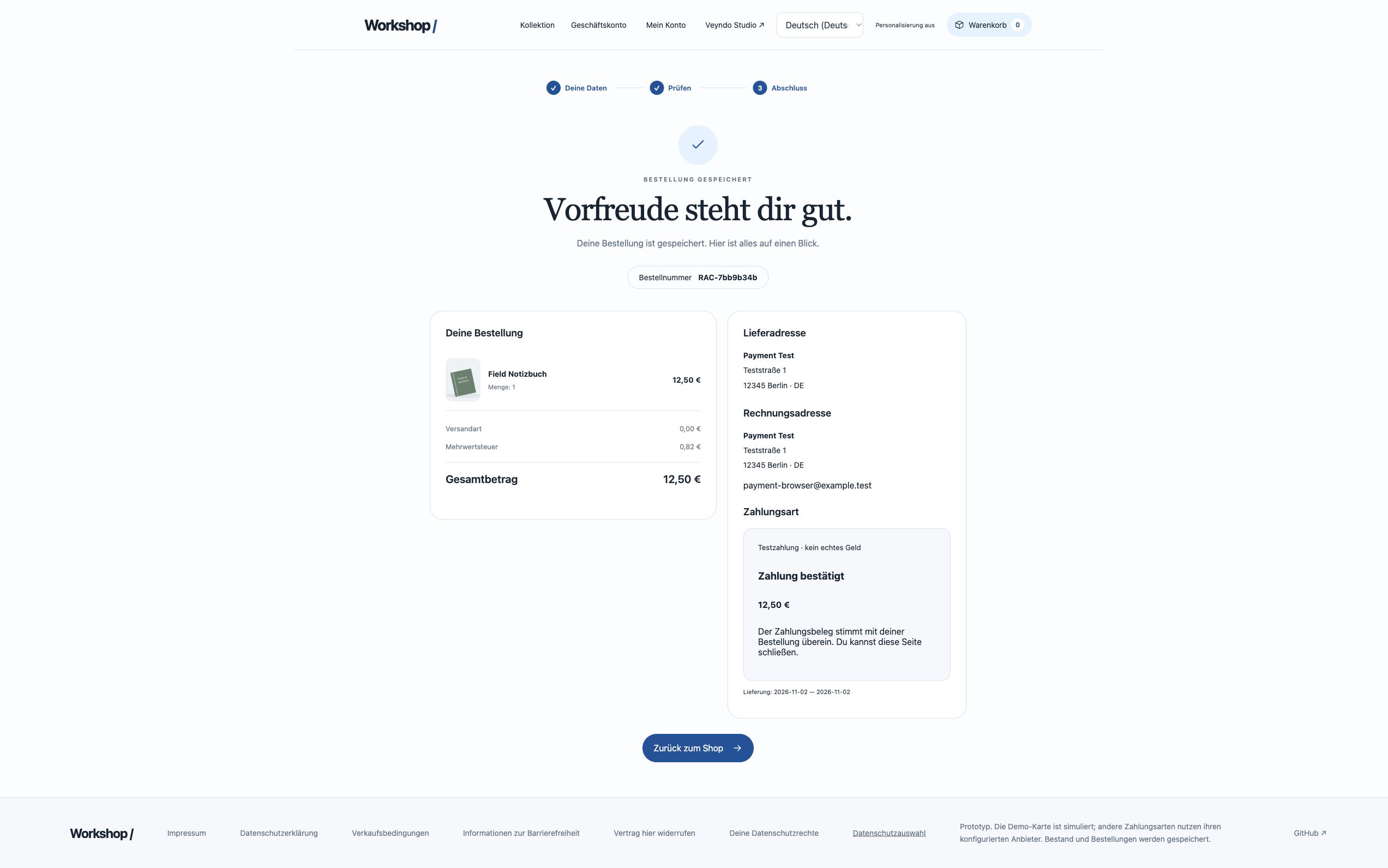
Local Chrome order RAC-7bb9b34b used the shared simulated SEPA form in German.
A second card order, RAC-f8831534, passed at 390 × 844 pixels. Both show
confirmed payment, return to the shop and an empty bag. The merchant API then
refunded one cent, replayed that same refund key and refunded the exact EUR 12.49
remainder for each order. No external money was involved.
After confirming the explicit test decision, the native checkout displayed
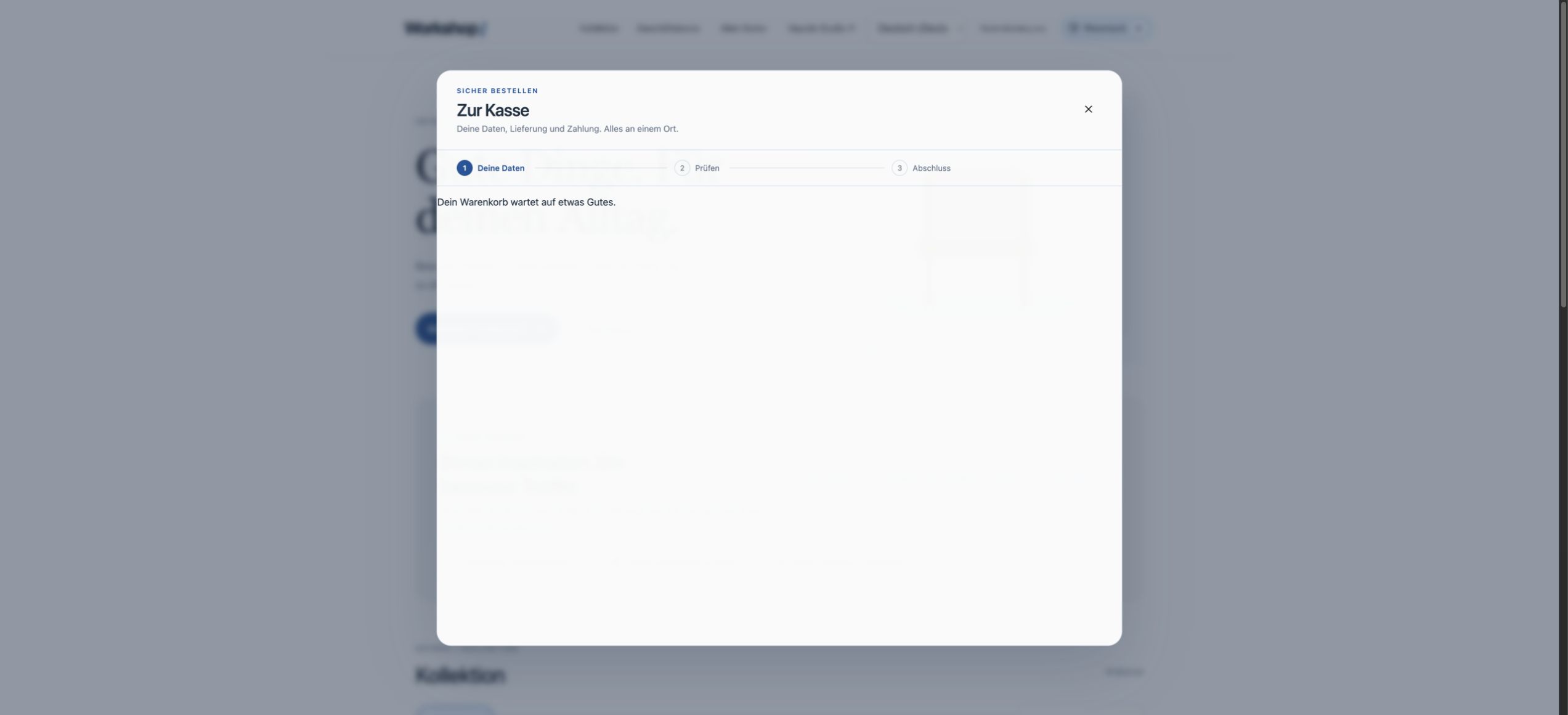
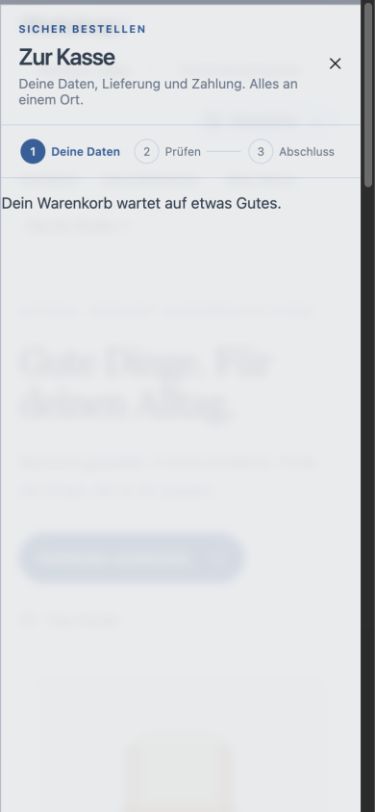
Zahlung bestätigt for EUR 12.50. Returning to the collection and opening the
bag showed zero items. The browser controller initially held the iframe document;
the existing form-reload action recovered the same order without a second purchase.
This accepts the local standard storefront path. Public hosting and the original
Storyfront iframe remain separate acceptance steps.
Mobile card form · Mobile payment confirmation · Mobile empty bag.


Klarna browser authorization and capture, 2 November 2026
Local Chrome order RAC-31c0dbba used the actual shared private payment form
for Klarna and EUR 12.50. The simulation stored the explicit shopper decision;
the native receipt showed Zahlung autorisiert and explained that the merchant
collects the reserved amount separately. The merchant's native capture command
then changed the ledger to captured. Replaying the same capture key returned
the original job. After reload, the receipt showed Zahlung bestätigt.
The browser returned to the collection and opened the empty native bag. A
one-cent refund, replay of its key and the exact EUR 12.49 remaining refund
completed against that same order. The final native state is refunded.
The browser controller initially held the provider document; the visible
presentation reload recovered this same order without another purchase.
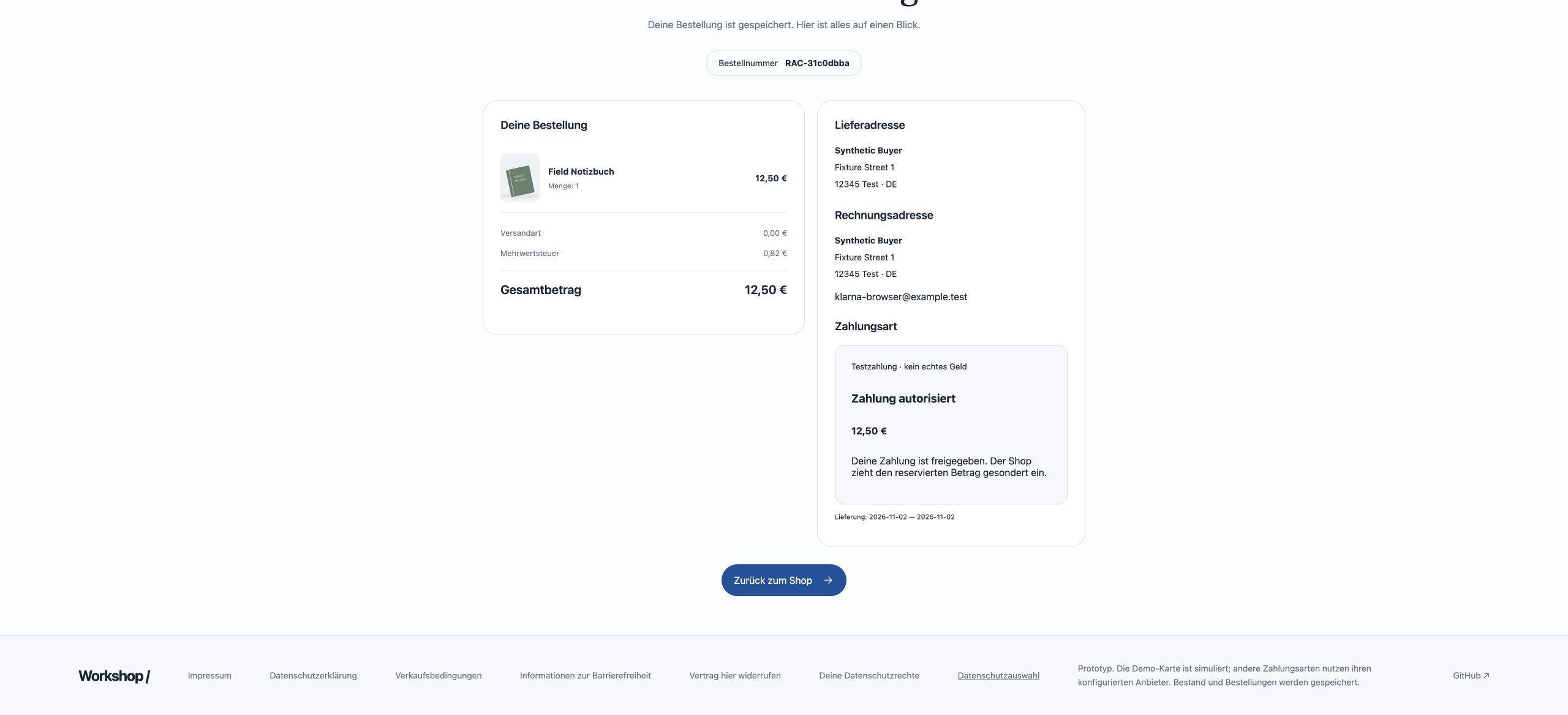
Confirmed capture · Returned empty native bag · Recorded result.
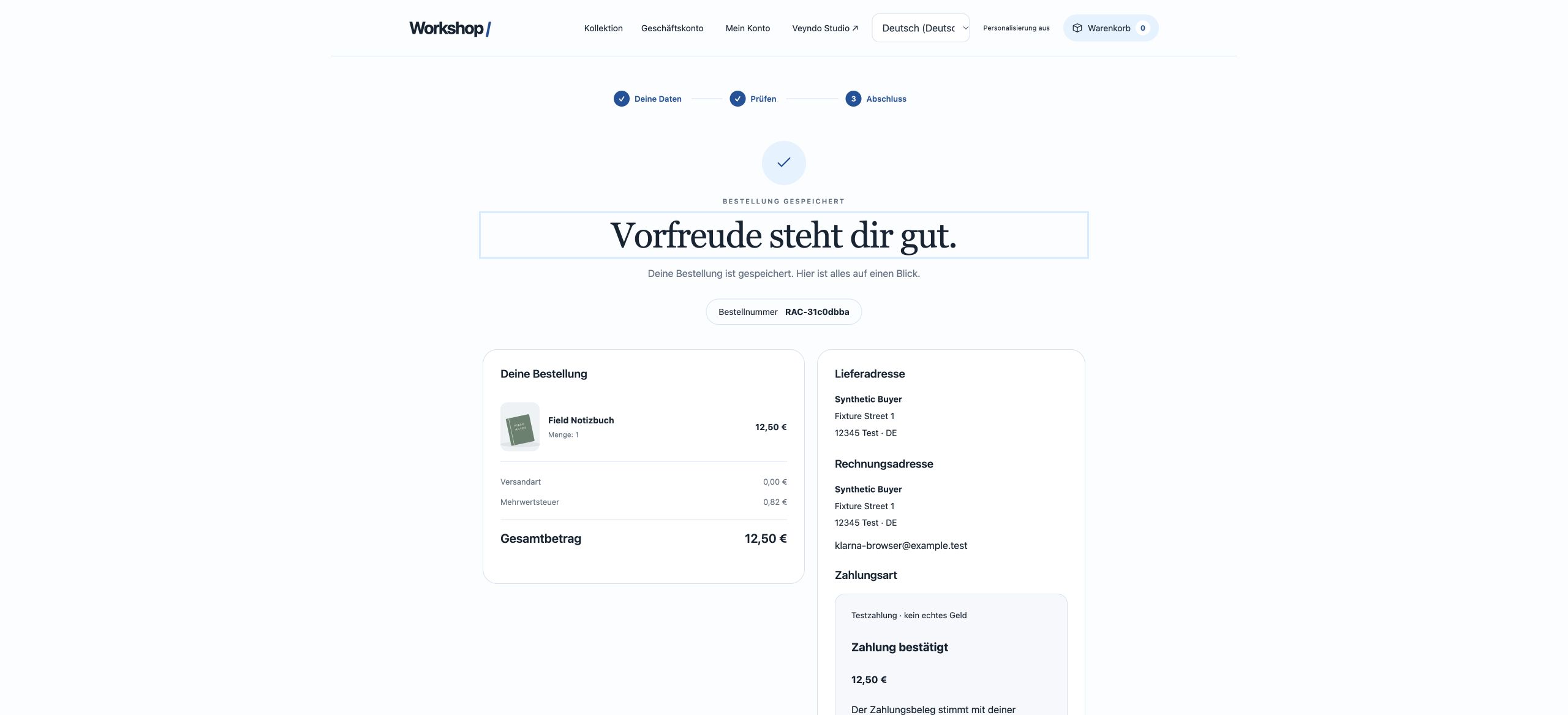
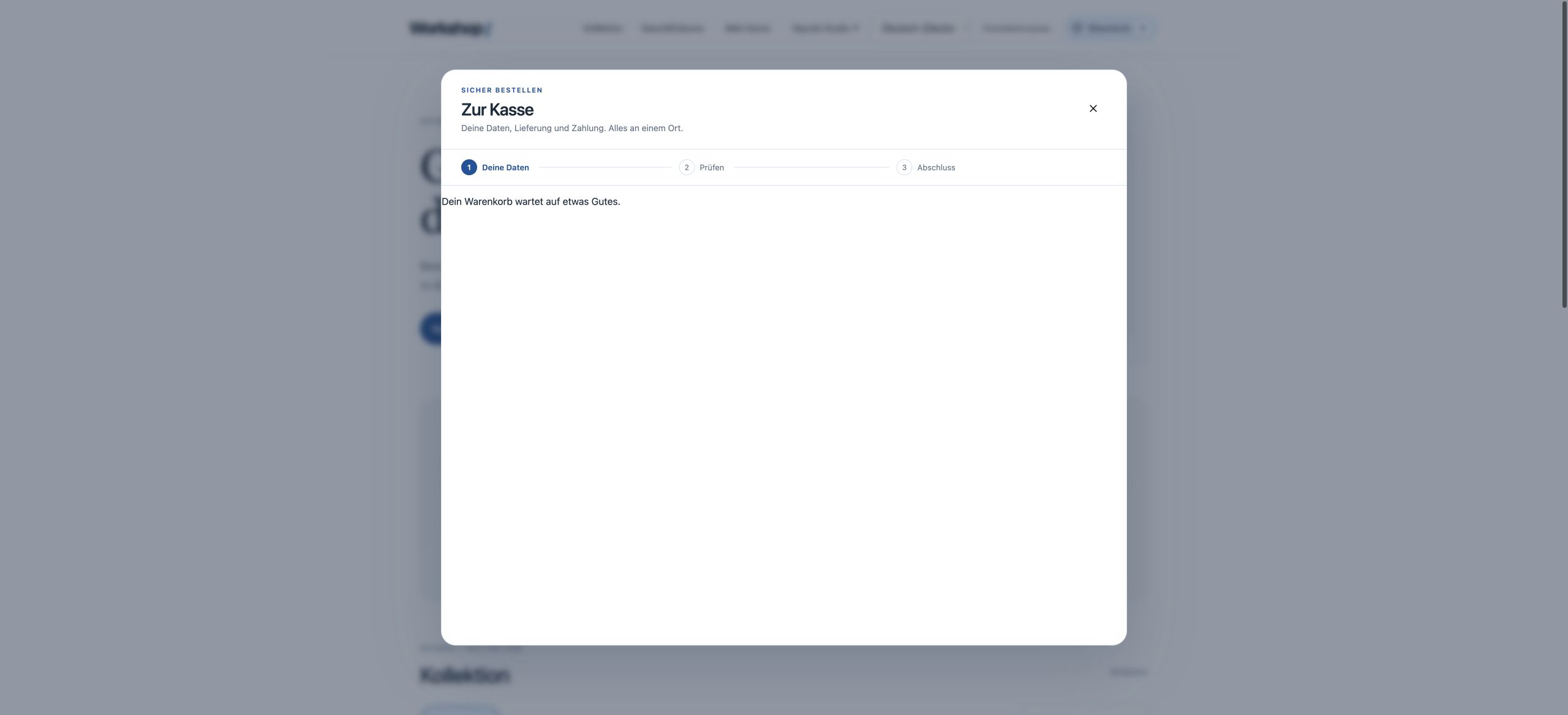
This is the local standard-storefront simulation with real Rust services and PostgreSQL. It does not establish public hosting, an actual Klarna provider account, bank approval or the nested original Storyfront browser journey.
Original Storyfront server integration, 2 November 2026
The original Storyfront handler at pin 5d5f0e743b083a4154044f1ab26b778f1916dad2
was called directly with an isolated fixture scope. It read a manifest generated
from the real Core catalogue, mapped its product to the canonical SKU and issued
the native single-use checkout handoff in German. The actual Core and private
Rust payment service created order RAC-5bdd03cf, captured the simulated
EUR 12.50 SEPA payment and admitted the signed notification.
The unchanged original completion handler then verified that exact native order. It accepted a repeated valid proof and rejected a changed quantity and a different order ID. Native refunds accepted one cent, replayed that request without another refund and completed the exact EUR 12.49 remainder.
This is an integration check of the original server handler and actual Rust services. It does not replace the original browser's bag, nested iframe, return or public-hosting acceptance. On 3 November the dedicated public service and restricted database access were provisioned, and the synthetic merchant onboarding completed. The original nested browser purchase then passed on 3 November as recorded below. No PSP was contacted.
Public recheck after Core upgrade, 3 November 2026
At 22:39 UTC the public Core was running e1dde810 from build
dreamy-channel-4551. Its migration-only job had completed with exit code 0.
The existing hosted private runtime reported 1.4.0, mode simulation.
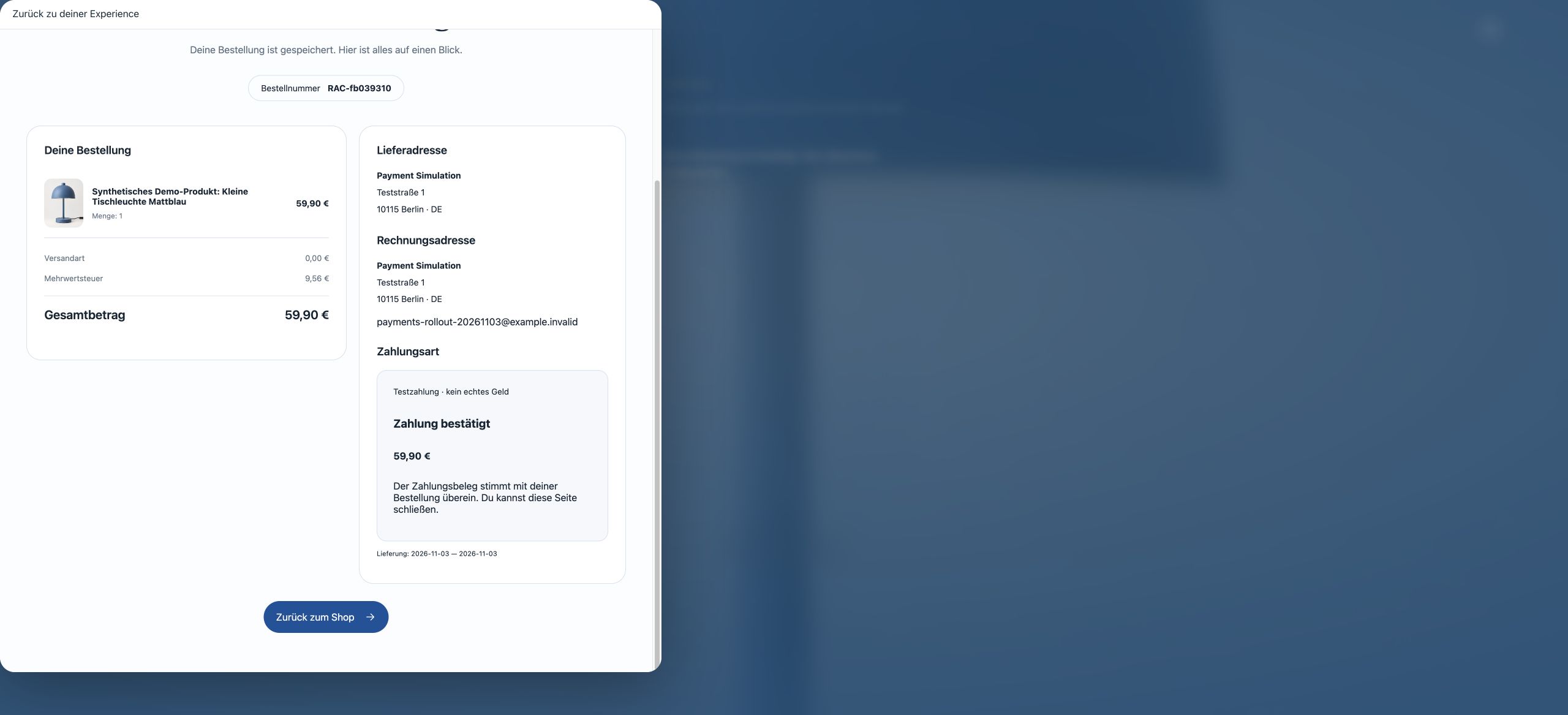
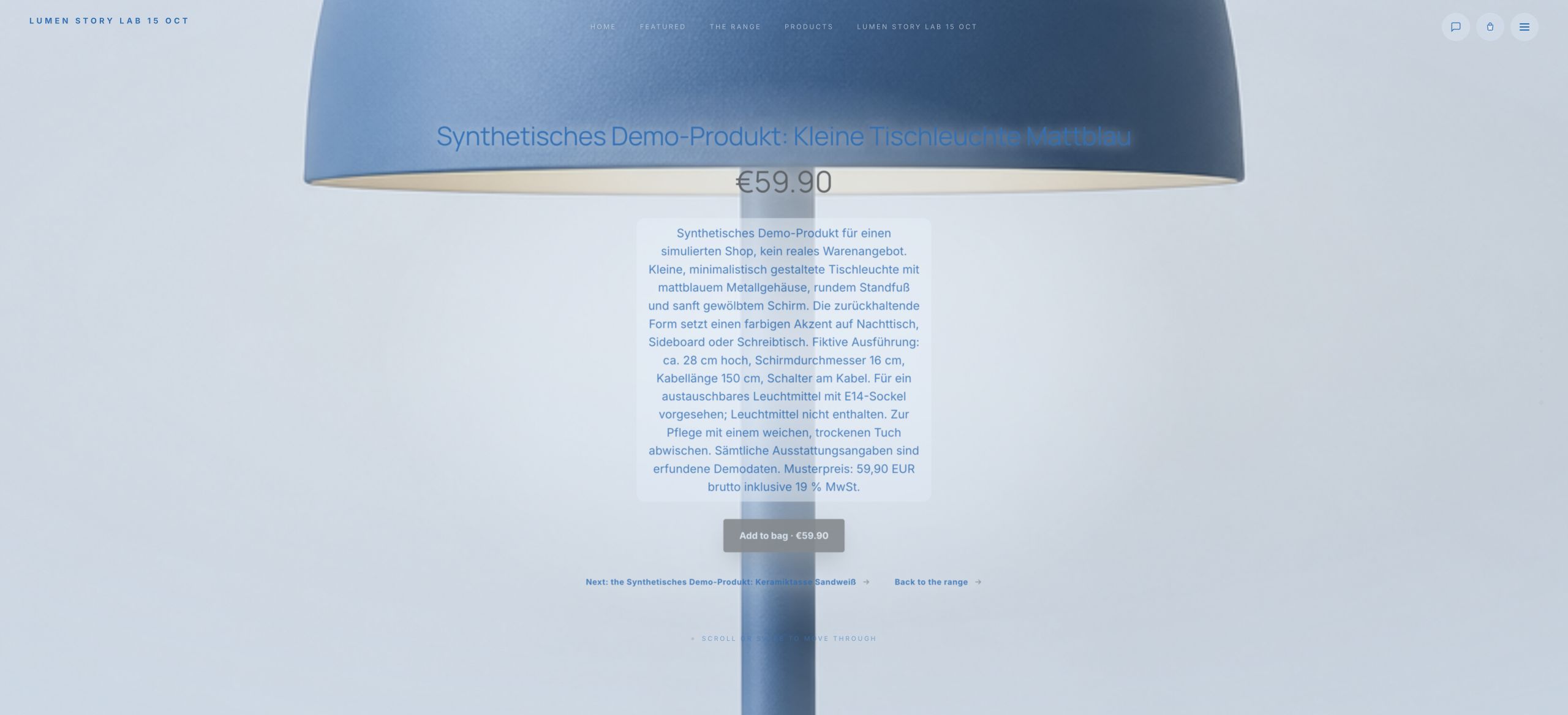
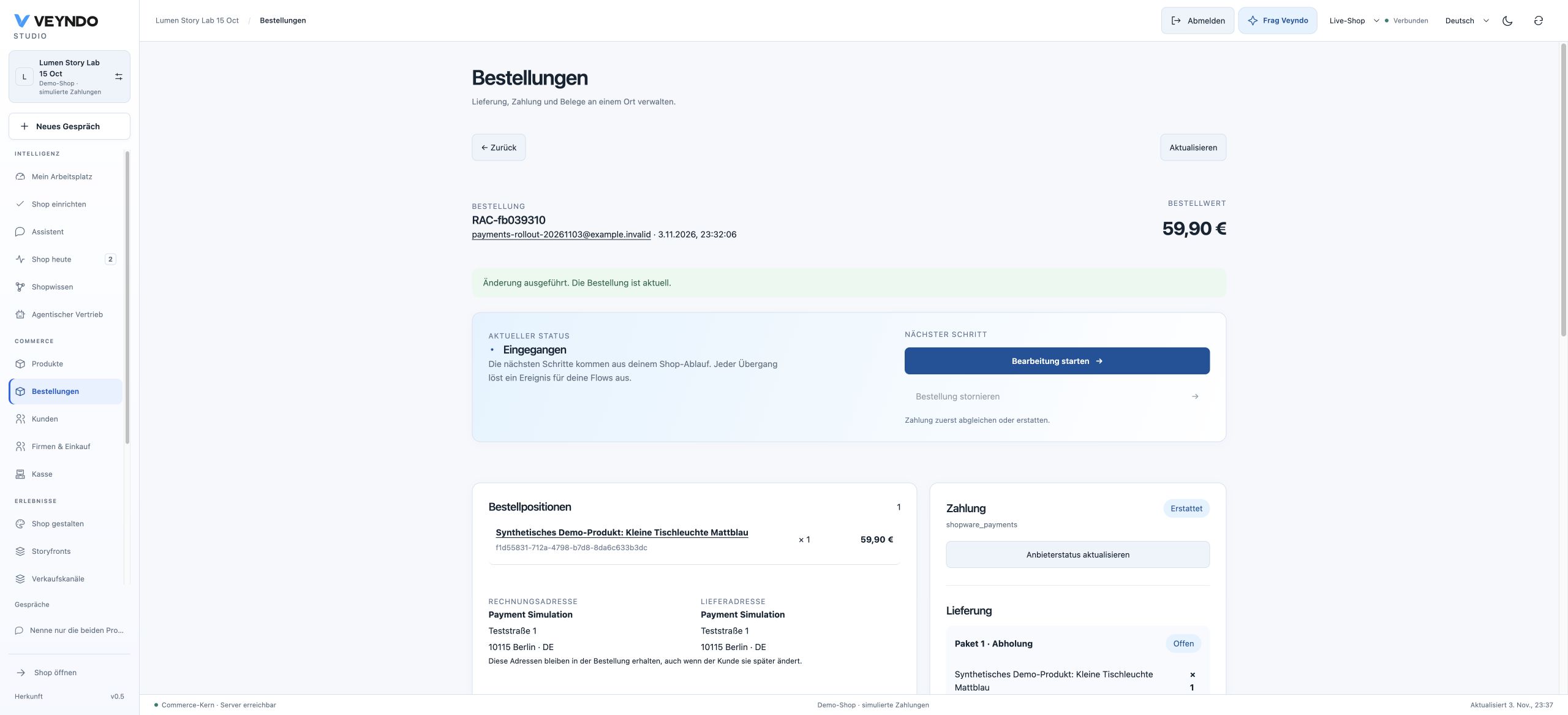
Original Storyfront order RAC-fb039310 completed its embedded native checkout and nested private card form for EUR 59.90. The native confirmation showed payment confirmed. Returning to the Experience closed the checkout and left the original bag empty, including after a full page reload. Studio then confirmed EUR 0.01 and EUR 59.89 refunds. A further provider-status refresh retained refunded and removed the refund-entry controls.
The browser tooling reported a paused document response. A fresh Storyfront tab loaded native checkout; opening the existing provider document once and retrying the same nested payment session recovered its form. No second order or payment was created. This records the observed recovery rather than claiming an uninterrupted first-load browser run. An expired Studio session was renewed through the existing start workspace and its same-account resume control.
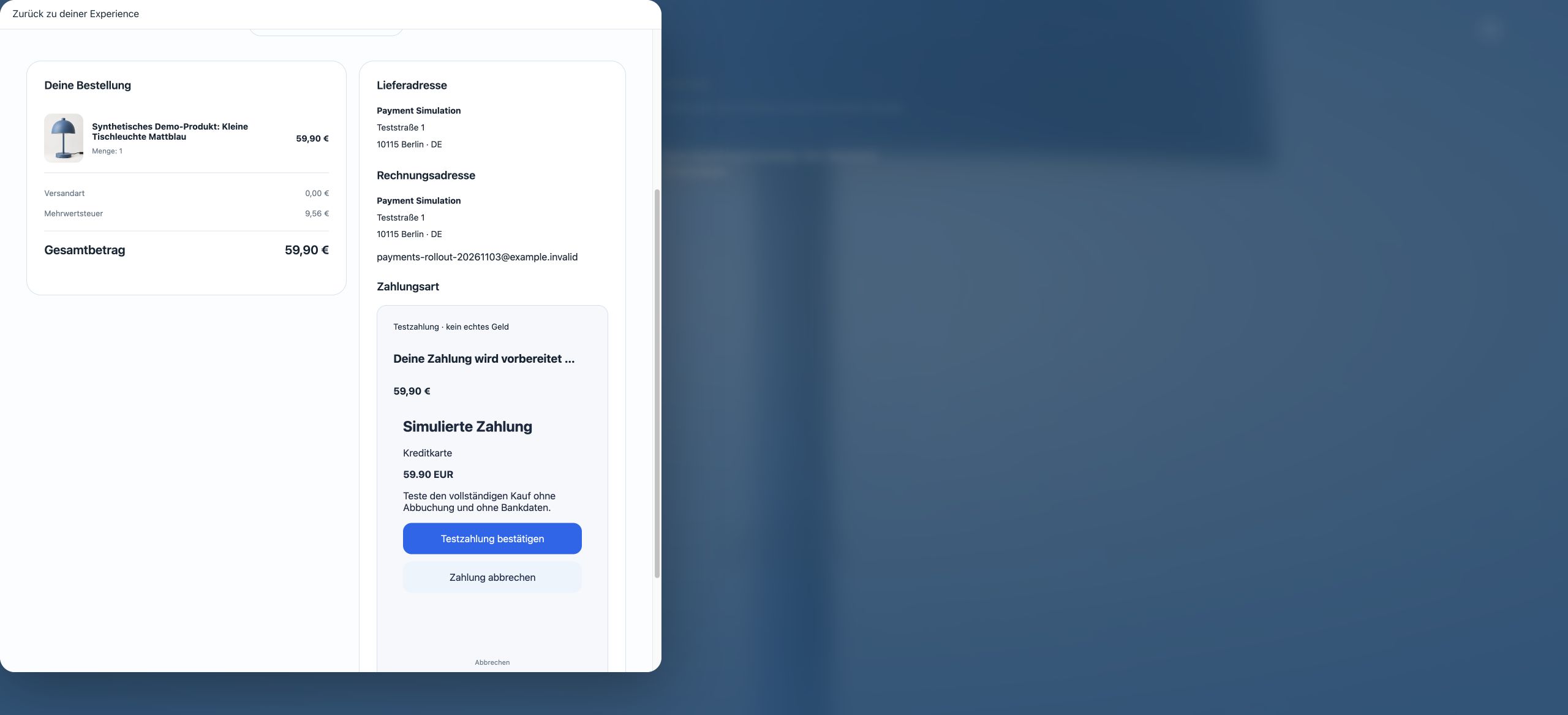
Confirmed payment · Empty original bag after reload.
Machine-readable result. This accepts the new Core against the existing private runtime. Private migrations 003/004, its encryption key and the 1.6.0 runtime/configuration rollout remain pending. Saved-method 1.6.0 and invoice 1.5.0 acceptance are separate.
Comparison with Shopware
The official Shopware Payments guide describes account/channel setup, immediate/manual collection, payment methods, transaction management, Flow actions, express checkout, Pay Later placement, vaulting and wallet configuration. Matching the native ledger backbone is not a claim of complete feature parity.
Completed hosted steps and remaining provider work are tracked explicitly:
- [x] Deploy the private provider service with its own restricted database access, HTTPS UI origin and native Core connection. Hosted simulation is online. Provider Sandbox/Live additionally require approved partner configuration and callbacks.
- [x] Connect the authorized PayPal platform Sandbox seller and accept native and original Storyfront wallet purchases, capture, return, basket clearing and exact partial/full refunds. This uses Veyndo’s own Sandbox platform configuration.
- [ ] Accept actual provider authorization, void and cancellation outcomes separately.
- [ ] Accept each enabled card/wallet/redirect method, including 3DS outcomes, country/currency eligibility and uncertain responses on that actual service.
- [ ] Complete original express/payment messaging controls through the existing versioned configuration. Native manual collection already has the separately recorded local Klarna browser acceptance above.
- [x] Implement externally initiated completed-refund reconciliation, with signed capture-link notification, native job binding and duplicate/changed-receipt rejection. Both actual Rust services pass against a local HTTP provider fixture; external PSP acceptance still requires the authorized account below. Native regression evidence.
- [x] Implement locally accepted customer-present saved methods, multi-capture, per-capture refunds and read-only transaction/fee details. These changes are merged into main. The saved-method and invoice schema/configuration rollout completed on 4 November; method-specific provider acceptance remains separate.
- [ ] Complete merchant-initiated recurring lifecycle, dispute reconciliation, broader reporting and shipment tracking.
- [x] Accept the public original Storyfront embedded card simulation through the actual hosted private provider, return, empty original cart after reload and complete native merchant refund on 3 November.
Shopware supplies a test account in its own integration. Access to the original source does not supply the approved partner credentials for a standalone Veyndo service. Apple Pay is not supported in that Shopware test account; its domain registration uses an active production account. Real charges are outside this acceptance. The 4 November wallet journeys above use actual PayPal Sandbox; earlier journeys use simulation.
The PayPal currency reference explains the whole-unit currencies. Additional merchant eligibility and currency receiving preferences are applied by the provider, not inferred from a manifest.
Repeating the local test
Build the public Core and private connector. Version 1.2.0 also provides
SWP_SIMULATION_ONLY=true for the hosted simulation cases, including execution of
the shipped checkout document with Node 22. Use a separate throwaway database for
each invocation.
For the original-shaped provider regression, in the private repository run
COMMERCE_ROOT=/absolute/path/to/veyndo python3 tests/local_stack.py. Supply a
throwaway DATABASE_URL or the test container and DB_PORT. Do not point the suite
at a merchant database. It removes its own automatically created database on exit.
SWP_BROWSER_ACCEPTANCE=true retains the isolated test processes for a browser
journey and writes only the local shop/provider URLs to .run/browser-acceptance.json.
Stopping it cleans up the isolated database.
See checkout, payment provider API, testing and the current product status.
Hosted deployment, 3 November 2026
The private Rust service runs in simulation with schema versions 1 and 2. Its dedicated runtime login has neither ownership, superuser, role administration, database creation, role inheritance nor RLS bypass. Temporary maintenance access was removed after migration and verification. Core resolves the versioned service through the existing payment and app contracts; no provider source is shipped in the public Core.
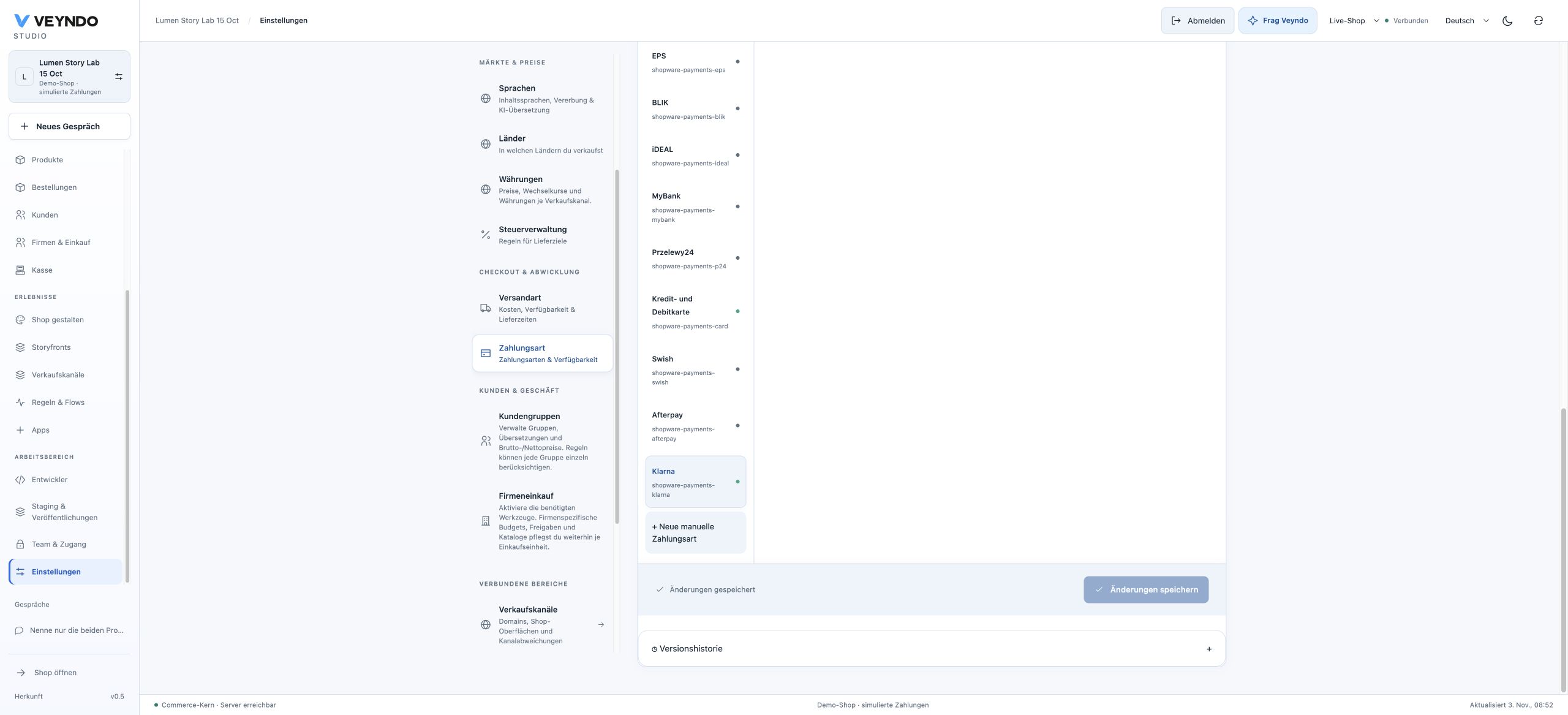
Synthetic merchant onboarding succeeded. Enabling the expanded method catalogue exposed the ordinary 64 KiB settings request limit. Only shop and channel settings now allow 1 MiB, with a structured JSON rejection above that limit. A targeted real HTTP test covers the larger catalogue, the unchanged ordinary route limit and the oversized settings error. The completed public original Storyfront card journey is recorded below.
Public original Storyfront purchase and refund, 3 November 2026
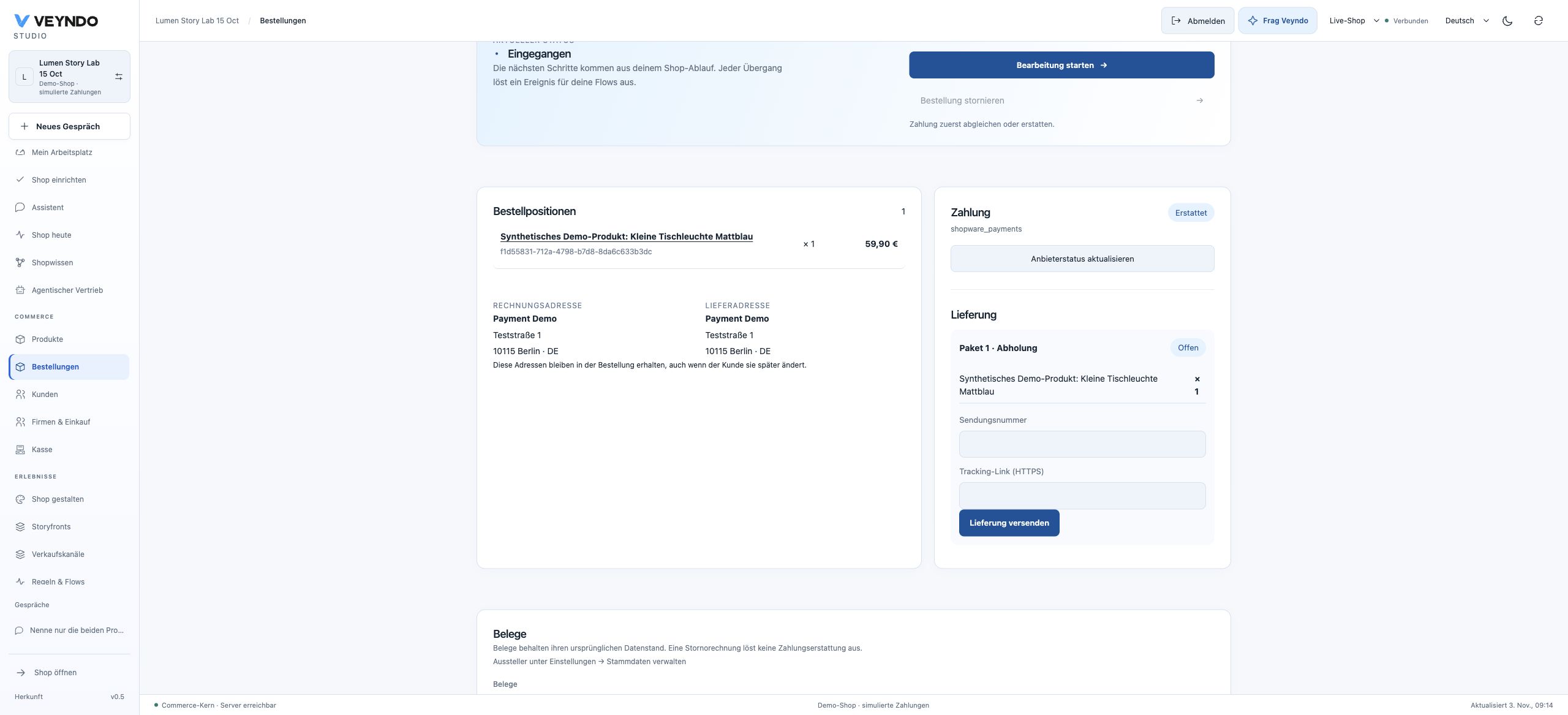
The public Lumen Storyfront created RAC-ef438264 for one synthetic Mattblau lamp, EUR 59.90, with pickup, zero shipping and EUR 9.56 included tax. The German order confirmation retained the German product name. The actual native checkout appeared inside the original Storyfront, and the private payment service's card simulation appeared in a second nested frame. Explicit test confirmation changed the native payment to captured.
The normal browser-controlled tab initially held a frame document response. The same public journey completed through the actual native Chrome interface without changing authentication, frame security or application source. The user did not perform any manual testing. The provider form loaded normally in that journey.
Returning through Zurück zum Shop closed the embedded checkout and updated the original Storyfront bag to zero items, with its completion message. Reloading the original Experience and opening the bag again still showed zero items.
Native Studio requested a EUR 0.01 partial refund, observed partially
refunded, then requested the exact EUR 59.89 remainder. The same order showed
refunded. Refreshing the provider status retained that confirmed final state.
The history also records the native order.placed and payment.captured Flows.
The private runtime was observed at documentation revision
cdea3552fc39ccaf4dee1e7952dfa5ba5c8a8a47, retaining the implementation first
hosted at 9511263faa8ababb01fb87f836ddd9a68127686e. Public Core ran
1f8c2a45b55dc1bcc00944e36a352299b06c517e, build auspicious-key-6715.
Only the shop/channel settings routes receive the 1 MiB allowance; the full
catalogue now saves successfully and ordinary request limits remain unchanged.
Saved method configuration · Structured observation.
This records public card simulation through the original Storyfront. The 17-method contract, local concurrent coverage and local SEPA/Klarna journeys retain their separate scope. Real PSP Sandbox/Live approval and complete original feature parity remain in the comparison above. No bank or card network was charged.
Deferred invoice implementation, 1.5.0
The feature branch adds source-backed invoice creation, pending-review recipient instructions, restart and lost-response recovery, exact native refunds and scoped HTTP/MCP reads. Actual local service/PG and explicit 17-method simulation checks passed. Detailed contract and rollout prerequisites. This does not change the public Storyfront acceptance recorded above. External provider tests remain deferred; no provider login or saved credential is needed.