
English source · 5 min
Invoice checkout and recipient details
Shopware Payments contract 1.5.0 adds the original deferred invoice flow to the private Rust provider. The customer enters date of birth and telephone number inside the short-lived private payment form. The provider order is created only after submission, using the complete invoice source and the original processing instruction. No PayPal approval link or second capture request is invented.
What the customer sees
The form shows whether the invoice is still being checked. Recipient details can arrive while the capture is pending. Bank name, recipient, IBAN, BIC and payment reference then appear without declaring the payment received. The normal native payment status remains authoritative. Final recipient details also remain available in the order completion checkout, outside the private frame.
The recipient display supports English, German, French and Spanish and was inspected at desktop and 390-pixel checkout width using marked example data. Simulation uses a separate explicit approval/cancellation choice and synthetic recipient details. Its display says Do not transfer money.
Ownership and integration
GET /store-api/payments/{id}/instructions requires the original checkout
capability. GET /api/payments/{id}/instructions and MCP
merchant.payment.instructions require current payments.read, orders.read
and customers.pii. MCP checkout.payment.instructions uses the same customer
capability. Unknown methods return an unsupported result. Payment-only transaction
inspection continues to omit bank, payer and customer fields.
The optional instructions method capability is frozen in the native payment
attempt alongside account, invoice, environment and adapter version. The Core
validates a typed recipient projection, bank checksum and reference bounds.
Validated instructions are cached immutably in the existing payment context.
They do not change the native monetary state. The existing payment worker, signed reconciliation, history and
Flow events retain ownership of actual financial transitions.
Invoices, email and flows
The first validated recipient receipt emits payment.instructions.available in
that same native transaction. Reconciliation and restarts cannot emit a second
notification. A pending capture remains unpaid even when these details exist.
Native invoice generation freezes these details in the existing immutable receipt snapshot and prints a localized payment footer. Issuing an invoice before the provider supplies its recipient details returns a conflict before allocating an invoice number. Delivery notes and cancellation receipts never request payment. Document access keeps its existing private document and customer-data permissions.
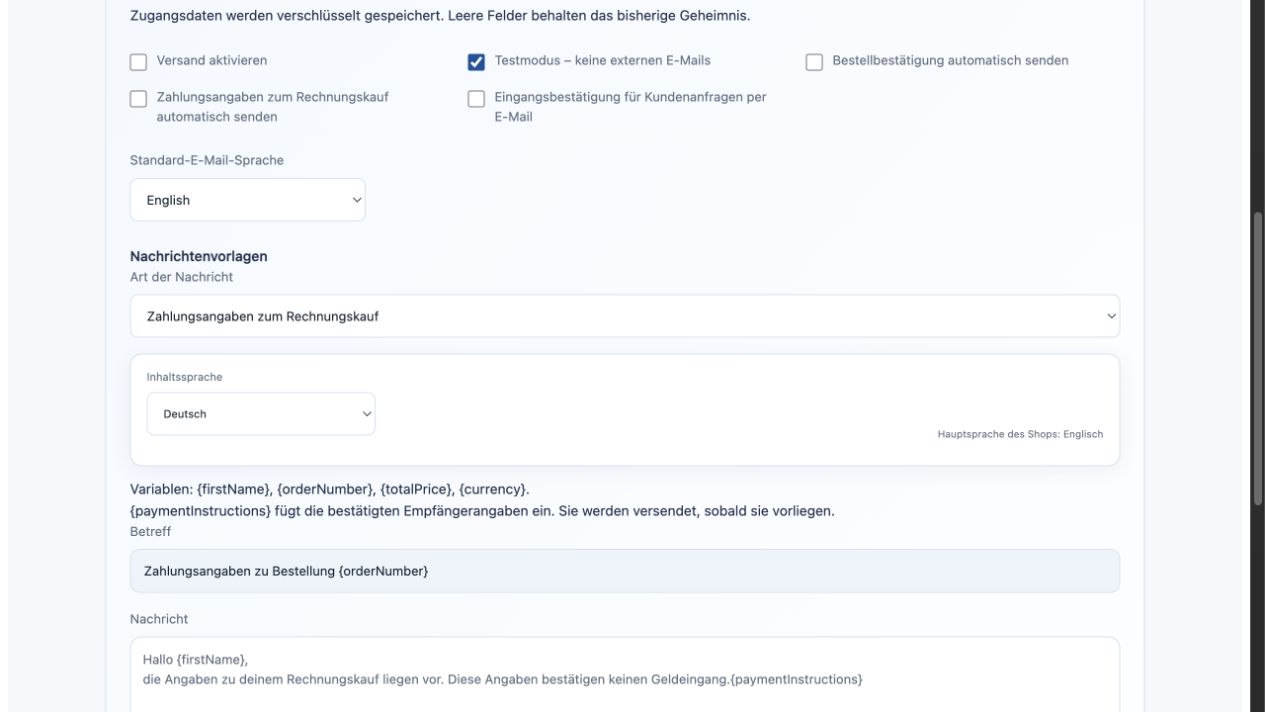
Email Delivery 1.3.0 offers a separate Invoice payment details template
and an opt-in automatic notification. Its {paymentInstructions} variable uses
the native amount, currency scale, recipient and reference. English, German,
French and Spanish templates are editable through the same content-language
picker as order confirmations; HTML substitutions are escaped. Simulation details
explicitly prohibit money transfer. Queue payloads remain encrypted.
The added app capability payments.instructions.read requires current
payments.read, orders.read and customers.pii at package approval. Event
projection discloses the recipient only with that exact app capability plus
customers.pii. Existing Email 1.2.0 remains approved without receiving this new
capability; upgrading to 1.3.0 requires review of its new permissions.
The graphical Flow Builder can target Email Delivery → send_payment_instructions
on the same event. The existing HTTP/MCP action gateway requires the same current
compound rights. Stored Flow job definitions omit bank instructions; execution
reloads the original order's evidence after checking the actor's current rights
and the installed app's explicit permissions. Choose either automatic notification
or a Flow for the same business message to avoid intentional duplicate sends.
Local template view
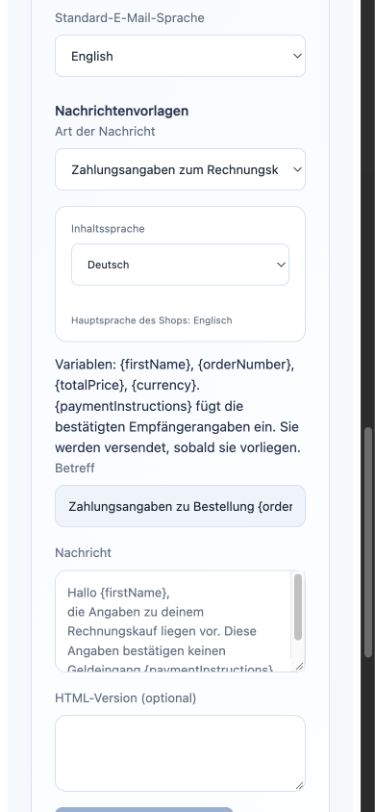
These screenshots show the actual Email Delivery component with synthetic settings, using the Studio styles. They are a component visual check, not a hosted provider-account test. The 390px view has no horizontal form overflow.
Recovery and cancellation
A stable private handle is created before the provider order exists. The private service links the eventual provider order without changing that native handle. Date of birth and telephone number remain transient; a committed payload digest prevents a lost response from being retried with changed input. The same request key recovers the original submission. A verified order webhook can also recover a lost response after a fresh account-bound invoice read, without a second create.
The existing durable notification queue polls unresolved invoices across restarts. It does not send a capture command. Accepted recipient details are immutable. Before submission, cancellation prevents any provider create. After submission, unconfirmed outcomes retain their native payment and stock reservation until the provider confirms settlement or a terminal outcome without funds. Refunds use actual owned captures and the same exact native refund budget.
Version and acceptance
The private service needs migration 003 before its strict runtime starts. It adds four columns and one fixed index to the existing shared attempt table. No merchant, app or transaction receives a separate table. The restricted runtime keeps its existing grants; a migration owner applies the schema. Preserve older adapter versions for historical payments when adding 1.5.0 to service configuration.
On 3 November 2026, actual public Core and private Rust services with isolated PostgreSQL and local provider HTTP passed deferred creation, immutable recipient instructions during capture review, current HTTP/MCP rights, foreign-cart/tenant denial, same-key response recovery, verified webhook recovery, restart, verified cancellation and exact partial/full refunds without a capture POST. The same actual-service test additionally accepts pending-invoice conflicts, immutable PDF snapshots, exactly one encrypted automatic mail and a separate Flow-triggered mail using reloaded recipient evidence. Targeted tests cover app projection, HTML escaping, four message languages and exact currency precision. The simulation matrix exercises all 17 methods using contract 1.5.0 with zero provider requests.
This release is merged into main. Hosted schema migration and service rollout completed on 4 November. Actual provider invoice acceptance remains separate from the accepted PayPal wallet purchases/refunds. Customer-present saved methods are implemented in contract 1.6.0 and have their own migration and acceptance record. Merchant-initiated recurring payments and remaining express/wallet configuration are still open. The public Storyfront card simulation acceptance retains its original observed release and scope.
Provider form completion, 4 November 2026
The private invoice form now loads the official PayPal legal component in a separate SDK namespace and FraudNet for the server-bound checkout session. The same opaque correlation is sent with the original order request. Submission stays disabled if required provider information fails to load. The request uses the supported German recipient locale and physical goods only.
Documented provider rejections show the specific customer-facing explanation and Ratepay privacy/contact links. A definite rejection becomes a durable no-funds cancellation; a lost response retains the original input and request identity. The targeted local Rust/Core/PostgreSQL flow passes instructions, native invoice PDF, automatic and Flow email, restart recovery, cancellation and exact refunds without a second capture request. Actual hosted provider approval remains separate from these fixtures.