
English source · 5 min
Flow proposals in the personal workspace: 21 October 2026
This check uses the ordinary public Studio, its configured OpenAI provider and a private synthetic shop. Local provider fixtures are listed separately below.
Original event and retained proposal
In private workspace stage-b6a9474f38cd4d53a73a, a single edit to the test desk's
German short description emitted product.updated. Flow
flow_native_work_20261021 prepared exactly one native operation:
merchant.category.create, ID flow_review_20261021, English name
"Flow review 21 October", active, hidden, type folder. The public Flow history
showed completion and the reviewable operation. Preparation did not create the
category. The Flow was then deactivated so later test cleanup cannot retrigger it.
Core/Studio 67bc91c retained this proposal, but the personal workspace showed zero
proposals. The UI passed the parent shop request to the task list while its header
showed the private environment. The repair uses the selected environment for task
reads and approvals and the parent shop only for personal layout preferences.
Approved queued, running and interrupted tasks also remain in the original actor's list after reload. A read-only execution marker reconnects the existing progress card; it does not approve or execute the task again. Current tenant, actor and permission-ceiling filters still apply.
Public execution and reload
Public Core/Studio 09b1aa35, image giving-insect-7440, started at 19:04 CEST
with one healthy replica and no restarts. A fresh Studio load showed the original
retained proposal in the selected private workspace. After inspecting its one
operation, one explicit approval completed the native task at 19:07:41 CEST.
- The original progress card reported Approved work completed, one completed action. A full browser reload restored that same completion without a new approval.
- The native category editor showed exactly one "Flow review 21 October" category: root folder, position zero, active, hidden from navigation, history revision one.
- Switching to the parent live shop showed only its original categories. The private category was absent. No publication was requested.
- The temporary product-description marker was removed and the original German text saved again. The Flow was already inactive, so cleanup cannot schedule a second proposal. The test desk remained EUR 349 with stock five.
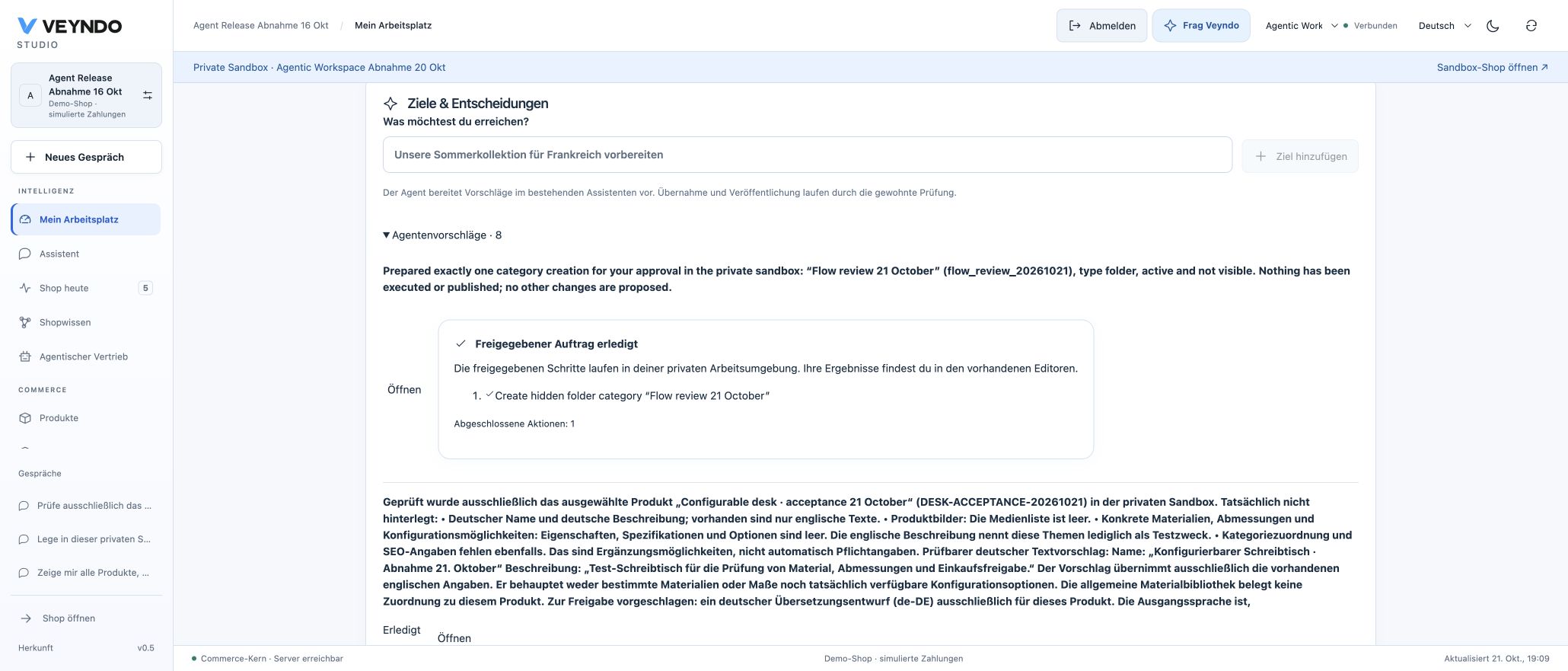
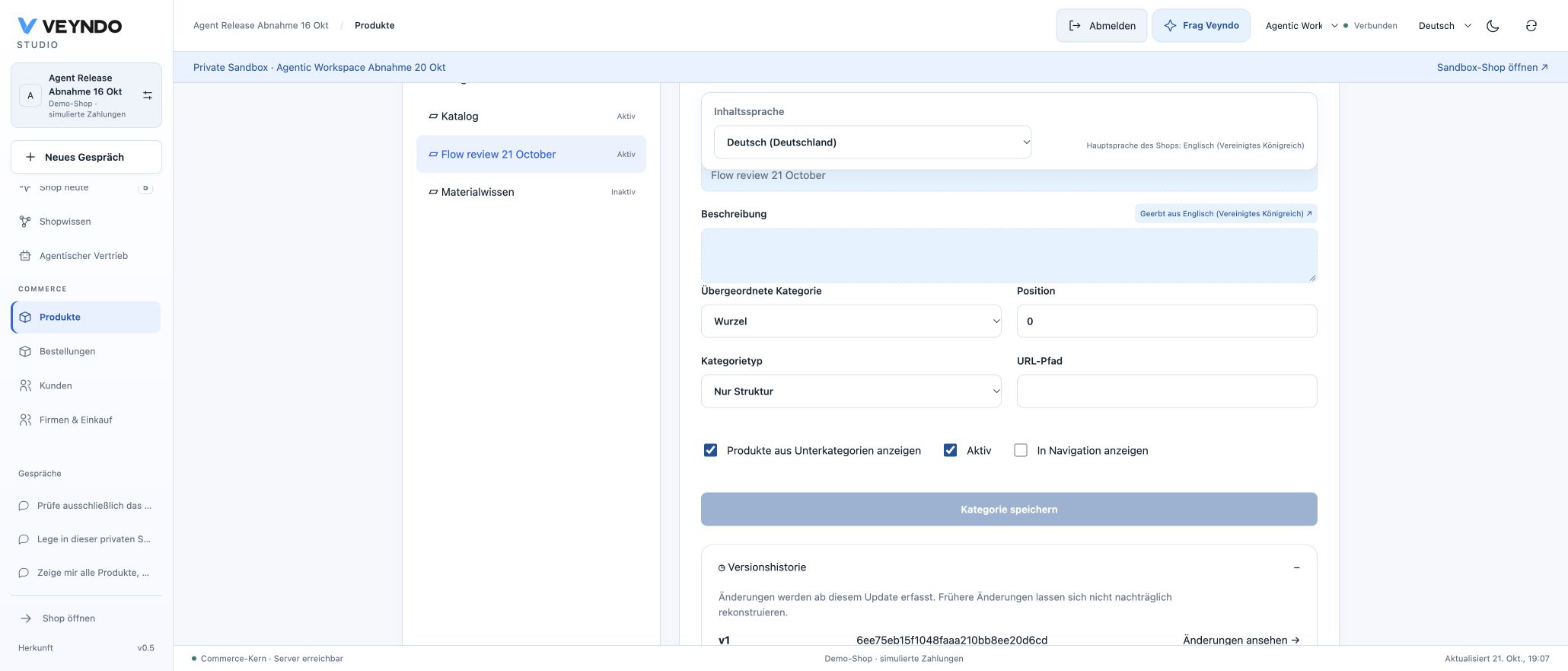
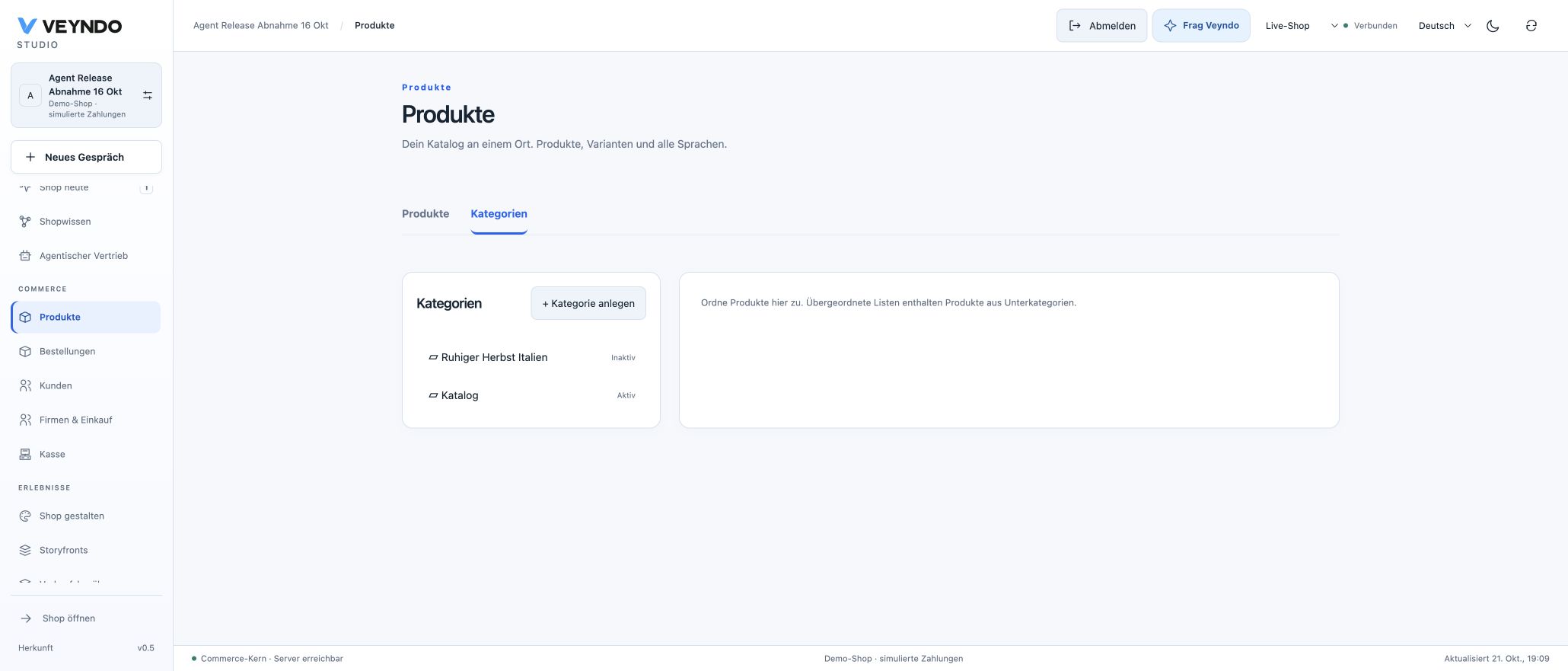
This is an actual configured-provider proposal and native private write in public Studio. It is not a simulated local model or a real payment acceptance.
Regression verification
- 758 frontend tests, including rendered private approval versus parent layout storage, environment switching, stale responses, task reload and worker progress.
- All Cargo workspace unit tests, Clippy, production build, formatting, formal checks and mutation rejection passed.
- 27 actual PostgreSQL/HTTP durable-agent cases passed: original product event, direct/graphical Flow, queued/completed work, killed-worker continuation, cancellation, duplicate approval, unchanged parent data, current permissions, emergency stop and late model results after lease expiry.
- Four-language UI and source-boundary checks passed. Frontend checks ran from an identical temporary source/dependency copy because macOS esbuild stalled while opening the original Documents parent directory.
The observed public review also exposed a misleading read-only notice for accepted or completed work. A shared review-card correction suppresses that notice and the duplicate approval button once execution has started. Actual read-only review remains blocked. The final frontend suite includes this distinction. A flaky onboarding test now waits for the existing consent review to enable installation before clicking; it does not weaken or skip the real consent check.
Public review follow-up
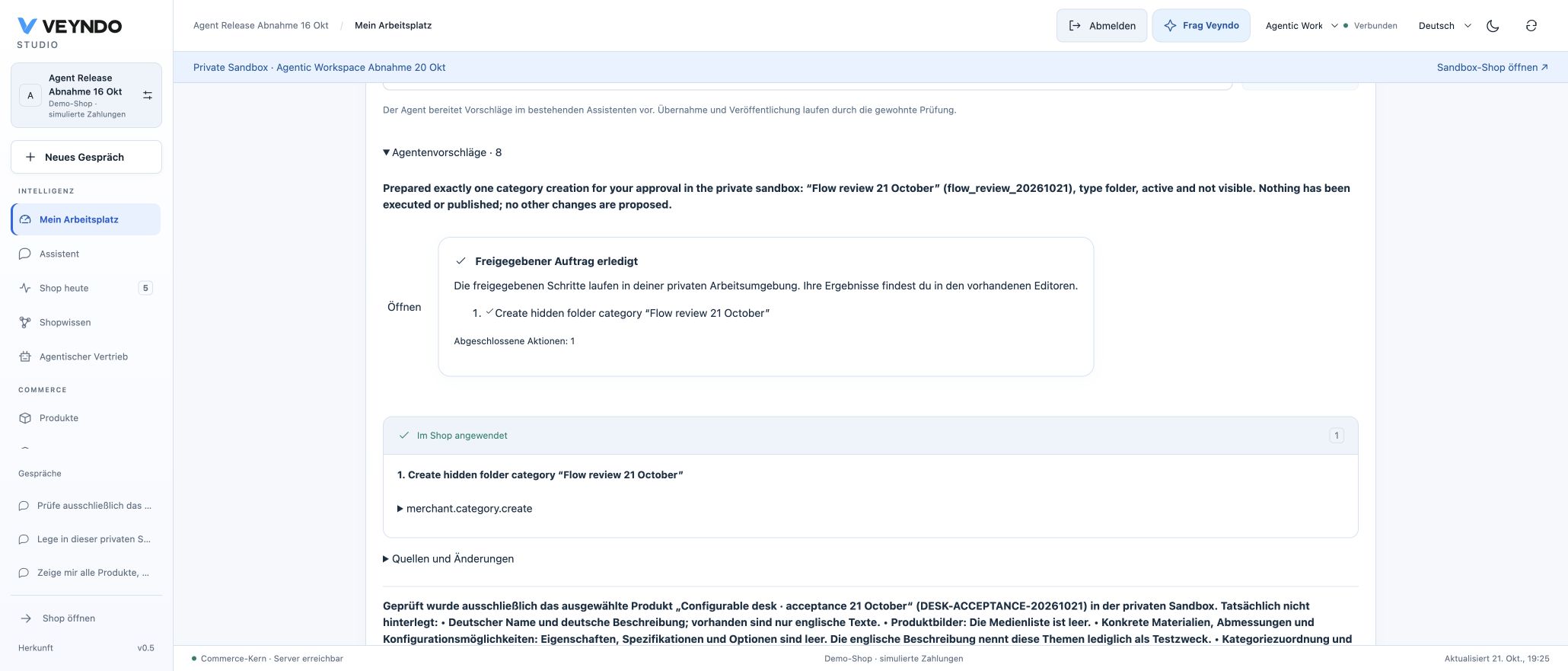
Public image oval-station-7696, commit 4ec94006, passed its health check on
21 October. A full browser reload and opening the original completed proposal
showed one completed operation and “Im Shop angewendet”, without another approval
button or the misleading read-only notice. The private environment remained selected.
Direct Flow-history acceptance
Public Core/Studio 4c0392ae, image pure-minute-7985, started on 21 October at
19:37 CEST with one healthy replica and no restarts. After a full Studio reload,
the direct Flow history showed the original task as Freigegebener Auftrag
erledigt, one completed action and Im Shop angewendet. The original private
workspace remained selected. No new approval, model request or commerce write
was needed. The direct history and personal workspace now use the same durable
progress card and current-permission control checks.
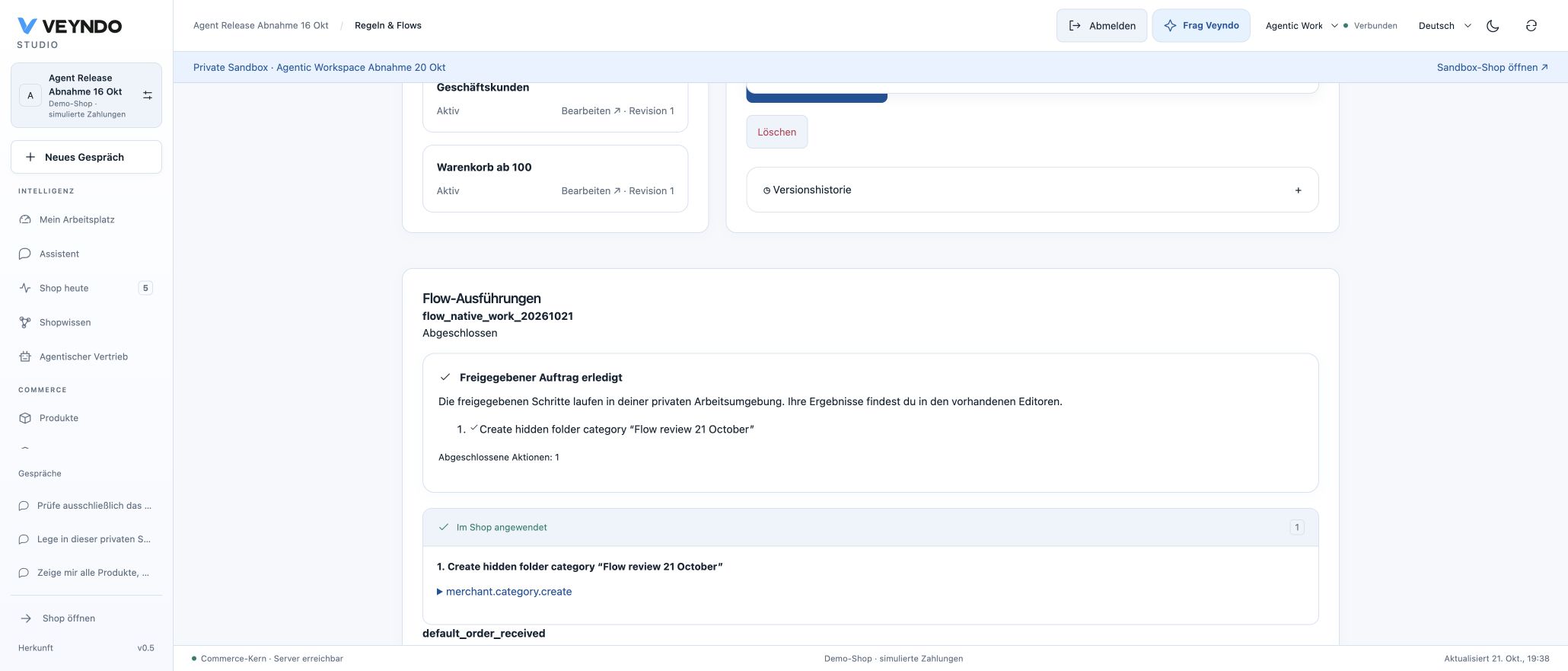
The final regression run passed 761 frontend tests, 27 actual PostgreSQL/HTTP durable-agent cases and 43 tenant-isolation cases, plus workspace Rust tests, Clippy, formatting, formal checks, mutation rejection and source boundaries. Rendered tests cover queued approval, completion, explicit continuation after failure, withdrawn controls and legacy immediate proposals. This public check covers the direct Flow history; nested graphical-pipeline result presentation is not separately claimed by this screenshot.
Reusing completed work: public acceptance
Core/Studio 650529c7, image aromatic-voyage-2152, was deployed on 21 October
at 20:22 CEST. Northflank reported one passing replica with no restarts. The public
Studio journey used the existing Agentic Workspace Abnahme 20 Okt private shop
and the completed category task above; no new identity or access was created.
- Als Flow wiederverwenden opened an inactive native Flow draft. The source
category ID was mapped to a generated per-run reference. The daily limit was
explicitly set to one.
repeat_work_20261021saved inactive at revision one, then activated at revision two. - A reversible German description edit on
DESK-ACCEPTANCE-20261021emitted the ordinaryproduct.updatedevent. The Flow history showed one fresh Bereit zur Prüfung proposal with the new category IDwork_489931d9c5da55d1a2323f0c. It had its own approval button; preparation did not apply the change or reuse the original approval. - Personal approval started the existing native worker. A full browser reload retained Freigegebener Auftrag erledigt, one completed action and Im Shop angewendet in direct Flow history.
- The native category editor and its history showed the generated ID at revision one, created at 20:28:14 CEST, active and hidden. The original category remained separately present. The parent live category list contained neither Flow test category.
- The Flow was deactivated at revision three before restoring the product's original German description. Product price remained EUR 349 and stock five. No publication, payment or external message was part of this test.
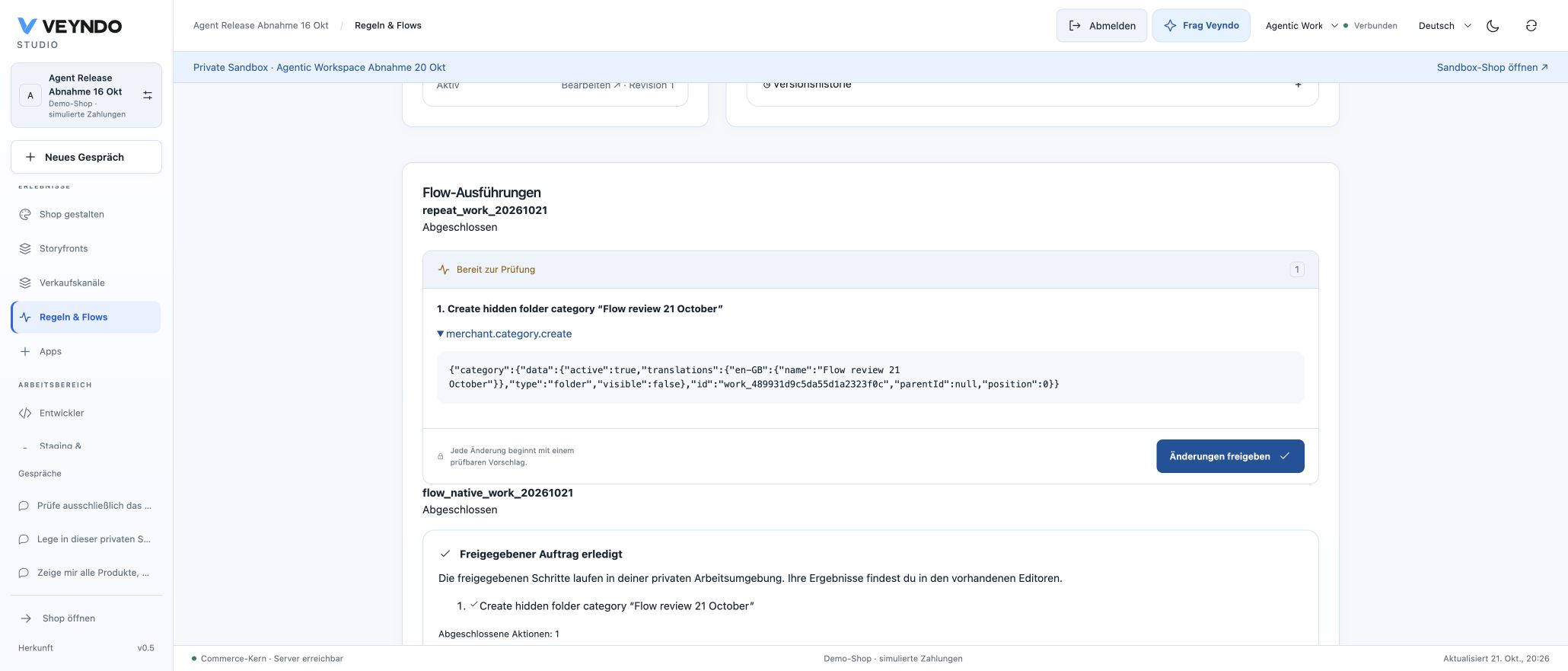
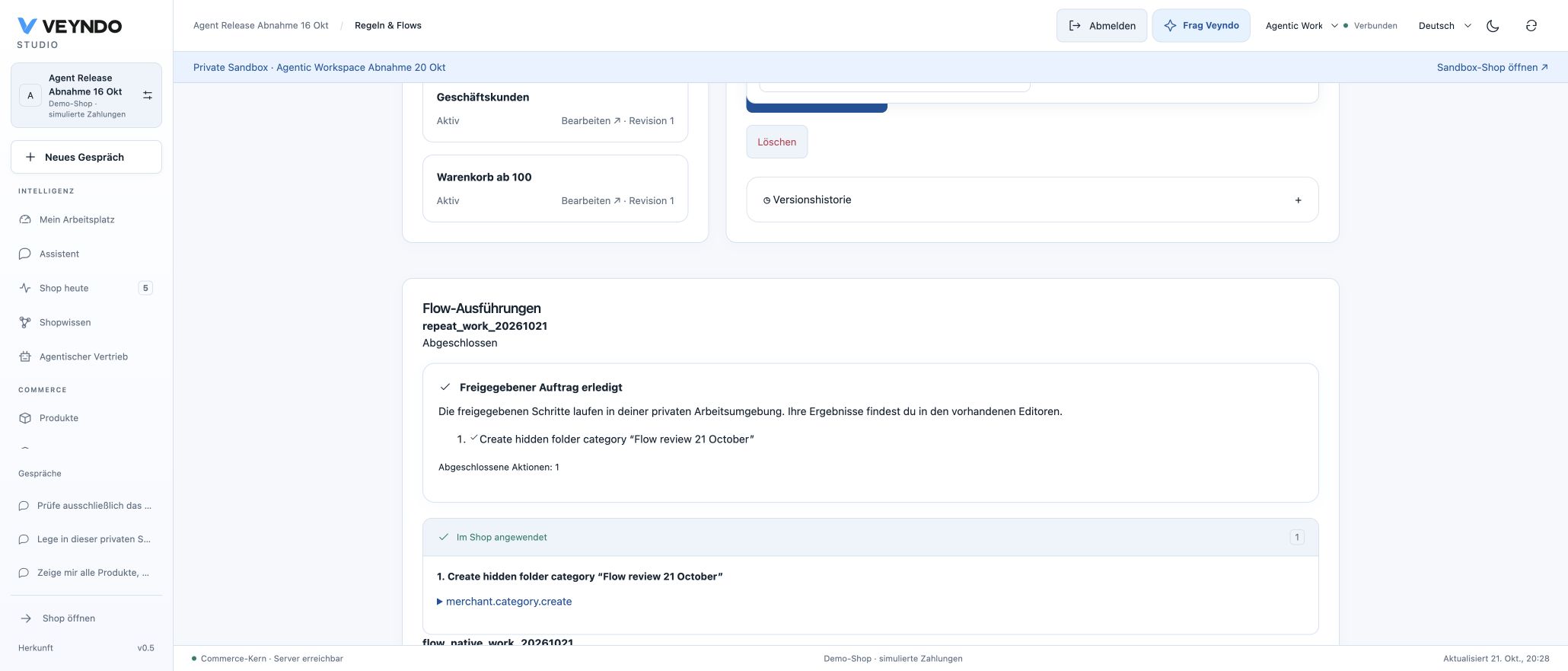
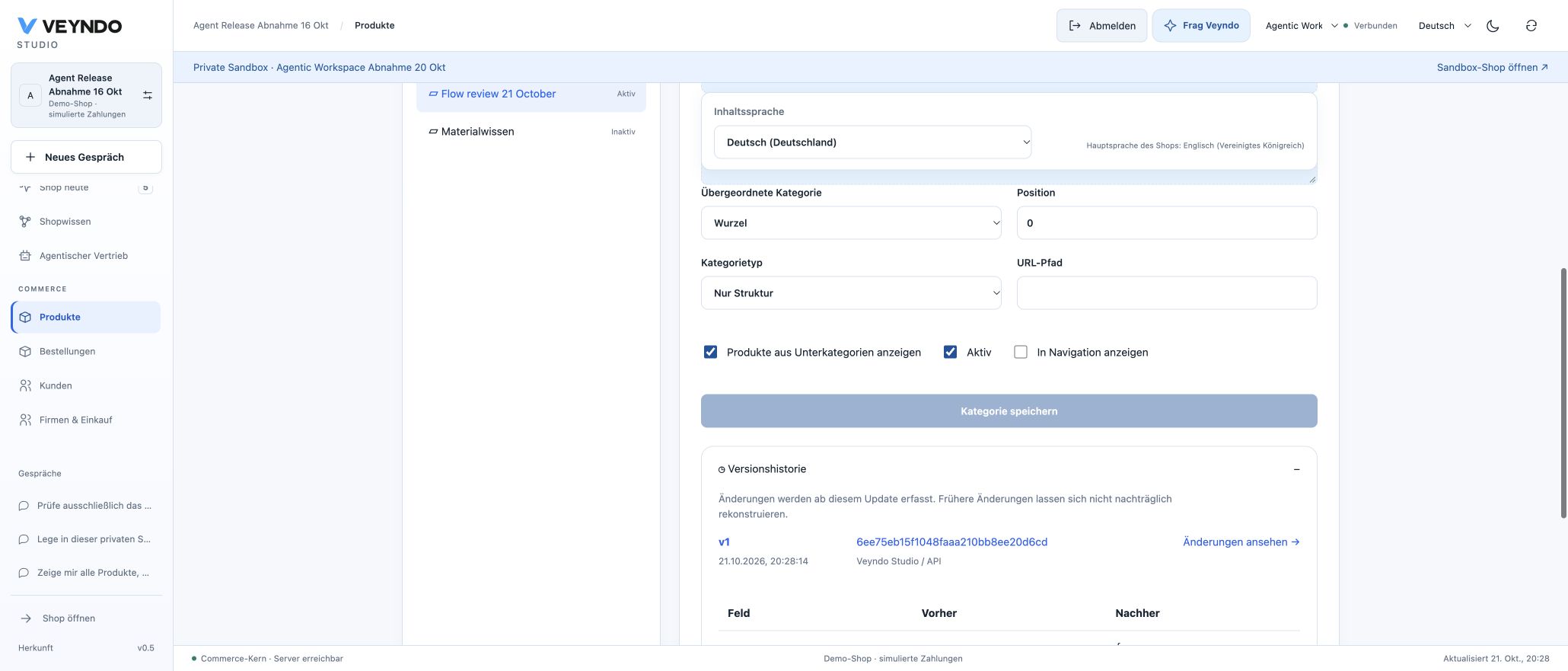
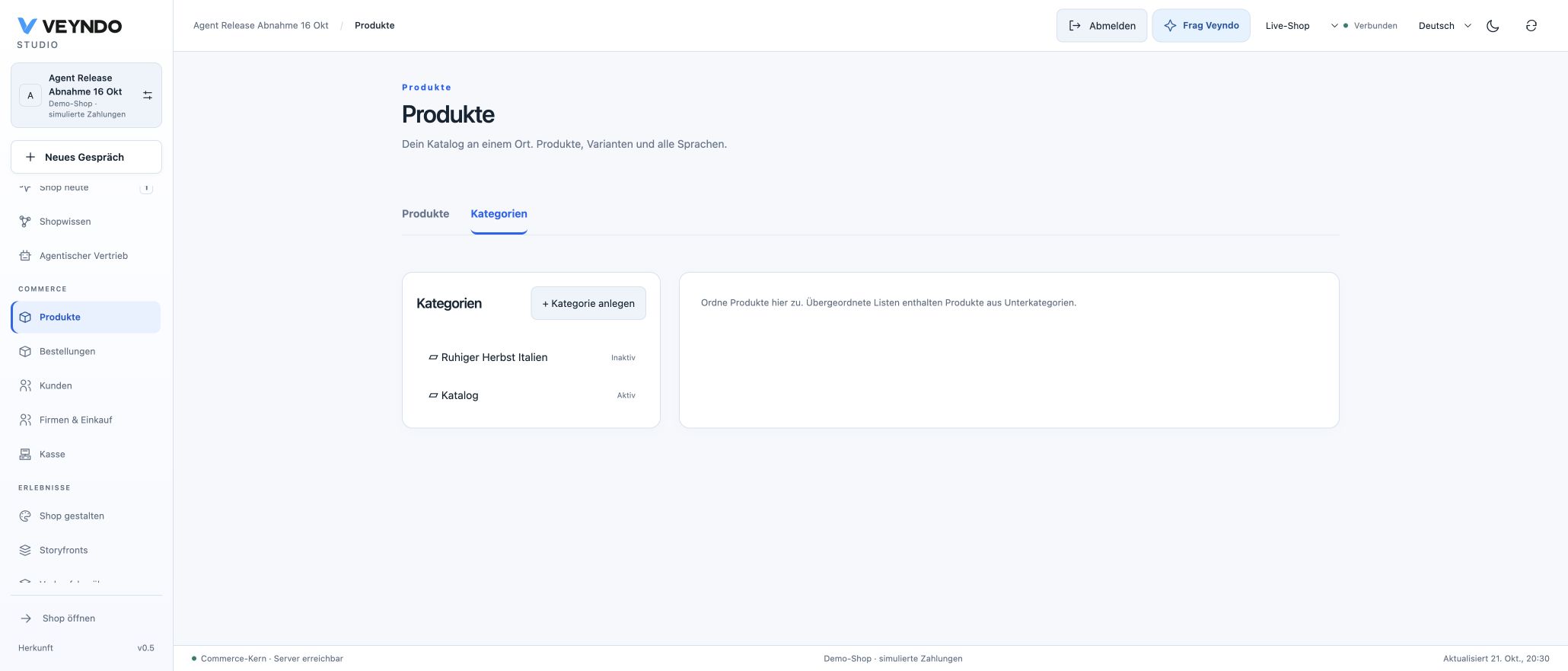
Local verification passed 768 frontend tests, 31 actual HTTP/PostgreSQL durable-agent cases and 43 tenant-isolation cases, plus Rust workspace checks, Clippy, formatting, formal/mutation and structure/localization checks. The native cases additionally cover typed event mappings, replay, original-source privacy, missing event values, foreign workspaces, withdrawn rights, stop and two workers competing for the final daily preparation slot. These checks are additional evidence; the public screenshot journey itself used one generated reference and one native category operation.
Remaining scope
Repeatable native work is a direct Flow action for private configuration tasks. It stores a protected source reference, not copied private inputs; source tasks are neither publication units nor transferred to other shops. Every new proposal needs personal approval. It does not establish arbitrary autonomous live writes or historical order replay. The new preparation path needs no model call. Legacy Flow inference retains its existing uncertainty handling; this extension does not add durable model checkpoints to that inference path.