
English source · 4 min
Shared visual workspace acceptance, 2 November 2026
Scope: standard shop design and declarative App Studio. The source reuses native page/app documents, domain editors, central inference and existing release owners. It introduces presentation navigation and context/reference transport, not another app runtime, table family, job queue or publication owner.
Native acceptance
The existing scripts/app_generation.py suite passes against a real local Rust
server, isolated PostgreSQL database and synthetic model HTTP provider:
- Invalid selected elements fail before a model call; configured language and all-channel app scope are checked against the supplied Manifest.
- A valid decoded PNG request larger than 64 KiB reaches the actual image-provider transport through the bounded developer HTTP route.
- Private-network references are unavailable. Credential URLs and non-raster uploads are rejected. Raw references never become executable markup.
- Coding-agent HTTP export and canonical
developer.taskMCP carry selected context. Read-only API identities cannot generate/export developer work. - Immutable versions retain source status, URLs and digests after reload, without raw pixels or HTML. New permissions and accepted business contracts remain protected against hostile model edits.
- Native immutable save, real private preview, record upload/save/reload, explicit staging, selected package publication and a simulated order review pass.
Two Rust unit cases cover selected-context validation and redacted provenance roundtrip. Existing Lean verification and negative mutation checks retain their original kernel boundary; they do not prove a model, HTTP provider or UI correct.
UI acceptance
65 targeted frontend cases pass across shared scene navigation, native page drafts, app construction, proposal review, restoration, behavior and schema previews. They include independent unfinished pages and undo retention, stale environment replies, candidate preview without adoption, native app save/stage/release, archive/restore and the visible insertion target when a drop ends on canvas chrome. The full platform suite remains the daily workflow rather than a per-commit run.
Actual local Chrome actions use a synthetic merchant and private environment:
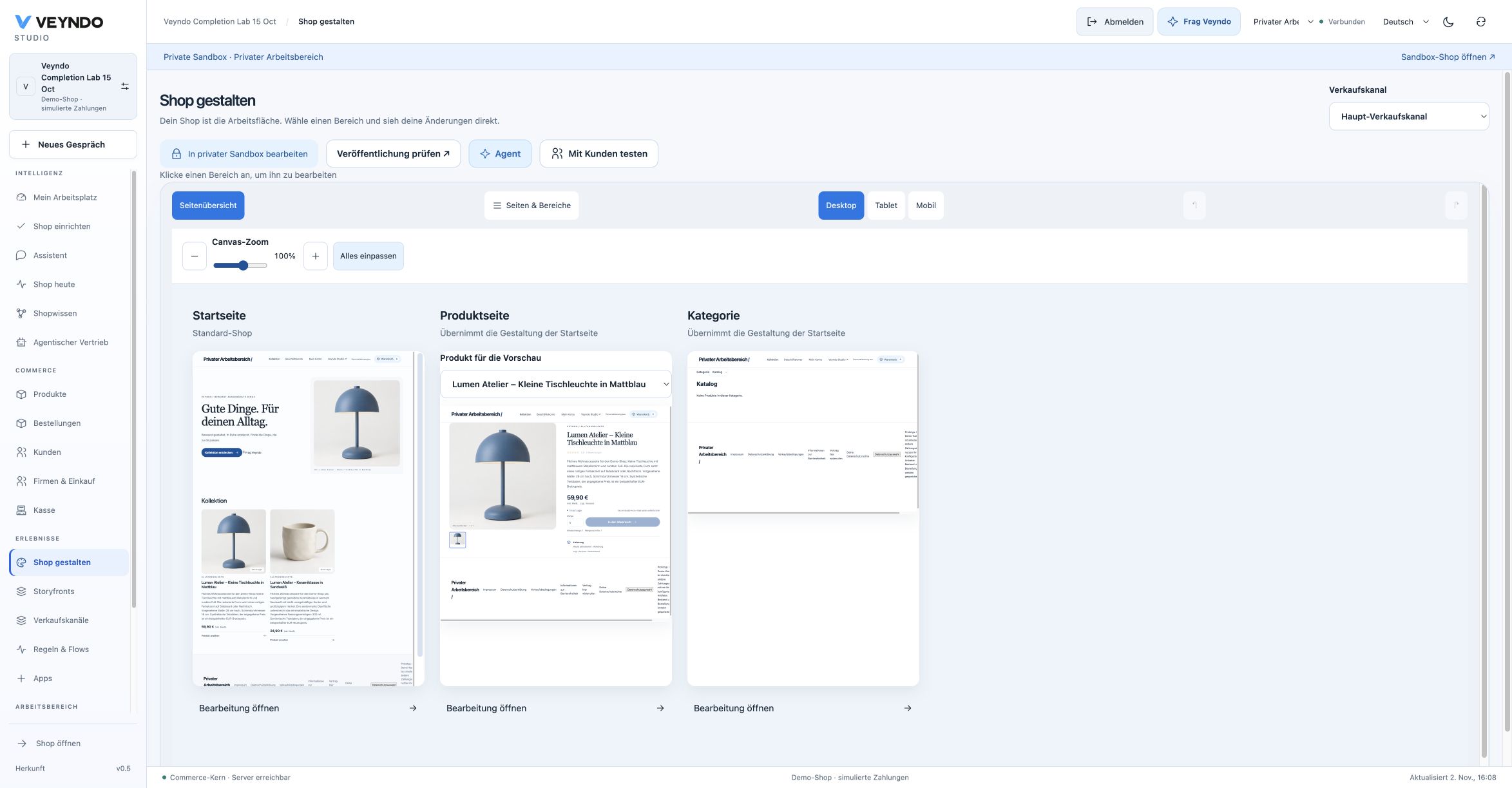
- Open the shared shop overview containing home, product, category and content.
- Open App Studio, edit a placement, add and duplicate a button and add a message through its graphical click-handler editor.
- Attach a screenshot, prepare a real native Codex task and inspect its visible
export: selected
button_2,workspaceview, German content language, one image and the exact edited typed handler are present. - Save a new immutable app version and confirm the native save result.
- Drag a palette item before the form, observe its actual first position, then undo. The original implementation incorrectly appended on an intervening canvas drop; the fixed journey and targeted regression both pass.
The separate three-placement advice package is synthetic demonstration content, saved through the native build API. App overview scenes explicitly use schema/ sample previews; the functional private preview remains a separate native action.
Desktop 1440 × 1000 and phone 390 × 844 checks passed. The narrow page width
remains exactly 390 px; the unscaled editor handoff keeps a 44 px touch target.
The mobile dock scrolls into reach on opening. Tablet 768 × 1024 with French
interface labels and landscape 844 × 430 also retain exact viewport containment.
An independent Impeccable finish review returned ship after reviewing the five
actual captures and the connected implementation. The manual design detector
reported no findings.
Screenshots are actual local captures. They do not establish external model quality, live provider charging or permanent original-design asset storage. Product/category handoffs open native data editing; arbitrary new product/category layout templates are outside this change.
Delivery
PR 258 merged as
f079e294362e3cc5c522615652d493661427e950. Main quick verification, the
smoke-tested packaged image, migration image and documentation deployment passed:
quick checks,
packaged runtime,
migration image,
website.
The existing Northflank main workflow
25831be9-0954-44c0-bac8-1677b61bb583 built that exact commit, completed snapshot
26-11-02-150522-backup, passed the native migration job and deployed Core with
one ready replica. Total duration was 12m55s; backup took 45s, migration 14s and
Core deployment 1m11s. Public /health returned status: ok with PostgreSQL and
simulated payment after deployment.
Actual public Chrome acceptance used the existing synthetic Veyndo Completion
Lab 15 Oct and a private environment. It covered the authenticated start-to-Studio
handoff, shared shop overview, opening the real product editor, an existing advice
app template in the new placement overview, selected-button actions and its existing
graphical click-handler editor. The public contextual agent exported a real Codex
task containing view: workspace, selected: save, language: de-DE, channel: *
and the current Manifest digest. Saving the native immutable app version returned
Version saved, with one immutable development version. The package was not installed or
published to the live shop by this acceptance.
The public illustrated guide loaded all three actual capture assets. The wider reference-image/provider fixture and selected-publication tests remain the local native acceptance described above. Public UI checks do not establish external model design quality or an additional real-payment acceptance.
Public shop overview · Corrected expanded task.
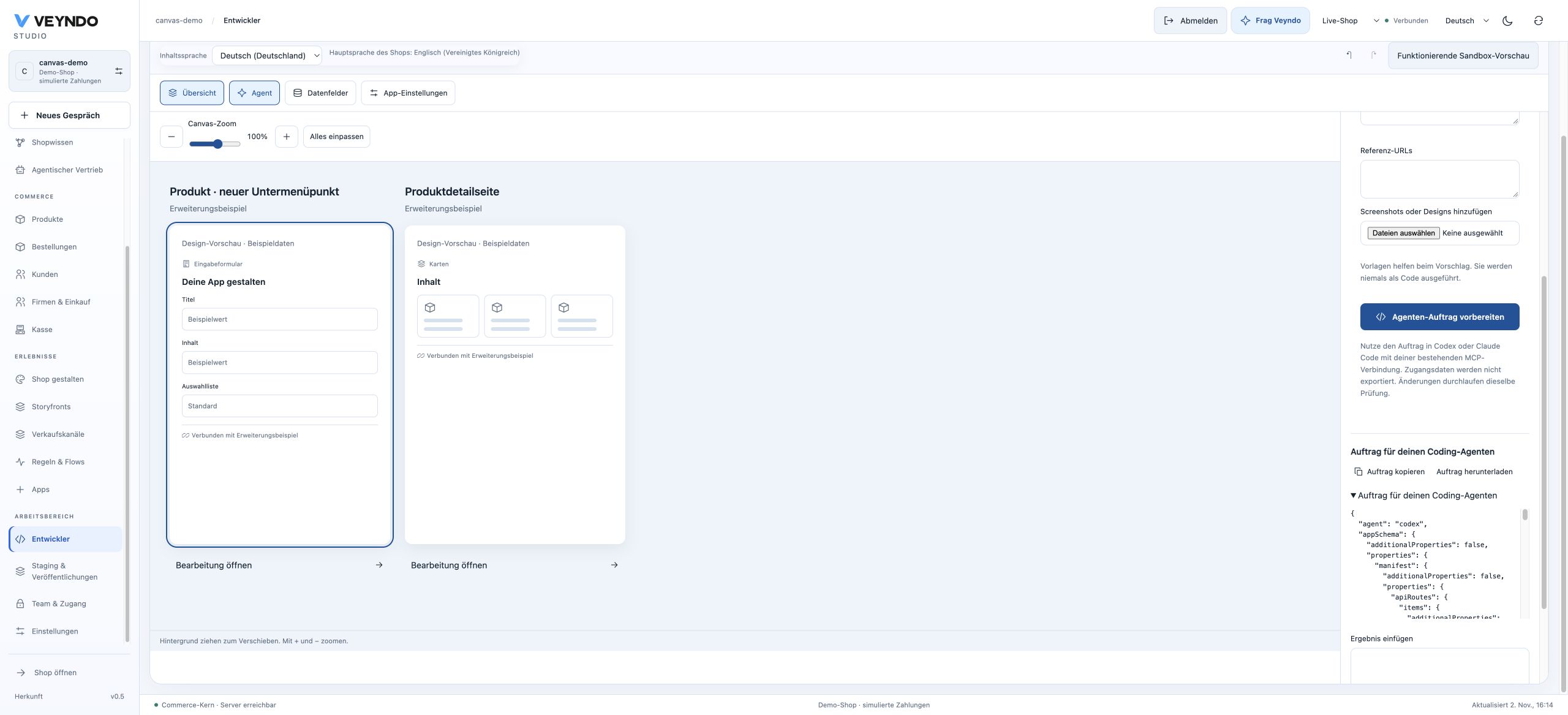
The public task check exposed intrinsic CSS grid expansion when the full task
was opened: content grew to roughly 3,982 px inside a 324 px dock. The shared
agent panel and task-transfer grid now use shrinkable tracks; long task tokens
wrap. A fresh actual local native export with 68,205 characters keeps the dock
at clientWidth = scrollWidth = 324, with no overwide descendants. At a 390 px
phone viewport, document width stays 390 and the dock stays 357 px without
horizontal overflow. The rebuilt frontend and formatting passed; the independent
finish review returned ship for this focused containment correction. The
linked corrected-task capture is local; the public overview is captured after
the first rollout.