
English source · 11 min
Connected AI workspace: acceptance, 20 October 2026
Base cf0a87bf; development branch feat/agentic-workspace, stacked on the service
integration work. The original checks below use separate disposable PostgreSQL databases and synthetic merchant accounts. Hosted rollout and browser observations are recorded separately at the end; the local fixtures do not establish hosted model behavior.
Demonstrated paths
- App discovery finds a relevant package after nine alphabetical fillers; metadata does not disclose sampled records. Actual reads use its managed action. Foreign shops, oversized pages and forged workspace identities are rejected.
- One exact approval saves two private managed records through the native Rust worker. Repeated approval does not repeat them; live records remain unchanged. Changing a target after review rejects approval. Live configuration and unadmitted operations are denied before a write.
- A filtered order view retains native criteria and originating context. Unknown tenant criteria fail. UI handoff reaches the real grid request; manual editing remains available and personal filters are excluded from persisted pins.
- Full app composition adds a model and setting, installs the proposed version in the real private preview and writes/reads an actual record. The existing lifecycle fixture still stages, publishes only its package and runs a simulated order review.
- Explicit private merchant guidance reaches the actual provider request with revision/hash provenance. Public publication fails and archiving withdraws it.
- Work suggestions reflect actual stock, disappear when stock is replenished and return no IDs/counts after the actor's rights narrow.
Reproducible checks
Use the existing isolated suite runner with a disposable PostgreSQL connection:
python3 scripts/verify_integration.py --only users providers app_generation durable_agents knowledge_workspace app_preview automation app_studio
cd frontend && npm test && npx tsc --noEmit && npm run build
The provider/model servers are local fixtures, with no paid calls. The real Rust HTTP routes, native operation registry, PostgreSQL transactions, app records, staging owners and workers execute the tested effects. Fixtures do not prove a live model understands every request. Native command and receipt transactions are separate; interrupted unknown native effects require review, not automatic replay.
The independent full-diff review found five concrete edge cases: agent opt-out, existing guidance demotion, custom action name collision, conversation ownership and translated-title/body inheritance. All five were repaired and re-reviewed.
Local verification passed: 718 frontend tests, 298 Rust workspace tests, strict TypeScript, Clippy, the affected native suites, prompt immutability, route rights, source ownership, frontend architecture and four-language interface checks. The existing formal gate passed 61 extracted policies with 156,705 conformance cases and zero mismatches; its mutation suite rejected 174 broken policies plus the syntax/binding/axiom negative controls. These proofs do not cover the new async execution adapters. The complete site build covers 296 Markdown documents in 303 pages with local links/assets and search checked. No blanket full-platform certification, external coding-agent execution or general exactly-once provider guarantee is claimed.
Final pool and interruption regression
The full native follow-on exposed two nested-connection waits: work approval held its task transaction during native rebinding, and native execution held its task transaction during the domain owner's write. Both now release that connection before the nested owner runs; approval compares the locked task revision and stop state again before queueing. Native category creation now preserves validated reviewed IDs instead of discarding them.
The actual durable_agents suite passes both directly and through PgBouncer with
one backend. It creates two private categories once, checks live isolation, kills
a managed-save worker, and resumes without duplicate records. A paused native
write followed by HTTP cancellation retains one completed receipt while the
second category remains absent. A paused native write followed by accelerated
lease expiry retains its outcome without renewing the expired lease. Matching
admission tokens fence old workers; cancellation remains terminal. Independent
focused review accepted these receipt and transaction changes.
The same durable cases also pass with the actual separate restricted tenant and system logins. This exposed and repaired a parent-shop stop-control read during private approval: the existing trusted coordinator now performs only the final stop/revision/queue transaction, after actor-scoped authorization and exact rebinding. Parent control is locked before the task, matching global stop; worker domain access remains under its original scope. No SQL grants or RLS bypass were added. Remaining app/provider/native follow-on suites passed locally, including app secrets, events, export, signed distribution, shared-storage migration, generation, ERP/EDI, marketplaces, shipping, grids and the visual workspace.
Hosted rollout and initial browser checks
PR #172 merged as 34e272b73bb124a321fde39db33f23dc390f46ed, with the exact same
Git tree as the tested 06b22f80. Full CI run
39420300367
passed all 102 registered suites, the restricted-login and pooler repetitions,
718 frontend tests, 298 Rust tests and coverage floors.
The existing Core and connector were released from that source. A fresh 6 GB
PostgreSQL disk snapshot agentic-workspace-20261020-34e272b completed before the
migration. The migration job's Kubernetes events confirm completion, followed by
the Core release. A waiting automatic workflow was stopped before this controlled
manual sequence during Northflank's reported control-plane incident. No new
provider credentials, database grants or paid service activation were introduced.
The separately prepared migration service remains a separate acceptance item.
Public checks use the synthetic shop Agent Release Abnahme 16 Okt and private workspace Agentic Workspace Abnahme 20 Okt. They already demonstrate:
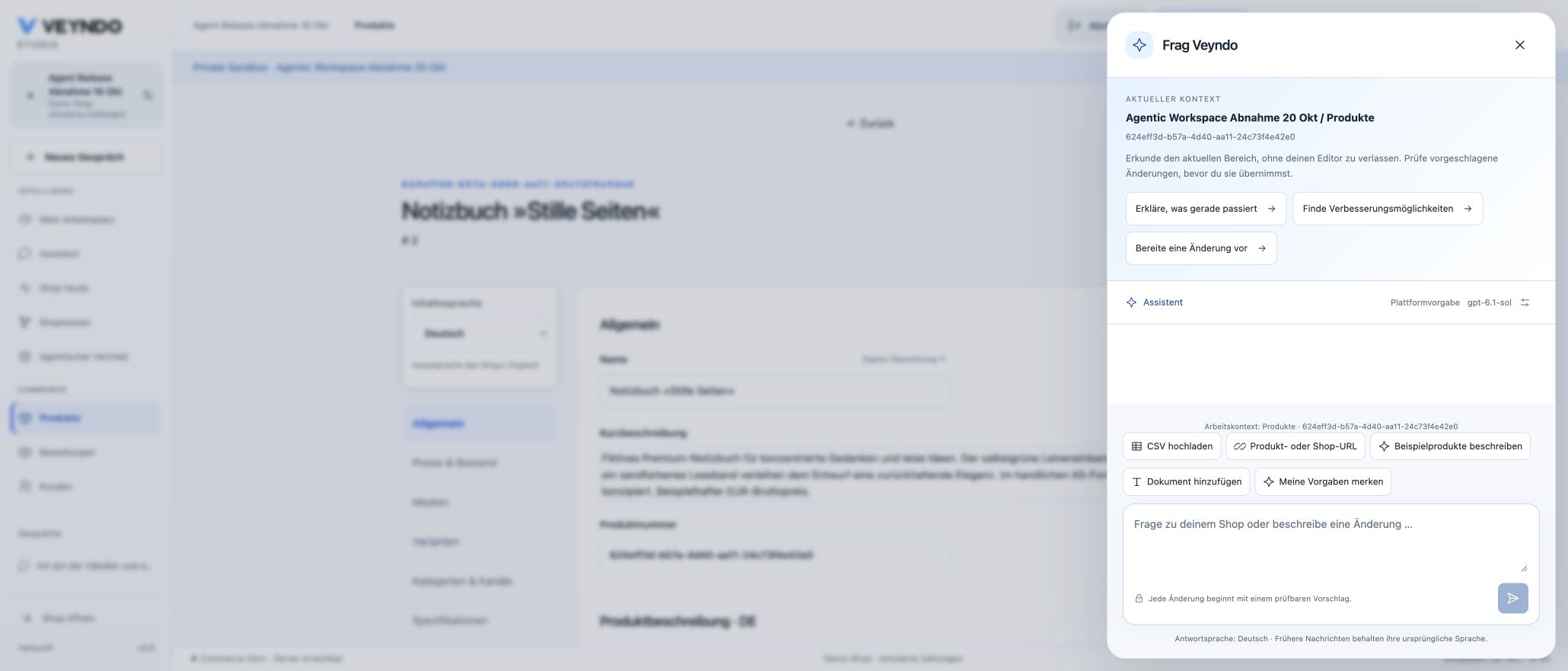
- The product drawer carries the actual selected product and private workspace, and offers CSV, URL, demo catalogue, document and explicit-guidance entry points.
- A new German guidance source is stored privately under an English-main shop, with revision 1 and a source fingerprint in the ordinary Shop knowledge owner.
- Setting a private product's stock to zero creates its actual work suggestion. Opening it reaches that product editor. Restoring stock to 20 removes the work suggestion. Live product stock was not changed.
The configured public gpt-6.1-sol exposed a strict-wire mismatch absent from the
older fixtures: optional operations and app lifecycles arrived as null, while
the native schema treats them as absent arrays. Those requests stopped before
approval or persistence. PR #173 (merged as e191ed83 after complete green CI run
39432103191)
repairs the shared OpenAI wire restoration,
with a failing-first unit case and actual local provider/native app regressions.
Required nulls and explicitly nullable/dynamic data remain unchanged for domain
validation. That source was deployed as a673816b (build deep-snail-5542) after snapshot
agentic-wire-20261020-a673816 and a successful 26-second migration job. The
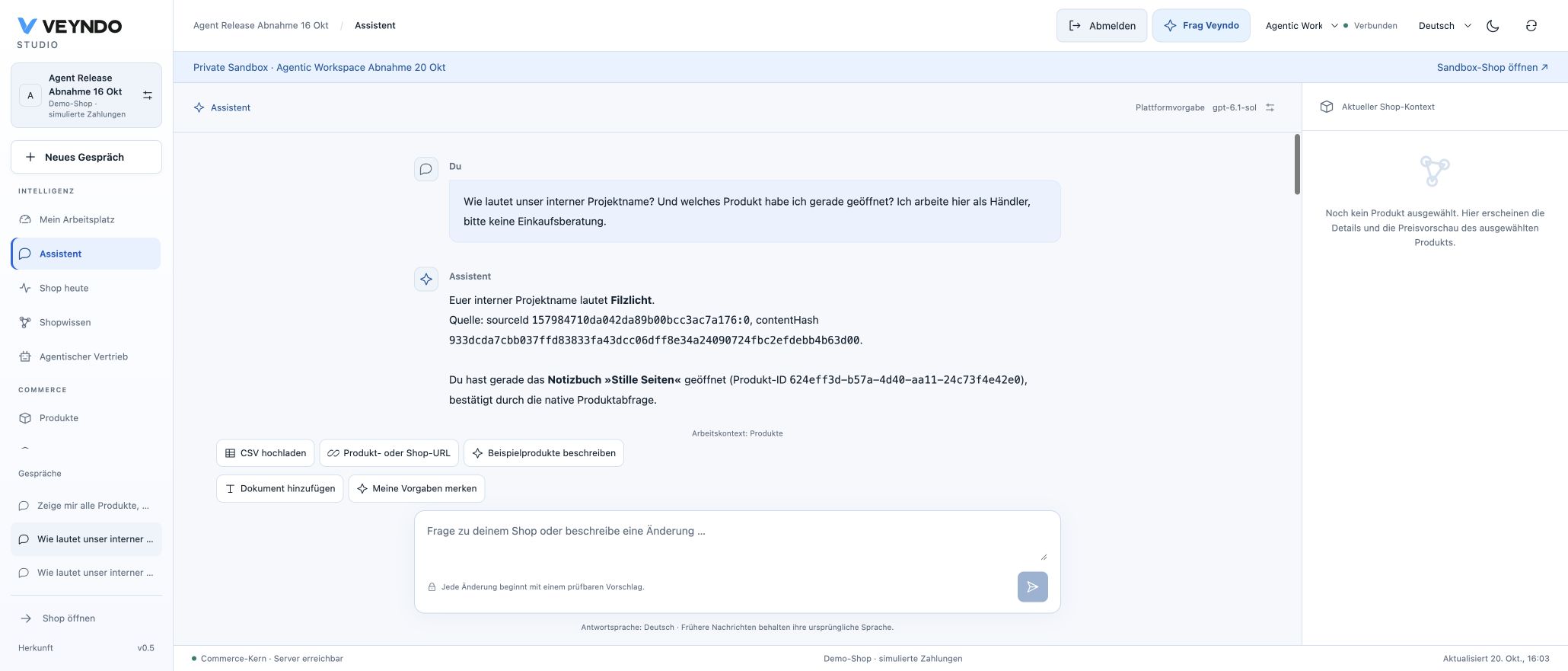
configured public model then correctly recalled the private guidance's project
name, source ID and hash, identified the selected notebook through the native
product read, and retained its merchant role.
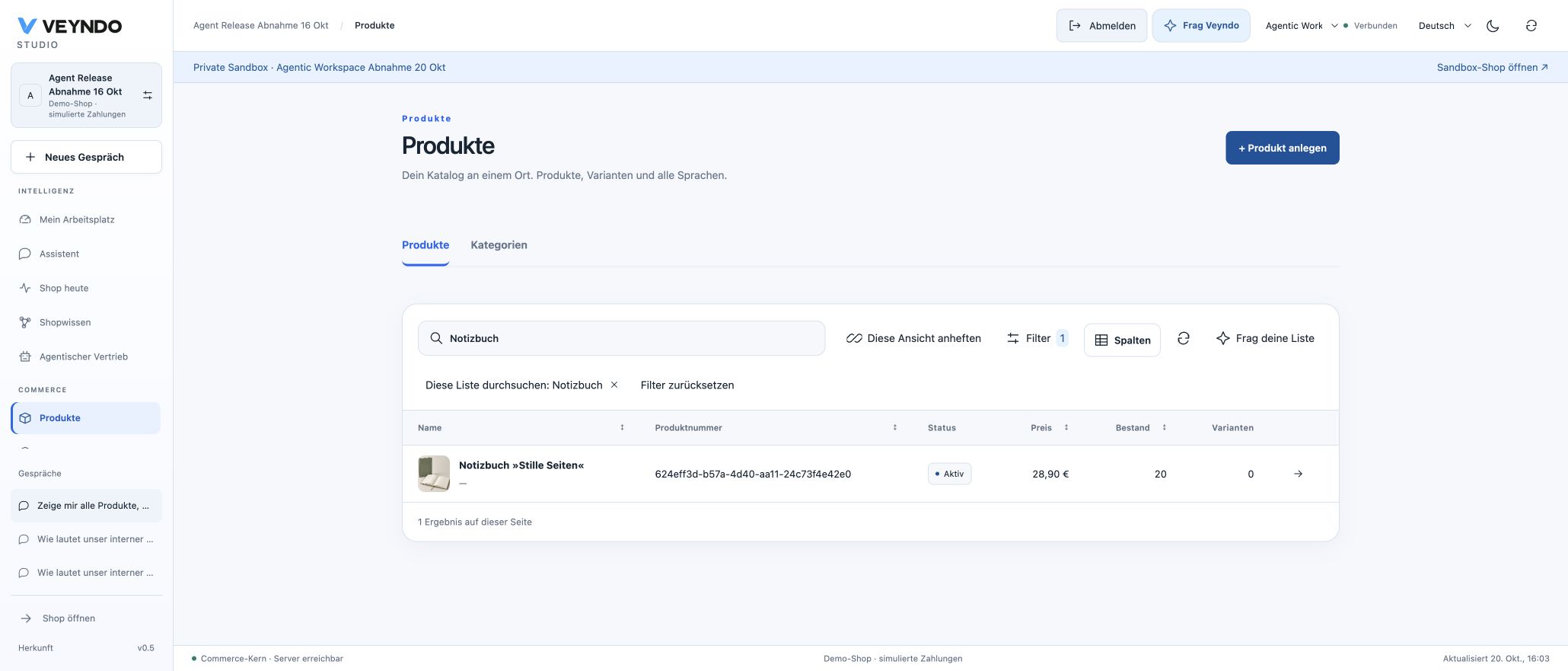
The same live model prepared search: Notizbuch; Open editable list reached
the native grid with exactly the notebook. Editing that filter to Stiftehalter
loaded exactly the pen holder. No product or order mutation was involved.
A subsequent two-category plan failed safely at native execution because the operation advertised an untyped object. It saved no categories and the old task was explicitly cancelled. App composition exposed an invalid nested-container candidate, also without saving a draft. These observed failures led to PR #174: canonical category DTO/configuration admission before review, saved-task polling with late-response fences, and one bounded native-validation repair for generated app proposals. No native permission or validation check was relaxed.
Failing-first regressions reproduce all three problems, including a historical poll response resolving after the current task loads in the same React batch. The repaired path passes 720 frontend tests, 299 Rust workspace tests, Clippy, TypeScript/build, actual OpenAI protocol fixtures with private app record writes, and native multi-step work through direct and one-backend pools. The complete restricted system/tenant-login pooler run also passes. A first local wrapper attempt used a broken Homebrew Node library after its native checks; the full wrapper was repeated successfully with the bundled Node runtime. Formal and mutation checks remain green; the async adapters are not new proved policies.
Public work/app repeat on that exact follow-on image is recorded below after release; these intermediate results do not claim all hosted flows passed.
Follow-on release preparation
The reviewed correction is commit 458ead3679e3c8c3b7d88033df0a11d6bb063286,
build divergent-start-8447. Integrating the now-merged parent creates
fe0595b5f0804efc040607e2dd85e7e3c4cd27c3 with the identical Git tree
7f7805aded857296578fe95805e5cd80f93cf7f6; it introduces no new runtime changes.
Required verification runs against that up-to-date branch without bypassing main
protection. Snapshot agentic-plans-20261020-458ead3 completed at 16:16:55 CEST
(6 GB, 66 seconds). The older e191ed8 automatic run
c54780bd-b1ba-440b-8100-987287cf2714 was stopped before backup/migration/deployment
so it cannot overwrite the follow-on image. Automatic workflow configuration and
security checks were not disabled.
The exact follow-on migration run c7fe2884-68e4-4e06-bbec-5c59bc731fa0
completed successfully in 23 seconds (pod vendune-migrate-6ad77ad21299d82764c6431f-9785k).
Core rollout vendune-core-75f89cb6bf starts at 16:31:02 CEST from that same build.
The new public Core pod vendune-core-75f89cb6bf-cgllv reached 1/1 passing
with zero restarts; the previous pod terminated normally. The 20 October public
model repetitions below use the worker and generation endpoints from this image.
The merchant work tab was reloaded before the fresh two-step request.
Public two-step work acceptance
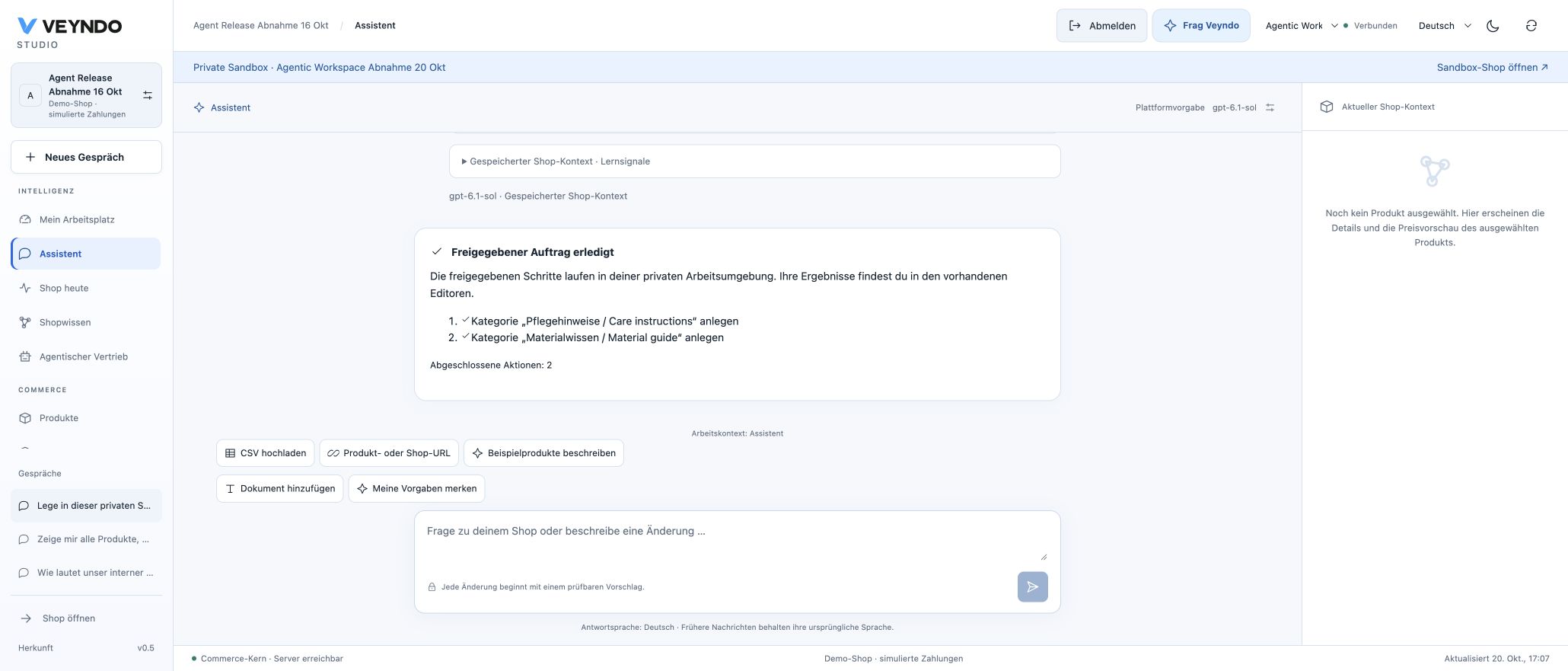
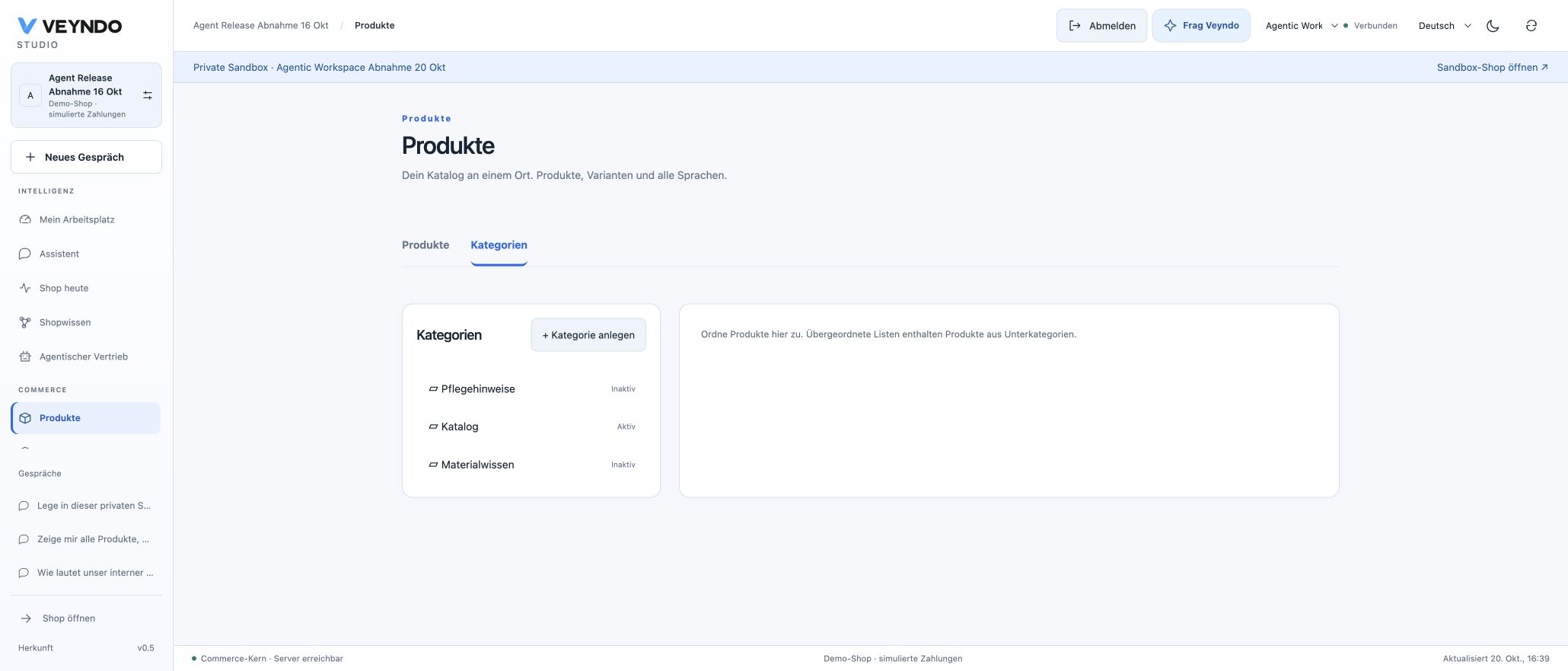
The configured public model prepared two canonical native category creates under
the private workspace: c81292e4-953b-432a-bba6-1628eb9f8a01 (Care instructions /
Pflegehinweise) and d923a3f5-a64c-443b-8cb7-2739fca09b02 (Material guide /
Materialwissen). The exact review includes positions, explicit inactive/hidden
flags and English/German translation maps. One approval completed both actions.
After a full browser reload, selecting the private workspace and reopening the saved conversation still shows completed actions: 2 with no second approval. The ordinary category editor shows both inactive categories beside Katalog. The Live-Shop category editor still shows only Katalog; neither new category was published.
The same model successfully generated native app version 0.2.0 with care_notes,
a region setting and a private list/form/save view. Trying an optional record
without a translated title then exposed a shared renderer crash. The focused PR #175, incorporated into PR #174, fixes
the record selector's missing-title fallback without changing save admission or
translations. The failing-first regression reproduces the exact existing-record
selection crash and then edits/saves it with the original revision. Focused
independent review, 721 frontend tests, build, architecture and localization pass.
The corrected public record journey is accepted below after release.
The saved generated version was recovered through Versions & Releases → View
version without another model call, then installed in the selected private
workspace. Its ordinary Studio sidebar now exposes Pflegehinweis-Bibliothek.
The generated care_notes.title and content are optional translatable fields;
the empty-field crash was not a bypass of a declared required field.
Through that ordinary installed native UI, record care_release_20261020 was
saved with English title/body, then updated with German title/body. The table
refreshes to the persisted German values and the same selected record remains
editable. The package stays version 0.2.0 with two models and three views; no
package or record was published live.
Selected package release and actual configuration
The Studio release review selected only app:advisor_mvgli5qo (review digest
591e7bd259b6). The native owner confirmed Selected changes published.
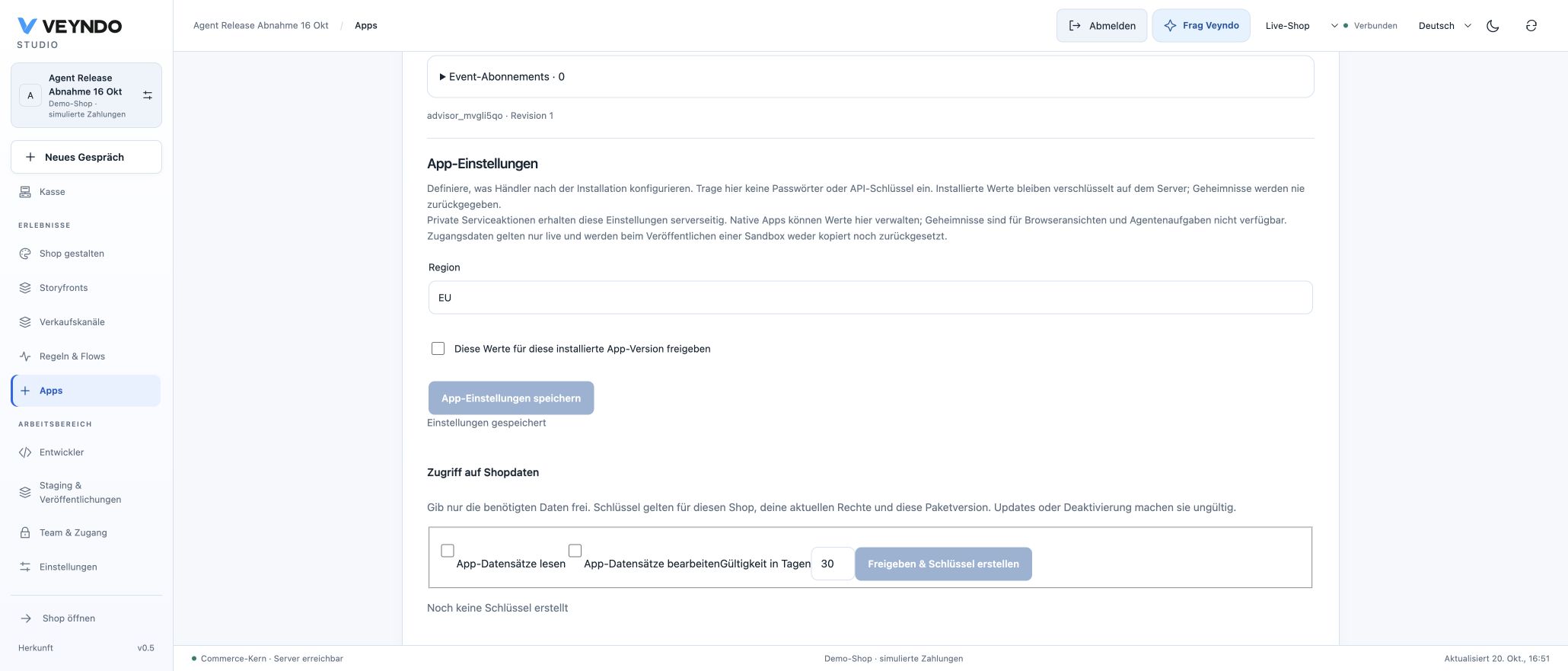
The synthetic live shop then listed the active 0.2.0 package with two models,
four actions, three surfaces and zero records. Private care notes and the two
categories were not included. Its central Apps panel accepted the non-secret
setting region = EU under the existing package-version approval and retained
that value after a full browser reload. No API key, credential or additional
permission was created. All installed app settings remain live-owner configuration;
the private settings controls intentionally remain disabled.
Final shared-renderer rollout
The final image is b0811f8a88a56a0d111874e9198457511654ab81, build
plant-horses-6593 (8m59s). Snapshot
agentic-native-ui-20261020-b0811f8 completed at 16:54:01 CEST
(6 GB, 55 seconds), including the successful synthetic app/configuration state.
Two native maintenance starts (49719a43-6f27-459b-af74-81ab26c787ee and
f8d4d837-79ab-42a8-ba0d-06a60d8471d6) failed closed on the initial
Qdrant request. The running shop was kept on its healthy previous image. A
read-only diagnostic in the same existing job resolved the private DNS name and
returned Qdrant HTTP 200. Running the unchanged native binary after a bounded
Qdrant health check passed the full maintenance setup: zero new namespace aliases,
Migration-only setup complete, exit 0 and job Success in 23 seconds
(64ee068c-dd71-48bc-951e-6a36e7bf6d39). Its first health attempt timed out;
the bounded retry reached the existing service. This is a network-start observation,
not evidence of a database or Rust domain change.
The existing maintenance-job owner now retains a bounded, fail-closed
curl health check using its existing QDRANT_URL, before exec /app/veyndo.
It retries connection/startup failures twice (5-second connect / 10-second request
limits) and does not bypass any native migration, database-role or alias check.
There is no new service, credential, permission or deployment queue.
The Core rollout starts at 17:03:28 CEST as vendune-core-6cc7f557d9.
Final readiness and browser read-back are recorded after confirmation below.
Final public read-back and optional-title regression
Core pod vendune-core-6cc7f557d9-gnbq5 reached 1/1 passing with zero
restarts; the previous pod terminated normally. After a full Studio reload the
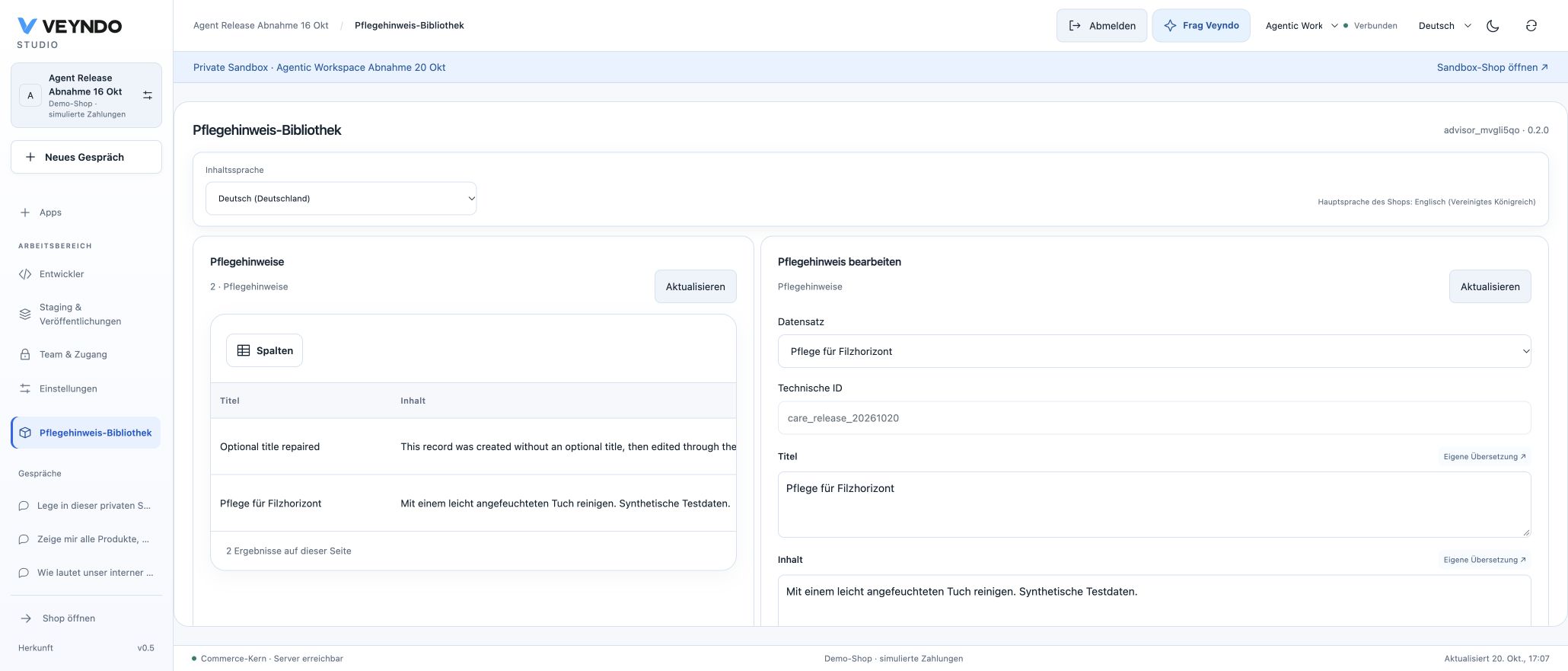
private care_release_20261020 record remained visible. Selecting English showed
Care for Filzhorizont and its original English body; selecting German showed
Pflege für Filzhorizont and its distinct German body.
The ordinary installed private form created care_optional_title_20261020 with
no optional title or body. It stayed usable, selected that stored record by its ID,
then accepted Optional title repaired and an explicitly entered English body
on the same record. The table and record selector refreshed; there was no blank
screen, lost revision or recreated package.
The retained job configuration was then tested with no temporary overrides.
Run 4f9000d7-1436-49cd-a4cd-2c08645bcd15 completed with job Success
in 30 seconds (pod 20 seconds). The native process and all checks remained in
place. After another complete browser reload, both private app records and the
completed two-step merchant task were still present; the latter still reported
completed actions: 2 and did not require approval again.
On the final public image, the conversation's CSV button opens the existing native Build catalogue dialog with Agentic Workspace Abnahme 20 Okt already selected. Switching its URL/demo-description tabs retains that private target. Add a document opens the ordinary localized private knowledge-source editor with its PDF/text upload. These are actual entry/navigation checks; no additional CSV, URL crawl or demo generation was submitted in this final navigation repeat.
The final configured model also received the original ambiguous request, “Stelle eine kompakte Leseecke unter 300 € zusammen”, from the actual notebook editor without an added merchant-role hint. It stayed with the available catalogue: furniture/lighting were missing and a sub-300-euro selection could not be supported. It did not offer an unrelated external shopping plan or mutate products. The verified CSV/URL/described-demo entry points remained directly below the response. This is one actual configured-model response, not a guarantee of every future ambiguous request.
Final required verification and merged source
Required full CI 39441599258
completed successfully on b0811f8a88a56a0d111874e9198457511654ab81.
It passed 721 frontend tests, 299 Rust workspace tests and all 102 registered
integration/browser-contract suites, including restricted system/tenant logins
and one-backend pooler repetitions. Formal/mutation checks and unchanged coverage
floors also passed. This full sensitive-renderer run was not replaced with a
frontend-only check or a branch-protection bypass.
PR #174 merged normally at 15:30:34 UTC as
2aadf62c4ad95f05abad32baf320619a3dea45dd. Both source trees are exactly
d2da868b450a698ee54edadb7ea7d0ecc9513387. The already accepted public
plant-horses-6593 image therefore contains the merged runtime source. The
redundant main-triggered workflow 50ab6021-340d-4b7a-86e0-947983f00c1f
was stopped at its build stage, before backup, migration or service replacement;
workflow configuration and required verification remain enabled.
The separately reviewed documentation updates touch no production Docker COPY inputs. They refresh README, the homepage, App Studio/workspace/operations guides, canonical status and actual screenshots through the normal Pages publication. The complete site check covers 296 Markdown sources in 303 pages, local links/assets, full-text search, sitemap and metadata. Browser inspection confirms the guide's actual Mermaid SVG and no broken article images.